01
Stalemate
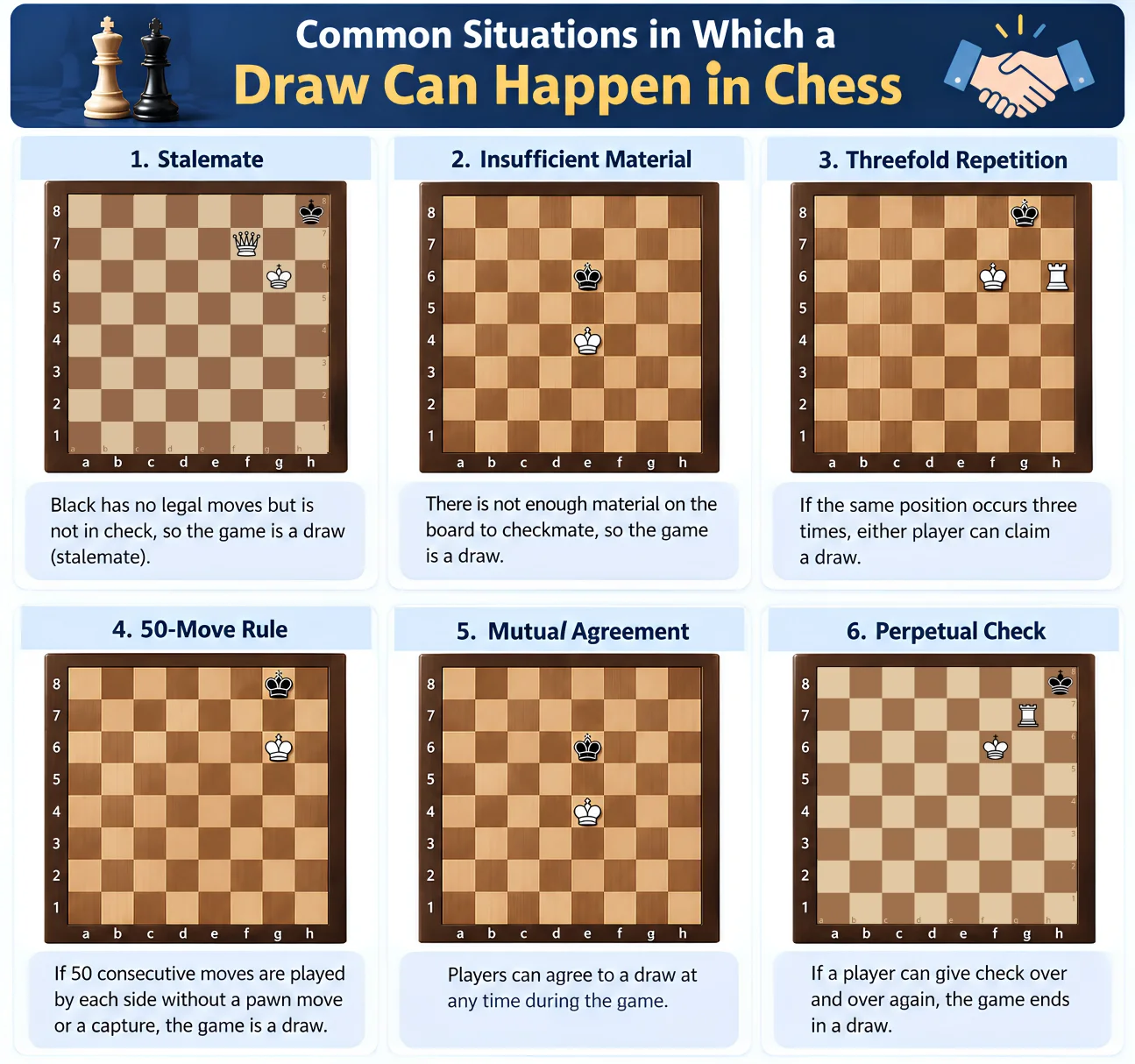
The player to move has no legal move, but their king is not in check.
A chess game does not always end with a winner. Sometimes, neither player wins and the result is a draw. But what exactly causes a chess game to be drawn?
A draw means that the chess game ends without a winner. Both players receive the same result. A draw can happen because of stalemate, an impossible checkmate position, repeated positions, the 50-move rule, or an agreement between the players.
In a drawn chess game, neither player wins. Under the standard scoring system, each player receives ½ point.
A draw does not necessarily mean the position was completely equal. One player may have been winning, but a specific chess rule or defensive resource can still lead to a draw.
Look at the position below. Only the two kings remain on the board. Neither side has enough material to checkmate the other, so the position is a draw.
With only the two kings remaining, neither player can produce checkmate. The position is therefore drawn.
The player to move has no legal move, but their king is not in check.
The position is reached where neither player can checkmate the opponent through any legal sequence.
The same position occurs three times and a player correctly claims the draw under the applicable rules.
A player can claim a draw when 50 moves by each side have passed without a pawn move or capture.
Both players agree to end the game as a draw after the required conditions for an agreement are met.
Stalemate is actually one type of draw. The important difference is that stalemate has a very specific condition: the player to move has no legal move and their king is not in check.
So remember: Every stalemate is a draw, but not every draw is a stalemate.
Imagine a game where both players still have pieces, but the same position keeps appearing again and again.
The position appears for the third time with the same player to move. What drawing rule should you think about?
Answer: Threefold RepetitionUnderstanding draws becomes much easier when you learn the individual rules one at a time. Continue with these related Brainiac Quick Chess Lessons and guides.
Build strong chess fundamentals through structured lessons, practical exercises and guidance from experienced coaches.
Book Your Free Demo Right Now →