
Online Chess Classes vs Self-Learning for Kids
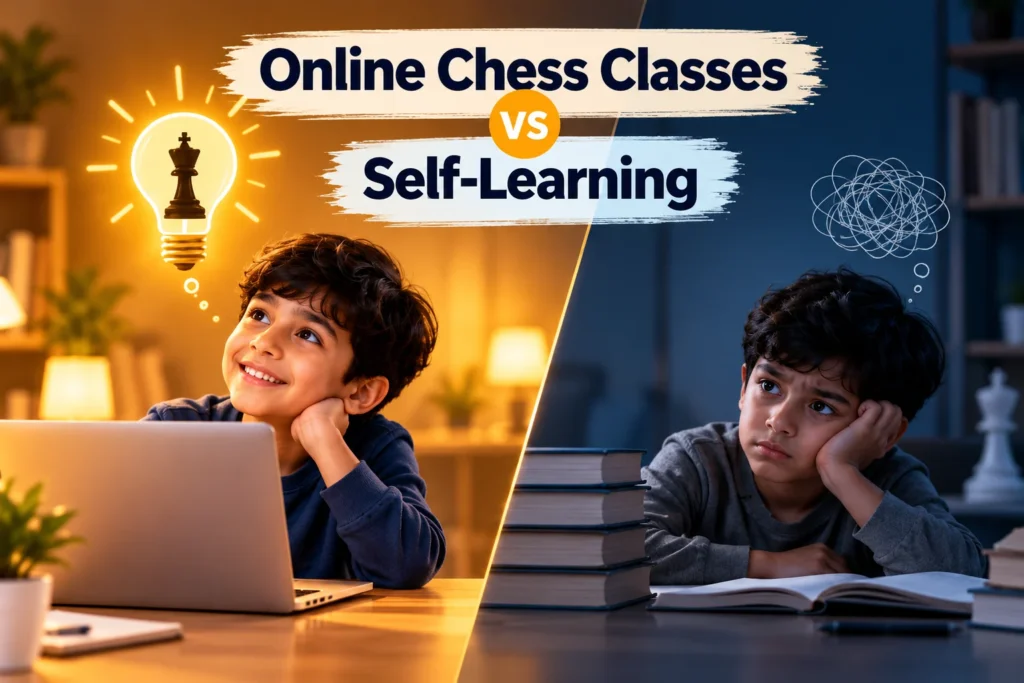
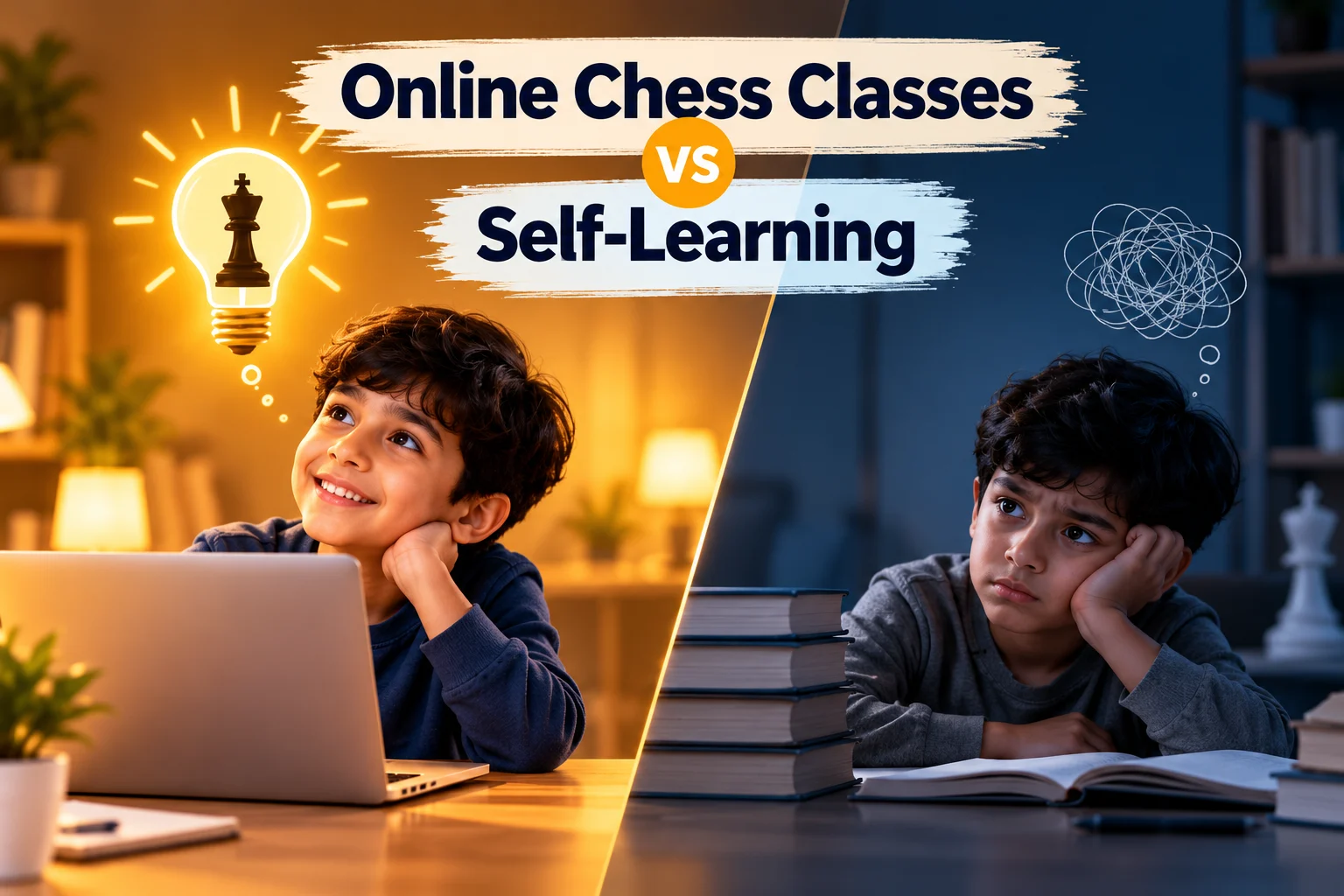
Should your child join a chess academy, or can they learn the game independently using videos, puzzles and online chess platforms? When comparing Online Chess Classes vs Self-Learning, parents often want to know which approach offers the right balance of guidance, flexibility, practice and value.
Both approaches can help children learn chess. Independent learning gives them freedom to explore at their own pace, while coached lessons can provide structure, feedback and help with difficult concepts. The right choice depends on your child's age, current chess knowledge, motivation and learning goals.
Online Chess Classes vs Self-Learning is not necessarily an either-or decision. Self-learning can be a useful starting point for children who enjoy exploring chess independently. Online coaching may be more suitable when a child needs a learning plan, personalised explanations or help understanding recurring mistakes. For many families, combining guided lessons with independent practice is a practical way to get the benefits of both.
What you will learn in this guide
- How online chess classes differ from independent learning
- The benefits and limitations of each approach
- Which learning method may suit different types of children
- How to create a simple chess practice routine
- When to consider adding a coach to self-study
- How to combine lessons, puzzles and games effectively
What Is Self-Learning in Chess?
Self-learning means that a child learns chess without regular live instruction from a coach. They may use beginner guides, recorded videos, chess books, online puzzles, practice games or interactive chess applications.
This approach allows children to explore the game at a time that suits them. They can repeat a lesson, pause a video, revisit a puzzle or play another game whenever they want. For a child who is curious and enjoys working independently, that flexibility can be a real advantage.
However, independent learning also requires the child to make decisions about what to study, recognise when they do not understand a concept and decide how to improve. Younger beginners may need a parent or another knowledgeable person to help organise the process.
Video Lessons
Recorded explanations help children revisit rules, tactics and strategies whenever they need a refresher.
Online Puzzles
Interactive puzzles let learners test ideas, practise spotting tactical patterns and receive immediate right-or-wrong feedback.
Practice Games
Playing games allows children to apply the rules and ideas they have learned against another player or a computer opponent.
Books and Guides
Chess books and beginner guides can explain concepts in sequence and provide exercises to work through independently.
What Are Online Chess Classes for Kids?
Online chess classes are lessons delivered remotely by a coach or instructor. Depending on the academy, a class may include live explanations, an interactive chessboard, guided exercises, practice games and feedback.
Instead of choosing every topic alone, the child follows a learning path designed around their current level. A coach can explain a concept, ask questions, review a position and suggest what the student should practise next.
The actual experience varies by provider. Some classes are group-based, while others offer individual instruction. Parents should ask how lessons are organised, how students participate and how progress is reviewed before choosing a programme.
Online Chess Classes vs Self-Learning: Key Differences
The main difference is how the learning process is organised. Independent learners choose and manage much of their own study, while coached students receive guidance from an instructor. Each method has strengths and limitations.
| Factor | Online Chess Classes | Self-Learning |
|---|---|---|
| Learning structure | A coach or curriculum can organise topics into a learning path. | The child or parent chooses the topics and sequence. |
| Feedback | A coach can explain why a move or decision needs improvement. | Feedback depends on the chosen tools, resources and review habits. |
| Flexibility | Live sessions follow the agreed class schedule. | Practice can happen whenever the child is available. |
| Questions | Students can ask the coach when a concept is unclear. | Students may need to search for another explanation or ask a parent. |
| Motivation | Regular lessons can create a learning routine and accountability. | The child needs to maintain interest and practise independently. |
| Personalisation | A coach may adapt explanations and exercises to the student's needs. | Personalisation depends on the resources and choices available. |
| Cost | Usually involves paying for coaching, depending on the programme. | Can begin with free resources, although some tools and books cost money. |
| Best use | Structured instruction, guided improvement and reviewing mistakes. | Exploration, repetition and independent practice. |
Neither option automatically guarantees better results. A useful learning experience depends on the quality of the resources or coaching, the child's engagement and the amount of thoughtful practice.
Benefits of Online Chess Classes for Kids
Guided chess lessons can be particularly useful when a child needs help connecting individual moves with broader ideas. Instead of simply learning which move an engine recommends, students can discuss why a move works and how to recognise a similar position in another game.
A Clear Learning Path
A structured programme can help students move from basic rules to tactics, planning and game analysis in a sensible sequence.
Personalised Explanations
A coach can respond to questions and explain a difficult idea in another way when the first explanation does not make sense.
Help Reviewing Mistakes
Reviewing a game with a coach can help children understand recurring errors, missed opportunities and alternative moves.
A Regular Routine
Scheduled lessons can encourage children to return to chess consistently instead of relying entirely on spontaneous motivation.
These advantages depend on how the class is taught. Parents should look for active participation, meaningful feedback and a suitable level rather than assuming that any paid class will automatically be effective.
Benefits of Learning Chess Online Independently
Choosing to learn chess online independently can be a sensible option when a child is exploring a new hobby or wants to practise outside formal lessons. Many free and low-cost resources make it easy to start with the rules and gradually explore more challenging positions.
Flexible Timing
Children can practise around school, homeschooling, sports and family commitments without needing to attend a scheduled lesson.
Repeat Difficult Topics
A learner can replay a video, repeat an exercise or revisit a rule until it becomes more familiar.
Low-Cost Starting Point
Free puzzles, beginner guides and practice games can help families discover whether their child enjoys chess before committing to coaching.
Independent Exploration
Curious learners can explore openings, famous games or interesting puzzles that catch their attention.
Self-study is most useful when the child has a manageable plan and knows how to review what they learn. Simply playing many games or watching unrelated videos may be enjoyable, but it does not always reveal which skills need attention.
Where Self-Learning Can Become Difficult
A child can learn a great deal independently, but some challenges are easier to solve with guidance. These difficulties do not mean self-study is ineffective; they show where additional support may be useful.
Common challenges for young learners
- Not knowing what to study after learning the basic rules
- Repeating the same mistake across several games
- Understanding a correct move without understanding the reason behind it
- Finding resources that are too easy or too advanced
- Losing motivation when progress feels unclear
- Spending time playing without reviewing important positions
For example, a child may solve a puzzle correctly because they recognise a familiar pattern, yet struggle to spot that pattern during an actual game. Reviewing real positions and discussing the thought process can help connect puzzle practice with practical play.
Parent tip: If your child enjoys self-study but seems stuck, you do not necessarily need to stop independent practice. Consider adding occasional coaching or structured game review to identify the next area to work on.
Which Approach Is Better for Your Child?
The right approach depends on your child's interests, age, current level and goals. Think about how your child learns best and what kind of support they need right now.
Complete Beginners
Self-study can introduce piece movements and basic rules. Guided lessons may help if the child needs demonstrations, questions answered or a clear order for learning new concepts.
Curious Independent Learners
Children who enjoy exploring videos, puzzles and games may do well with self-study, particularly when they have a simple routine and support when they get stuck.
Children Who Want to Improve
If a child wants to understand recurring mistakes or work towards specific goals, a coach can help organise practice and review relevant games.
Competition-Focused Learners
Children preparing for tournaments may benefit from a plan that includes coaching, game analysis, tactical practice and experience playing under competition conditions.
If you are unsure where to begin, explore our guide on how to choose the best chess academy for your child. It can help you think through class format, teaching approach and your child's learning needs.
What Is the Best Combination of Coaching and Self-Study?
Many families do not need to choose just one method. Guided chess lessons for kids can introduce concepts and help identify mistakes, while independent practice gives children a chance to apply those ideas between sessions.
Think of a lesson as an opportunity to understand something new and practice as a way to revisit it. The goal is to make independent work purposeful without turning every day into a demanding chess schedule.
| Learning Activity | Purpose | Example |
|---|---|---|
| Coached lesson | Understand a concept | Learn how a fork attacks two targets |
| Independent puzzles | Recognise the concept | Solve a few fork puzzles at a suitable level |
| Practice game | Apply the idea | Look for tactical opportunities during a game |
| Game review | Reflect and improve | Identify a missed opportunity and consider why it was overlooked |
This cycle connects instruction, practice, application and reflection. It also helps children see that improvement is about understanding positions and making better decisions, not simply completing more exercises.
A Simple Weekly Chess Practice Plan for Children
A manageable routine can help children practise regularly without crowding out other activities. The example below is only a suggested template. Adjust it according to your child's age, interest, current level and any coaching schedule.
| Day | Suggested Activity | Learning Goal |
|---|---|---|
| Monday | Review a recently learned concept | Recall and understand |
| Tuesday | Solve a few suitable chess puzzles | Practise tactical patterns |
| Wednesday | Attend a coached lesson, if scheduled | Learn and discuss new ideas |
| Thursday | Play a practice game | Apply learned concepts |
| Friday | Review one interesting position | Recognise mistakes and alternatives |
| Weekend | Enjoy a casual game or favourite chess activity | Keep learning enjoyable |
Short sessions may be enough for younger beginners, while older or more experienced learners may choose to spend longer on games and analysis. The important thing is to keep practice realistic and suited to the child's needs.
How Parents Can Support Chess Self-Study
Parents do not need to be strong chess players to help their children develop useful learning habits. Your role can be to create a suitable routine, encourage curiosity and help your child find support when a concept becomes difficult.
-
Choose One Learning Goal at a Time
Instead of asking your child to study everything, focus on a specific topic, such as protecting pieces or recognising checkmate patterns.
-
Encourage Active Practice
After watching a lesson, ask your child to try a related puzzle or demonstrate the concept on a chessboard. Applying an idea can reveal whether it has been understood.
-
Review Mistakes Without Blame
Ask what happened in an interesting position and what your child might try next time. Treat errors as information to learn from rather than reasons to criticise.
-
Keep a Simple Progress Record
A notebook can record the topics studied, puzzles attempted and questions to revisit. There is no need to track every move or turn learning into a daily test.
-
Seek Help When Needed
If your child repeatedly struggles with the same idea or wants a more structured path, consider asking a coach for guidance or feedback on selected games.
How to Know When Your Child May Benefit from a Chess Coach
Self-study can remain part of your child's routine even after they begin coaching. Consider adding guided lessons if one or more of the following situations sound familiar.
- Your child understands the rules but does not know what to learn next.
- They repeatedly make similar mistakes and cannot explain why.
- They want to improve but feel unsure how to practise effectively.
- They enjoy chess and want to explore more challenging ideas.
- They are preparing for tournaments and need more focused guidance.
- They would benefit from discussing games and asking questions directly.
These are not strict requirements for joining a class. A child can start coaching as a beginner, while another may prefer self-study for a while. Discuss the child's goals and current level with the academy before deciding on the most appropriate approach.
Frequently Asked Questions
1. Is it better for kids to learn chess online through classes or self-study?
Both approaches can be useful. Self-study offers flexibility and independent exploration, while online classes can provide structured lessons and feedback. The best choice depends on the child's learning style, goals, current level and need for guidance.
2. Can children learn chess online independently for free?
Yes. Children can start with free beginner guides, puzzles, videos and online practice games. Parents should help younger learners choose age-appropriate resources and create a manageable routine.
3. What are the benefits of online chess coaching?
Online coaching can provide a learning plan, explanations from an instructor, opportunities to ask questions and guidance when reviewing games. The value depends on the quality of teaching and how actively the child participates.
4. Is self-study enough for a beginner chess player?
It can be enough to learn the rules and explore basic concepts, especially when a child enjoys learning independently. A coach may become useful when the child needs help choosing what to study next or understanding repeated mistakes.
5. How much time should children spend practising chess?
There is no single amount that works for every child. Start with short, manageable sessions and adjust according to age, interest and other commitments. Regular, focused practice is more useful than forcing a long session when a child is tired.
6. Can my child combine online classes with independent practice?
Yes. A child can use coaching to understand concepts and then reinforce them through puzzles, games and review between lessons. This combination can help connect guided learning with independent decision-making.
7. Do children need a chess coach to improve?
Not every child needs regular coaching. Some learn effectively through independent resources and thoughtful practice. A coach can be helpful when a child needs personalised feedback, a structured plan or support with specific learning challenges.
8. How can parents tell whether a child is improving at chess?
Look for better understanding of rules, improved recognition of threats, more thoughtful move choices and the ability to explain mistakes. Wins and ratings can offer some information, but they do not tell the whole story of a child's learning.
Choose a Chess Learning Approach That Fits Your Child
Comparing Online Chess Classes vs Self-Learning is ultimately about understanding what your child needs at this stage. Independent study can encourage curiosity, flexible practice and exploration. Guided lessons can add structure, personal feedback and a clearer direction when a learner needs help.
You do not have to commit to only one approach. Begin with the resources that suit your child's interest, observe how they learn and introduce more guidance if it becomes useful. With an appropriate routine, independent practice and coaching can complement each other.
Explore Online Chess Coaching for Your Child
Want to understand which learning approach may suit your child? Contact Brainiac Chess Academy to discuss their current chess level and ask about available online coaching options.
Ask About Online Chess Classes →Every child learns differently. Choose a chess learning approach based on the child's interests, goals and support needs. Coaching can help, but progress depends on the learning experience, practice and individual circumstances.