










How Much Practice Does a Child Need for Online Chess Training?
Parents often wonder how much chess practice their child really needs outside an online class. The answer is not simply “more hours.” Effective Online Chess Training for Kids works best when lessons are supported by focused practice, games, review, and enough flexibility for school and everyday life.
An online chess lesson gives a child guidance, but the lesson itself is only one part of the learning process. Children also need opportunities to solve positions, play games, revisit concepts, and understand mistakes. At the same time, chess practice has to fit around school, homework, sleep, family time, and other interests.
That is why there is no single number of practice hours that works for every child. A young beginner may benefit from short, simple activities, while an older child preparing for tournaments may need a more structured routine. The right amount depends on the child's age, level, goals, attention span, coaching schedule, and available time.
How Much Chess Practice Does a Child Need?
There is no universal number of hours. For most children, a consistent and age-appropriate routine is more practical than forcing long sessions. Short periods of focused practice can include puzzles, games, lesson review, or homework, while the overall schedule should remain flexible around school, energy levels, and the child's interest in chess.
How Much Practice Does a Child Need for Online Chess Training?
The amount of practice a child needs outside an online chess class depends on what the child wants from chess. A child playing casually after school has different needs from a child who is preparing for regular tournaments. Even two children of the same age can require different routines because their attention span, chess experience, school workload, and interest may be different.
| Learning Goal | What Practice May Look Like | Main Focus |
|---|---|---|
| Casual Learning | Short puzzles, occasional games, and reviewing interesting positions. | Enjoyment, familiarity, and basic understanding. |
| Regular Skill Development | A repeatable weekly routine combining puzzles, games, lesson review, and homework. | Building useful habits and reinforcing coaching concepts. |
| Tournament Preparation | More focused tactical work, practice games, analysis, opening review, and time-management practice. | Applying skills under realistic playing conditions. |
The important point is that practice should have a purpose. Spending a long time moving pieces around without thinking about why a move works may be less useful than a shorter session in which a child carefully solves positions and reviews mistakes.
For children, consistency usually matters more than forcing long practice sessions. A short session completed with attention can be more useful than a much longer session when the child is tired, distracted, or frustrated.
How Online Chess Training and Home Practice Work Together
Good Online Chess Training for Kids should not end when the live lesson finishes. The lesson introduces ideas, demonstrates positions, and gives the child direction. Home practice gives the child a chance to use those ideas independently.
For example, if a coach introduces a simple tactical idea during a lesson, the child can later solve a few positions involving that idea. Playing a practice game then provides an opportunity to notice whether the same idea appears during an actual game.
The cycle becomes more useful when the child reviews what happened. Instead of treating every game as simply a win or loss, the child can identify one or two moments that deserve another look.
Parents considering structured coaching can also read about how to choose an online chess academy for your child, particularly when comparing lesson structure, homework, feedback, curriculum, and progress tracking.
How Much Chess Practice Is Suitable for Different Age Groups?
Practice length should be treated as a flexible starting point rather than a strict requirement. Younger children often need shorter activities and more variety, while older students may be comfortable spending longer periods analysing positions.
| Age / Stage | Practical Starting Point | Suitable Activities | Attention Consideration |
|---|---|---|---|
| Preschool / Very Young Beginners | Short activities of roughly 10–20 minutes when the child is interested. | Piece recognition, simple puzzles, mini-games, basic checkmates. | Keep sessions playful and stop before fatigue becomes obvious. |
| Early School-Age Children | Many children may find 15–30 minute focused sessions manageable. | Puzzles, short games, lesson review, simple homework. | Break longer practice into smaller activities if attention drops. |
| Older School-Age Children | A practical starting point can be around 30–60 minutes depending on level and interest. | Tactics, calculation, complete games, analysis, openings and endgames. | Longer analysis can work when the child is genuinely engaged. |
| Teenagers | Practice can become more structured, with duration adjusted to goals and school workload. | Game analysis, calculation, tournament games, opening preparation and endgames. | Independent study can increase, but school commitments still matter. |
These ranges are not scientific requirements or rules for every child. A child who is enthusiastic about chess may voluntarily practise longer, while another child may learn better through several shorter sessions. The quality of attention and the usefulness of the activity should guide the schedule.
What Should a Child Do During Daily Chess Practice?
A useful Daily Chess Practice session does not need to contain every possible chess activity. In fact, trying to fit puzzles, openings, endgames, games, calculation, and analysis into every session can make practice unnecessarily complicated.
- Tactical puzzles: Solve a small number of positions and explain why the solution works rather than immediately moving to the next puzzle.
- Reviewing previous lessons: Revisit one idea from the most recent online class. The goal is to remember and apply the concept.
- Playing a practice game: Play a complete game when time allows. Encourage thoughtful moves rather than rushing.
- Analysing mistakes: Look back at important moments. Ask what the child was thinking before the move and what could have been considered.
- Opening practice: For children who are ready, learn opening principles or a small number of relevant ideas rather than memorising long variations without understanding them.
- Endgame practice: Practise basic checkmates and fundamental endgame positions appropriate to the child's level.
- Short calculation exercises: Ask the child to consider possible moves before moving a piece. This can be done with a physical board or an online position.
Example: A Simple Beginner Session
- 10 minutes of simple tactical puzzles
- 10 minutes reviewing the previous lesson
- 15–20 minutes of a practice game or mini-game
- 5 minutes discussing one interesting mistake or position
This is an example, not a fixed requirement. The session can be shorter or divided across different days.
How Many Chess Puzzles Should Kids Solve?
There is no magic number of puzzles that every child should solve each day. Puzzle quality and understanding are more important than simply counting how many positions were completed.
A child may solve five puzzles carefully, explain the tactical idea behind each one, and review the positions they got wrong. Another child may rush through twenty puzzles while guessing moves and immediately checking the answer. The number alone does not tell you which session was more useful.
Good Chess Practice for Kids can include different types of puzzles as the child develops:
- Tactical patterns: forks, pins, checks, captures, and simple combinations.
- Pattern recognition: recognising familiar positions without relying entirely on trial and error.
- Calculation: thinking through a short sequence before making a move.
- Mistake review: returning to incorrect answers and understanding the missed idea.
- Gradual difficulty: increasing complexity only when the current level becomes comfortable.
Parents can also ask the child to explain the answer in simple language. If a child can identify the winning move but cannot explain why it works, the position may still have learning value.
How Important Are Practice Games for Kids?
Practice games give children a chance to apply ideas in situations that are less predictable than isolated puzzles. During a game, the child has to choose candidate moves, respond to an opponent, manage time, and recognise when a familiar tactical or positional idea appears.
Complete games are useful because they also expose habits that may not appear in puzzle solving. A child might solve tactical positions correctly but overlook the same pattern during a game because they are moving too quickly.
After the game, a simple review can be more valuable than immediately starting another one. Ask questions such as:
- Where did the position start to become difficult?
- Was there a move the child considered but rejected?
- Did the child miss a check, capture, or threat?
- Was there enough time to think?
- What is one idea to remember for the next game?
Do not measure practice only by the number of games played. One carefully reviewed game can reveal a useful habit that several unreviewed games might not reveal.
Should Kids Get Chess Homework After Online Classes?
Chess Homework for Kids can be useful when it reinforces something the child has already learned. Homework does not need to be a large worksheet or a long list of positions.
Depending on the child's level, useful homework may include:
- A small set of tactical puzzles related to the lesson.
- A position where the child has to find and explain a move.
- Reviewing one practice game.
- A short calculation exercise.
- Learning an opening concept rather than memorising a long line.
- Practising a basic endgame position.
- Writing down one lesson takeaway before the next class.
Homework should be appropriate for the child's age and current level. If a child regularly finishes every assignment feeling overwhelmed, the workload may need to be adjusted rather than simply adding more practice.
This is also one reason parents may want to evaluate whether an academy provides a clear connection between lessons, homework, practice, and feedback rather than treating each class as an isolated session.
How Can Parents Create a Chess Practice Routine?
A Chess Practice Routine does not have to look like a school timetable. It should give the child enough structure to know what to do while leaving room for schoolwork, family plans, rest, and changes in interest.
Here is one example of a balanced weekly routine:
| Day | Practice Activity | Approximate Effort | Purpose |
|---|---|---|---|
| Monday | Tactics | Short focused session | Pattern recognition and calculation |
| Tuesday | Practice game | One complete game if time allows | Apply concepts in play |
| Wednesday | Review previous lesson | Short review | Reinforce coaching concepts |
| Thursday | Tactics + calculation | Focused practice | Improve decision-making habits |
| Friday | Light practice | Flexible | Keep the routine manageable |
| Saturday | Coach-led class | According to coaching schedule | Learn new concepts and receive feedback |
| Sunday | Game analysis / optional practice | Flexible | Review, reflect, or rest |
This schedule is only an example. A child who has several school assignments on Thursday may move the chess activity to another day. A child with a weekend tournament may also have a completely different week.
For families following online chess classes in the UK, the weekly routine can be adjusted around the child's local school timetable and after-school commitments rather than copying a schedule designed for another country.
How Much Chess Practice Is Enough During the School Week?
School workload should be one of the first things parents consider when creating a chess schedule. Chess should have a realistic place alongside school, homework, sleep, sports, music, family time, and other activities.
During a particularly demanding school week, reducing chess practice can be completely reasonable. A child might complete a few short puzzles instead of playing several long games. During school holidays, the same child may have more time for games and deeper analysis.
Families using online chess classes in Canada may need to plan around local school hours, extracurricular activities, and family schedules. The same principle applies regardless of where the child lives: build the chess routine around the child's real life.
A simple scheduling rule for parents
Start with the child's existing commitments, identify realistic free periods, and then place chess practice into those spaces. Do not design a large practice schedule first and expect school, rest, and family time to fit around it.
Should Kids Practice Chess Every Day?
Daily practice can be convenient for some children, especially when the sessions are short and enjoyable. It can make chess a familiar part of the weekly routine. However, daily practice is not a requirement for every child.
A few focused sessions spread across the week may suit a child better than demanding chess practice every single day. Rest days can also be useful, particularly after a busy school week or tournament.
| Factor | Short Daily Practice | Long Occasional Practice |
|---|---|---|
| Consistency | Provides frequent contact with chess. | May work when the child's schedule is busy on weekdays. |
| Attention | Short sessions can be easier for some children to manage. | Longer sessions may allow deeper analysis when the child is engaged. |
| Learning Review | Allows concepts to be revisited frequently. | Can provide longer blocks for game analysis or study. |
| Flexibility | Requires some regularity. | May fit irregular family schedules more easily. |
| School Compatibility | Works well when practice is genuinely short. | May be easier during weekends or holidays. |
| Potential Challenge | Can feel repetitive if every day is identical. | Long gaps can make maintaining a routine harder for some children. |
Missing a day does not mean a child has failed to maintain progress. A sustainable routine should be flexible enough to accommodate normal family life.
How Much Practice Does a Child Need Before a Chess Tournament?
Tournament preparation is different from normal weekly practice. The purpose is not simply to increase the number of hours. The child should become comfortable with the types of decisions they may need to make during actual games.
- Tactical practice: Review common tactical patterns appropriate to the player's level.
- Opening review: Refresh familiar opening ideas and principles instead of trying to memorise a large amount of new material immediately before the event.
- Endgame practice: Review fundamental positions the player is likely to encounter.
- Practice games: Play games using a time control that gives the child experience thinking within a realistic time limit.
- Game analysis: Review recent games and identify recurring decision-making mistakes.
- Time management: Practise checking the clock and avoiding unnecessary time trouble.
- Previous tournament games: Revisit earlier tournament positions to identify lessons that can be applied next time.
The amount of preparation depends on the child's level, tournament format, experience, and goals. A first local event may require a very different preparation plan from a serious tournament schedule.
How Can Parents Keep Chess Practice Fun?
Children are more likely to stay engaged when practice includes variety and gives them a sense of progress without making every session about winning.
- Use short chess puzzles as mini-challenges.
- Try puzzle races when the child enjoys friendly competition.
- Play practice games with different goals, such as focusing on developing pieces.
- Play family chess games without making the result the main focus.
- Review an interesting position from a recent game.
- Use age-appropriate chess videos as an occasional learning activity.
- Set small, practical goals such as remembering to check for opponent threats.
- Celebrate consistency, careful thinking, and good habits, not only wins.
Parents do not need to turn every chess activity into a lesson. Sometimes a relaxed game is simply a relaxed game. Keeping some separation between learning and enjoyment can help children maintain a healthy relationship with the activity.
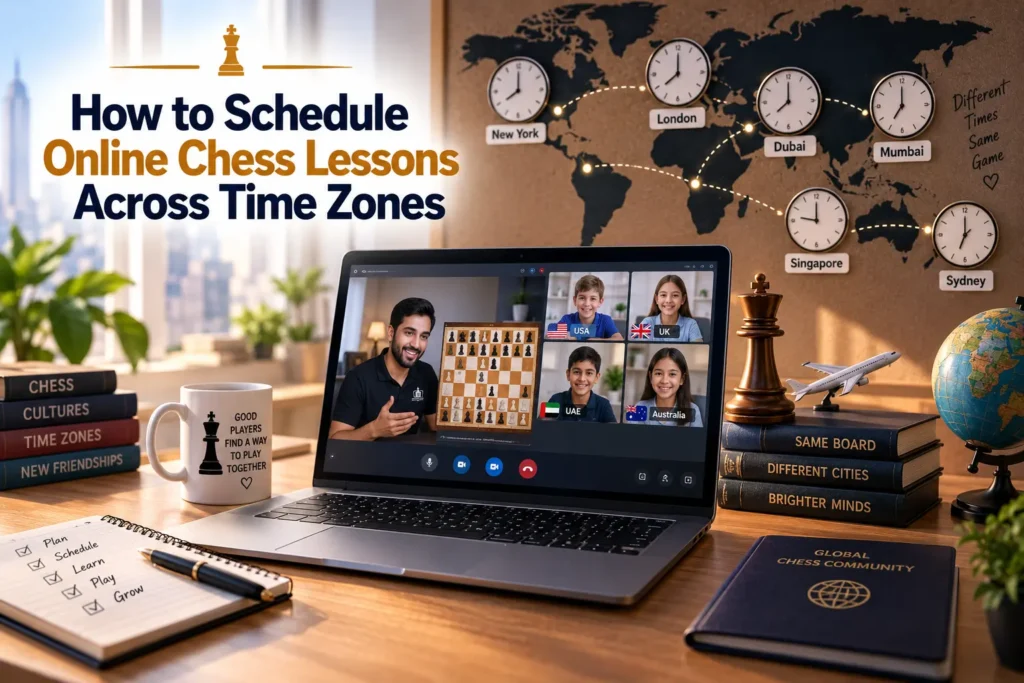
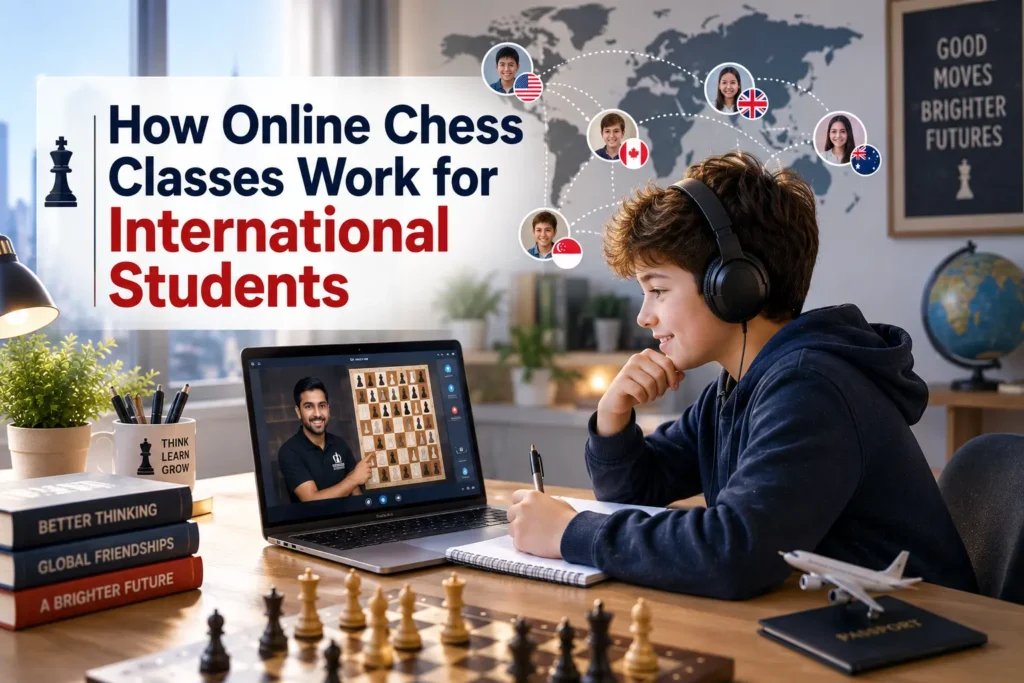
How Should International Students Plan Chess Practice Around School?
Children learning chess online may live in countries with very different school calendars, weekend structures, after-school activities, and daily routines. This means there is no single international practice timetable that every student should follow.
A child taking online chess classes in the USA may have a completely different after-school schedule from a child studying in another country. The practical solution is to build chess practice around the child's local routine.
The same principle applies to families using online chess classes in Australia. School finishing times, sports, family commitments, and online lesson timings can all influence when independent practice is realistic.
For a child studying in Singapore, structured practice can be especially useful when the week contains several scheduled activities. Families exploring online chess classes in Singapore can think of independent practice as a flexible extension of coaching rather than another fixed school-style obligation.
Similarly, families using online chess classes in the UAE can create a home practice schedule that works around the child's school and family routine. The location changes, but the basic principle remains the same: practice should fit the child, not the other way around.
Sample Weekly Chess Practice Routine for Kids
The following sample combines coaching, independent practice, games, and review without requiring every activity every day.
| Day | Practice Activity | Approximate Effort | Purpose |
|---|---|---|---|
| Monday | 5–10 puzzles + lesson recap | Short | Refresh a recently learned concept |
| Tuesday | One practice game | Moderate | Apply ideas during play |
| Wednesday | Review one game position | Short | Understand a mistake |
| Thursday | Tactics + short calculation | Short to moderate | Improve tactical awareness |
| Friday | Light chess activity or rest | Flexible | Keep the schedule sustainable |
| Saturday | Online coaching session | Coach-guided | Learn and receive feedback |
| Sunday | Game analysis or optional game | Flexible | Review or enjoy chess without pressure |
Adapt this routine according to age, chess level, school schedule, coaching frequency, and tournament goals. For some children, fewer sessions will be more realistic. For others, additional practice may be enjoyable and appropriate.
Pros and Potential Challenges of a Structured Online Chess Practice Routine
Pros of a Structured Routine
- Creates consistency without requiring long daily sessions.
- Gives children clear practice goals.
- Reinforces concepts introduced during online lessons.
- Makes it easier to review games and identify recurring mistakes.
- Allows parents and coaches to track practice more clearly.
- Provides flexibility for home-based learning.
Potential Challenges
- Too much practice can create unnecessary pressure.
- Extended screen time may make sessions tiring.
- School workload can reduce available practice time.
- A repetitive routine may reduce interest.
- Poorly structured practice can focus too heavily on quantity.
- Children may become overly focused on winning rather than learning.
Chess Practice Checklist for Parents
Use this checklist when reviewing your child's current chess routine:
- Is the practice age-appropriate?
- Is the child getting enough breaks?
- Is schoolwork being managed?
- Is practice reasonably consistent?
- Is the child solving puzzles thoughtfully?
- Are practice games being reviewed?
- Is the child enjoying the routine?
- Is the workload increasing gradually?
- Is coach feedback being used?
- Is tournament preparation being treated differently from regular weekly practice?
People Also Ask About Chess Practice for Kids
How many hours should a child practice chess?
There is no universal number. Practice should be adjusted to age, level, goals, school workload, and attention span. Short focused sessions can be appropriate for many children.
Is 30 minutes of chess practice enough?
Thirty minutes can be a useful practice session for many children, particularly when the time is focused. It can include puzzles, lesson review, a short game, or analysis.
Should children practice chess every day?
Not necessarily. Some children enjoy short daily sessions, while others may benefit from several focused sessions across the week with room for rest.
How many chess puzzles should kids solve daily?
Puzzle quality matters more than a fixed daily number. Children should have enough time to think, understand incorrect answers, and recognise the underlying pattern.
How much chess practice is needed before a tournament?
Tournament preparation depends on the player's level, experience, format, and goals. Tactical practice, games, analysis, time management, and relevant opening and endgame review can all be included.
Frequently Asked Questions
How much practice does a child need for online chess training?
The amount varies according to age, chess level, goals, school workload, coaching frequency, and interest. A practical routine should combine focused practice with enough flexibility for the child's normal schedule.
How often should kids practice chess?
Many children can benefit from practicing several times during the week. Some may enjoy short daily sessions, while others may prefer fewer, longer sessions. The routine should remain realistic and sustainable.
Is daily chess practice necessary for children?
No. Daily practice can work well for some children, but it is not necessary for everyone. Regular, purposeful practice across the week can also provide a useful structure.
How many chess puzzles should a child solve?
There is no fixed number. A child should have enough time to think about each position and review mistakes. Five carefully considered puzzles may be more useful than many rushed attempts.
Should children get chess homework after online classes?
Homework can help reinforce lesson concepts when it is short, relevant, and appropriate for the child's level. Tactics, position exercises, game review, and basic opening or endgame work are common options.
How can parents create a chess practice routine?
Start with the child's school and family schedule, then add realistic chess sessions. A weekly routine can rotate tactics, games, lesson review, analysis, and coach-led classes rather than requiring every activity every day.
How much should children practice before a tournament?
Tournament preparation should reflect the child's experience, level, tournament format, and goals. Practice can include tactics, time-controlled games, game analysis, time management, and review of familiar opening and endgame concepts.
Can international students practice chess around their school schedule?
Yes. Online learning allows families to build independent practice around their local school hours, extracurricular activities, weekends, and coaching schedule. The routine should be based on the child's actual daily life.
Conclusion: What Is the Right Amount of Chess Practice?
The right amount of practice is the amount a child can complete with reasonable focus while still managing school, rest, family life, and other interests. There is no universal practice target that every child needs to follow.
For Online Chess Training for Kids, the most useful approach is usually to connect coaching with purposeful home practice. A child can review the lesson, solve a few relevant puzzles, play a game, and spend time understanding mistakes. As the child's level and goals change, the routine can change too.
Parents do not need to count every minute. Instead, look at whether the routine is realistic, consistent, age-appropriate, and helping the child engage with chess thoughtfully. Tournament preparation can become more focused when necessary, while normal school weeks can remain lighter.
Ultimately, chess practice should have enough structure to provide direction without becoming another source of unnecessary pressure.
Ready to Build a Better Chess Practice Routine?
A structured online coaching program can help children understand what to practise, how to approach different positions, and how to review their games. Brainiac Chess Academy provides online chess coaching from India for students learning internationally, with practice designed around the child's learning needs.
Book Your Free Demo Right Now WhatsApp Us