

















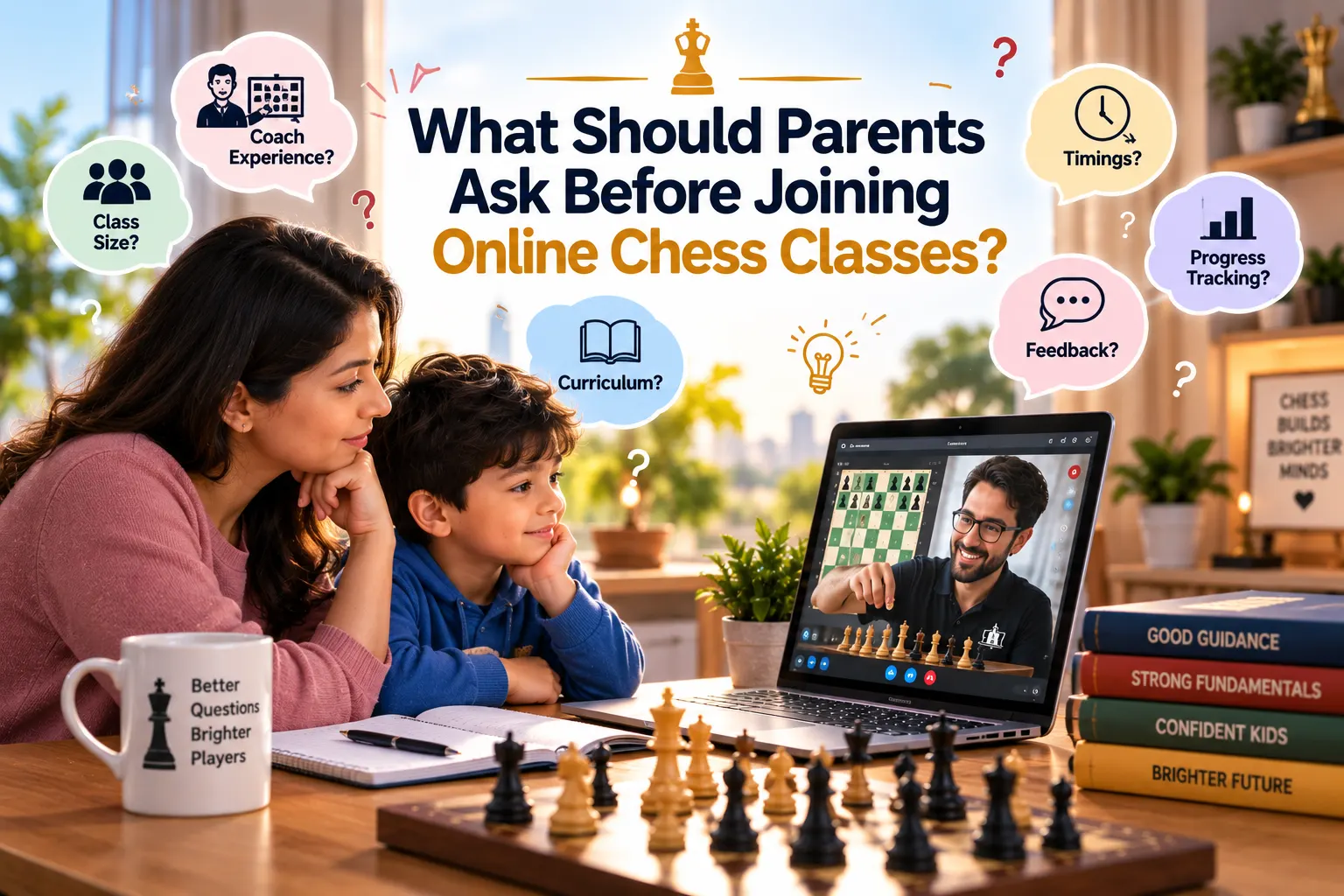
What Should Parents Ask Before Joining Online Chess Classes?
Choosing an online chess program for a child involves more than checking the monthly fee. The right questions can help parents understand the coach, curriculum, class size, schedule, practice expectations, feedback, technology, progress tracking and enrollment policies before making a decision.
Before enrolling a child in an online chess academy, parents often have practical questions: Who will teach my child? What will they learn? How many students will be in the class? What happens if my child misses a session? Will parents receive feedback? And what exactly is included in the fee?
These are important questions because online chess programs can differ considerably in teaching style, curriculum, class format, scheduling, communication and practice support. The goal of this guide is not to tell parents which academy to choose. Instead, it gives you a practical set of Questions to Ask Before Joining Online Chess Classes so you can compare programs with clearer expectations.
What Should Parents Ask Before Joining Online Chess Classes?
Ask about the coach, curriculum, class size, timings, practice, homework, feedback, progress tracking, trial or demo classes, technology, communication and pricing policies. The aim is to understand exactly how the program works before enrolling, not simply to compare fees.
Why Should Parents Ask Questions Before Joining Online Chess Classes?
Two online chess academies may both advertise live classes for children but operate very differently. One may use small groups, another may offer one-to-one coaching, and another may organise larger classes around a structured curriculum.
Even when the basic subject is the same, the learning experience can differ because of the coach's teaching approach, the child's starting level, class frequency, homework expectations, feedback process and technology being used.
Asking questions before enrollment helps parents avoid assumptions. For example, a parent may assume that every class includes individual game analysis, while an academy may treat game review as a separate activity. Similarly, a parent may expect flexible rescheduling when the academy has a fixed missed-class policy.
Parents who want the broader framework for how to choose an online chess academy for your child can use that guide alongside this article. This article has a narrower purpose: giving you questions to ask before you actually join.
Questions to Ask About the Chess Coach
The coach has a direct influence on how a child experiences an online lesson. Parents do not need to collect an impressive list of credentials. More useful questions focus on how the coach actually teaches children.
What experience does the coach have teaching children?
Ask specifically about experience working with children rather than only asking how long the person has played chess.
Does the coach teach beginners as well as advanced students?
If your child is starting from the basics, ask whether the coach regularly works with beginners.
How does the coach explain difficult chess concepts to children?
Ask whether concepts are explained through examples, questions, digital-board demonstrations or practical positions.
How does the coach keep children engaged during online lessons?
Ask how the child participates instead of simply listening to the coach speak.
How does the coach analyse student mistakes?
Ask whether mistakes are reviewed during class, through games, through homework or during separate feedback.
Does the coach adapt lessons to the child's level?
Ask how the coach handles children who learn concepts faster or slower than expected.
A useful question is not only “Who is the coach?” but also “How does the coach adapt lessons when a child is struggling with a concept?” The answer can reveal more about the teaching approach than a long list of credentials.
Questions to Ask About the Chess Curriculum
A structured curriculum can help parents understand what their child is expected to learn over time. However, the important question is not simply whether an academy says it has a curriculum. Ask how that curriculum actually affects your child's lessons.
- Is there a structured curriculum?
- How is the child's current chess level assessed?
- What topics are taught at each level?
- How are tactical patterns introduced and practised?
- How are openings taught?
- How are basic and advanced endgames introduced?
- Is game analysis part of the learning process?
- Is tournament preparation available when appropriate?
- How does the academy decide when a child is ready for the next level?
When Choosing Online Chess Classes, parents should also ask how the curriculum is adjusted when a child already knows some topics. A structured curriculum should still leave room for the coach to respond to the child's actual level.
For example, a child who already understands piece movement may need more tactical work rather than spending multiple sessions repeating the same basic material.
What Should Parents Ask About Class Size?
Class size can change the way an online lesson feels. One-to-one coaching, small group classes and larger group classes each have different practical characteristics.
| Factor | One-to-One | Small Group | Larger Group |
|---|---|---|---|
| Individual Attention | High opportunity for direct interaction. | Shared between a smaller number of students. | Usually shared across more students. |
| Interaction | Direct coach-child interaction. | Includes interaction with other students. | More students can contribute to the lesson. |
| Feedback | Can be focused on one child's positions and questions. | Coach feedback is shared within the group. | Individual feedback time may be more limited. |
| Peer Learning | Limited peer interaction during the lesson. | Children can learn by seeing other students solve positions. | More opportunities to observe different answers and approaches. |
| Cost Considerations | May involve a higher fee because teaching is dedicated to one student. | May provide a balance between shared learning and interaction. | Can be structured around a larger number of students. |
| Potential Use | May suit children who need highly individualised attention. | May suit children who enjoy structured group learning. | May suit programs designed for larger learning communities. |
There is no universally correct class size. The useful question is whether the format gives your child enough opportunity to participate, ask questions, practise positions and receive appropriate feedback.
What Questions Should Parents Ask About Class Timings?
Timing becomes especially important when a child and coach are in different cities or countries. Parents should understand not only the regular class time but also what happens when school, holidays or family plans interfere.
What days and times are classes available?
Ask for the actual available schedule rather than assuming that every day or time is flexible.
Which time zone is the schedule based on?
Confirm whether the displayed time is already converted to your child's local time.
Are weekend classes available?
Weekend options can matter for children with busy weekday school schedules.
Can the class timing be changed later?
Ask whether changing schedules requires availability in another batch or time slot.
What happens if the child misses a class?
Clarify whether there is a make-up class, recording, alternative session or another policy.
How are daylight-saving changes handled?
Families in countries that change clocks seasonally should know whether class times are automatically adjusted or need confirmation.
If you are comparing International Chess Class Timings, always convert the final class time into the child's local clock before confirming enrollment.
What Should Parents Ask About Online Class Technology?
Technology should make the lesson easier to follow, not become a constant source of confusion. Technical requirements can vary between academies, so parents should ask for the exact setup before the first class.
- Which video or communication platform is used?
- Is a digital chessboard included in the lesson?
- Does the child need a separate physical chessboard?
- Is a camera required?
- Is a microphone required?
- What happens if internet connectivity fails?
- Is screen sharing used?
- Can parents observe the lesson when appropriate?
- Does the child need to install any software?
- Is the platform suitable for the child's device?
Before the first class
Ask the academy for its technical requirements in advance. It is better to discover that a particular browser, application or device setting is needed before the child's first lesson rather than five minutes after the class begins.
What Questions Should Parents Ask About Practice and Homework?
Live coaching is only one part of Chess Coaching for Children. Parents should understand what the academy expects students to do between classes.
- Is homework given after classes?
- How much independent practice is recommended?
- Are tactical puzzles assigned?
- Are practice games recommended?
- Are student games reviewed?
- Is the child expected to maintain a regular practice schedule?
- How does the coach use previous mistakes in future lessons?
- Is homework checked or simply assigned?
Practice expectations should be realistic for the child's age and school workload. A seven-year-old and a teenager preparing for tournaments may need very different levels of independent work.
Parents should also ask what happens if the child cannot complete every task. A useful program should leave room for normal school commitments rather than assuming that every child has the same amount of free time.
How Does the Academy Track a Child's Progress?
Progress tracking is one area where parents should ask for specific information rather than accepting vague statements such as “your child will improve.”
How is progress measured?
Ask whether progress is reviewed through lessons, exercises, games, assessments or a structured level system.
Does the academy provide feedback?
Find out how parents learn what the child is doing well and what needs more practice.
Are student games reviewed?
Game analysis can reveal practical habits that may not appear in isolated exercises.
How often is progress reviewed?
Ask whether reviews happen informally during lessons or through periodic assessments.
What happens if the child struggles with a topic?
The answer can tell you whether the academy revisits difficult concepts or simply continues with the planned curriculum.
Look for concrete indicators: topics completed, positions understood, recurring mistakes, game analysis, participation and areas identified for future practice. Avoid relying entirely on promises about future ratings or results.
What Questions Should Parents Ask About Communication?
Good communication becomes especially important when parents are not physically present in the lesson. Before enrolling, understand who you can contact and how questions or concerns are handled.
- Who can parents contact about the child's learning?
- How are concerns communicated to the coach or academy?
- How often can parents receive updates?
- Is coach feedback shared with parents?
- How are class schedule changes communicated?
- What happens if the child needs additional support?
- Who should parents contact about technical problems?
- Is there a separate support channel for administrative questions?
Parents researching Online Chess Classes for Parents should remember that communication is not limited to receiving progress reports. It also includes knowing whom to contact when something unexpected happens.
Should Parents Ask for a Trial or Demo Class?
If an academy offers a trial or demo class, it can give parents useful information before enrollment. A demo is not a complete test of long-term teaching quality, but it can help you observe the basic learning environment.
During the demo, look at:
- Coach communication: Does the coach explain ideas in a way the child can follow?
- Child engagement: Does the child get opportunities to answer questions and make decisions?
- Teaching style: Is the lesson interactive or mostly one-way?
- Digital tools: Is the digital board easy for the child to understand?
- Class structure: Does the lesson have a clear beginning, teaching segment and practice component?
- Level suitability: Does the content appear appropriate for the child's current knowledge?
Evaluate a demo based on the child's learning experience, not simply whether the child wins a game. A child can win a demonstration game and still have questions about the teaching method, curriculum or long-term structure.
What Should Parents Ask About Pricing and Policies?
Price is important, but parents should compare the complete fee structure rather than looking only at the headline monthly amount.
Pricing and Policy Checklist
- What is the monthly or course fee?
- Is there a registration or enrollment fee?
- Is the trial or demo class paid or free?
- How many classes are included?
- What is the class frequency?
- What happens when a student misses a class?
- Is rescheduling available?
- What is the cancellation policy?
- What is the refund policy?
- How long does the course or level continue?
- Are there additional charges for specific services?
- Are tournament-related training sessions or activities charged separately where applicable?
Parents should ask for the complete fee and policy information before making a payment. This avoids misunderstandings about what is included in the enrollment.
Questions to Ask If Your Child Wants Tournament Training
Tournament preparation is different from ordinary weekly chess learning. If your child has competitive goals, ask whether the academy can support the areas that matter for practical tournament play.
- Does the academy provide tournament preparation?
- Is game analysis included?
- Are opening concepts covered?
- Are endgames covered?
- Is time management discussed?
- Are practice games included?
- Can the coach review previous tournament games?
- Can the training plan change as an important tournament approaches?
Tournament coaching should still be based on the child's current level and actual needs. Parents should avoid programs that present tournament outcomes as guaranteed results.
What Should Parents Abroad Ask Before Joining Online Chess Classes?
Parents living outside India may need to ask a few additional questions before enrolling. International online coaching can involve different time zones, school calendars, payment arrangements and communication expectations.
USA
Parents should confirm the child's local class time and ask how schedule changes are handled when the family and academy are in different time zones.
Canada
Canadian families may want to confirm the local time carefully because schedules can differ between regions and school commitments can vary.
UK
UK parents should ask how the academy handles seasonal clock changes and whether the displayed lesson time is based on UK local time.
UAE
Families considering home-based coaching should ask about class flexibility, school schedules, missed lessons and communication with parents.
Australia
Parents should confirm the exact local class time for their region and ask about weekend availability when comparing international coaching options.
Singapore
Parents can ask how beginner-level lessons are structured and how practice or homework fits around the child's school timetable.
Families in the USA who are comparing country-specific options can also review online chess classes in the USA for more context around international home-based coaching.
Canadian parents evaluating available online programs can explore online chess classes in Canada while considering local school and family schedules.
Families in the UK can use online chess classes in the UK as a country-specific resource when comparing scheduling and coaching arrangements.
Parents in the UAE considering home-based coaching can also look at online chess classes in the UAE for more location-specific information.
Australian families can explore online chess classes in Australia when checking how international online coaching may fit their local routine.
Parents in Singapore looking specifically for children's programs can also review online chess classes in Singapore alongside this broader enrollment checklist.
The Complete Parent Checklist Before Joining Online Chess Classes
Save or screenshot this section before speaking with an online chess academy. You do not need to ask every question in one conversation, but these questions cover the main areas that can affect your child's learning experience.
1. Coach
- What experience does the coach have teaching children?
- How does the coach adapt lessons to my child's level?
- How does the coach review mistakes?
2. Curriculum
- Is there a structured curriculum and level system?
- What topics will my child learn at their current level?
- How are openings, tactics, endgames and game analysis covered?
3. Class Format
- How many students are in each class?
- How much opportunity does each child get to participate?
- How long is each lesson and how frequently are classes held?
4. Schedule
- What is the class timing in my child's local time zone?
- Are weekend classes available?
- What happens if my child misses or needs to reschedule a class?
5. Practice
- Is homework provided?
- How much practice is recommended between classes?
- Are puzzles and student games reviewed?
6. Progress
- How is my child's progress measured?
- How often will progress be reviewed?
- What happens if my child struggles with a topic?
7. Communication
- Who can parents contact with questions?
- How is feedback communicated?
- How are schedule changes or important updates shared?
8. Technology
- Which platform and digital chessboard are used?
- What device, camera and microphone are required?
- What happens if there is an internet or technical problem?
9. Pricing
- What is included in the total fee?
- What are the cancellation, refund and rescheduling policies?
- Are there any additional charges parents should know about?
Benefits and Potential Challenges of Asking Questions Before Enrollment
Benefits
- Creates clearer expectations before enrollment.
- Makes academy comparison easier.
- Helps parents understand the curriculum.
- Reveals whether the schedule fits the family.
- Improves transparency around fees and policies.
- Creates a clearer basis for parent-coach communication.
Potential Challenges
- Different academies may use different terminology.
- A large number of questions can make comparisons feel complicated.
- A single demo cannot reveal every aspect of long-term teaching quality.
- Parent expectations may not always match the child's learning needs.
- Some answers may depend on the child's specific level or schedule.
People Also Ask About Choosing Online Chess Classes
What should I ask a chess coach before enrolling my child?
Ask about the coach's experience with children, teaching approach, level adaptation, mistake analysis, class participation and how feedback is provided.
What should parents look for in online chess classes?
Parents can examine the curriculum, class size, coach interaction, schedule, technology, practice expectations, feedback, progress tracking and enrollment policies.
How do I know if an online chess academy is suitable?
Compare how the academy teaches children at your child's level, how lessons are structured, what practice is expected, and whether the schedule and communication system fit your family.
Should children take a trial chess class?
If a trial is available, it can help parents observe the coach's communication, class structure, digital tools and the child's comfort with the learning environment.
What questions should I ask about online chess class timings?
Ask which time zone is being used, whether the displayed time is local, what happens during school holidays, whether weekend options exist and how missed or rescheduled classes are handled.
Frequently Asked Questions
What questions should parents ask before joining online chess classes?
Parents should ask about the coach, curriculum, class size, lesson frequency, timings, technology, practice, homework, feedback, progress tracking, communication, trial classes, pricing, cancellation policies and tournament preparation where relevant.
What should I ask about the chess coach?
Ask about the coach's experience teaching children, how difficult concepts are explained, how lessons are adapted to different levels, how mistakes are analysed and how children participate during online sessions.
What should parents ask about the chess curriculum?
Ask whether there is a structured curriculum, how the child's level is assessed, what topics are taught at each level, how progress is reviewed and how the academy handles difficult topics or movement to the next level.
Should I ask for a demo class before enrolling?
If a demo is available, it can help parents observe the coach's communication, teaching style, digital tools, class structure and the child's comfort with the program. A demo should be treated as an introduction, not a complete measure of long-term teaching quality.
What should I ask about online chess class timings?
Ask for the exact local class time, available days, weekend options, rescheduling rules, missed-class policy and how international time-zone or daylight-saving changes are handled.
How should parents ask about progress tracking?
Ask how progress is measured, whether games and exercises are reviewed, how often parents receive feedback, whether the academy uses levels or assessments, and what happens if the child needs additional support.
What should I ask about fees and cancellation policies?
Ask for the complete fee structure, including registration or trial charges where applicable, class frequency, course duration, missed-class rules, rescheduling, cancellation, refunds and any additional charges.
What should parents ask if their child wants tournament training?
Ask whether tournament preparation includes game analysis, tactical training, opening and endgame work, practice games, time management and review of previous tournament games. Tournament results should not be presented as guaranteed.
Conclusion: Ask the Right Questions Before You Enroll
Choosing an online chess program is easier when parents know exactly what they want to understand before enrolling. The most useful Questions to Ask Before Joining Online Chess Classes are not limited to the price. They cover the coach, curriculum, class format, schedule, technology, practice, feedback, progress tracking, communication and policies.
A demo class can help you see how the coach interacts with your child, while questions about curriculum and progress can help you understand what happens after the first few lessons. International families should also confirm local class timings, missed-class policies and communication arrangements before making a commitment.
Most importantly, consider the child's actual needs. A program that looks attractive on paper still needs to be appropriate for the child's age, current chess level, learning style, school schedule and goals.
Parents who want a practical checklist can save this guide and use it while speaking with different academies. The goal is not to find the program with the longest list of features, but to understand what each program actually provides and whether it fits your child's learning needs.
Ready to Explore Online Chess Classes for Your Child?
If you are considering online chess coaching for your child, you can ask questions about the child's current level, learning structure, class format and suitable schedule before deciding. Brainiac Chess Academy is based in Sector 7, Janata Market, Vashi, Navi Mumbai, India, and provides online chess coaching internationally.
Book Your Free Demo Right Now WhatsApp Us