How to Build a Daily Chess Practice Routine
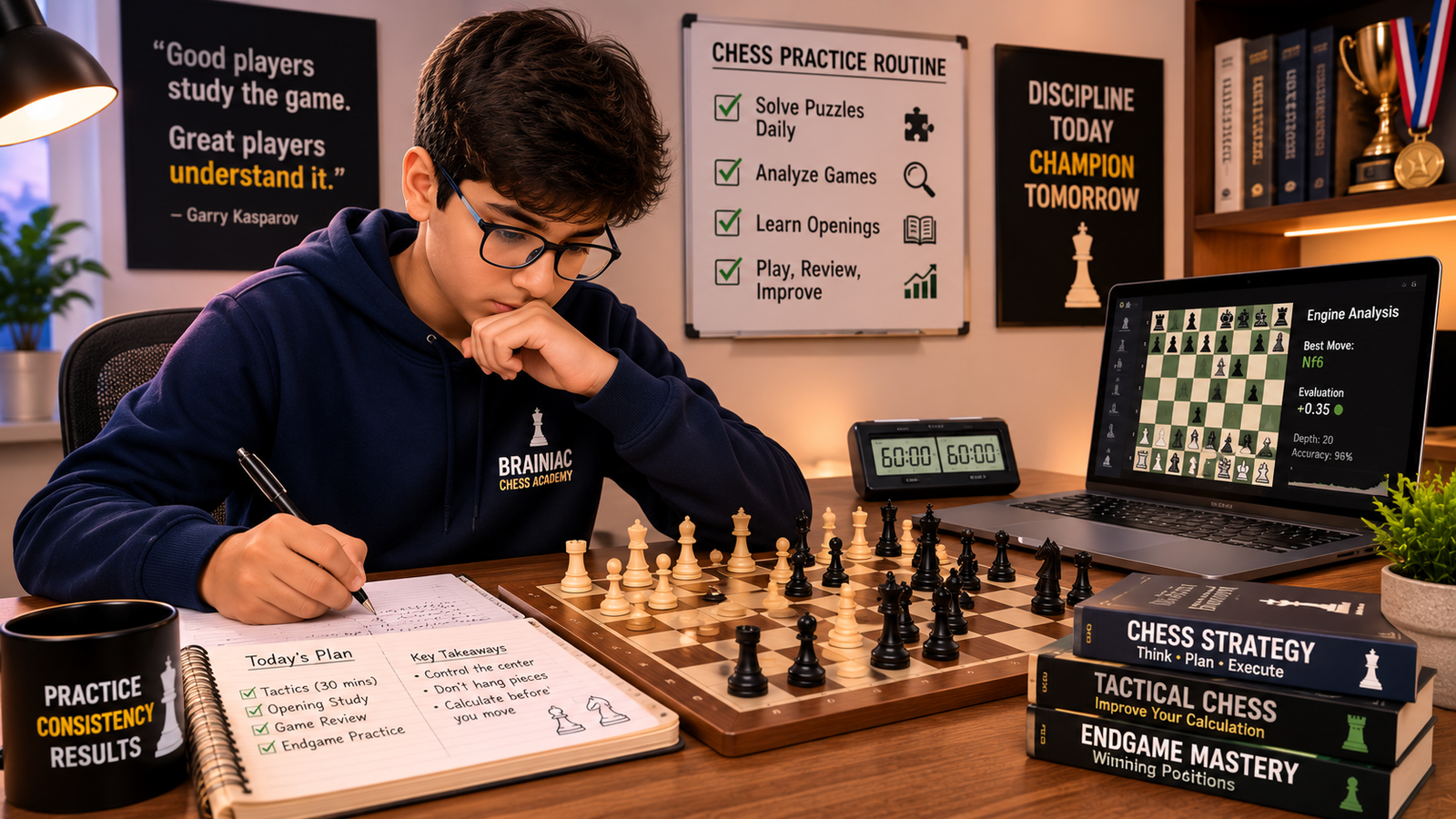
Every ambitious chess player remembers the moment they decided they wanted to get seriously good at the game. You probably started playing game after game online, hoping that pure repetition would push your rating higher. For a while, it worked. But then, inevitably, you hit a plateau. You stopped winning, and you realized that simply playing blitz games isn't enough to achieve true mastery. To break through that barrier, you need a structured Chess Practice Routine.
As FIDE-rated educators who have trained hundreds of beginners and tournament competitors, we see this exact scenario every single week. The difference between a player who stays stuck at the same rating for years and a player who rapidly climbs the ranks is never raw talent—it is the quality of their daily training.
A well-designed Chess Practice Routine transforms random, chaotic playing into deliberate, skill-building practice. In this comprehensive guide, we will teach you how to build the perfect Daily Chess Training schedule. You will discover exactly what you should be studying, how to balance tactics with endgames, and how to create a personalized Chess Improvement Plan that yields real, consistent results. Let’s dive into the blueprint for your chess success.
Why Every Chess Player Needs a Chess Practice Routine
If you walked into a gym, picked up random weights for five minutes, and then ran on a treadmill for two minutes, you wouldn't expect to build an athletic physique. Chess is exactly the same. The mind requires structured resistance to grow. A Chess Practice Routine provides that structure.
First and foremost, a Chess Practice Routine builds consistency. Playing five hours on a Sunday and nothing for the rest of the week is highly ineffective. The brain solidifies pattern recognition through daily, repeated exposure. A consistent routine ensures you are touching the chess board—mentally or physically—every day.
Secondly, it ensures comprehensive skill development. A proper Chess Practice Routine forces you to study the parts of the game you naturally avoid. If you love attacking, you might hate studying endgames. A balanced Chess Improvement Plan ensures you do not develop glaring weaknesses that opponents can exploit in tournaments.
Finally, adopting a Daily Chess Training schedule eliminates the frustration of "random practice." When you sit down at the board, you shouldn't waste time wondering what to do. Your routine dictates your focus, allowing you to maximize your learning in whatever time you have available, leading directly to rating improvement.
The Perfect Daily Chess Training Schedule
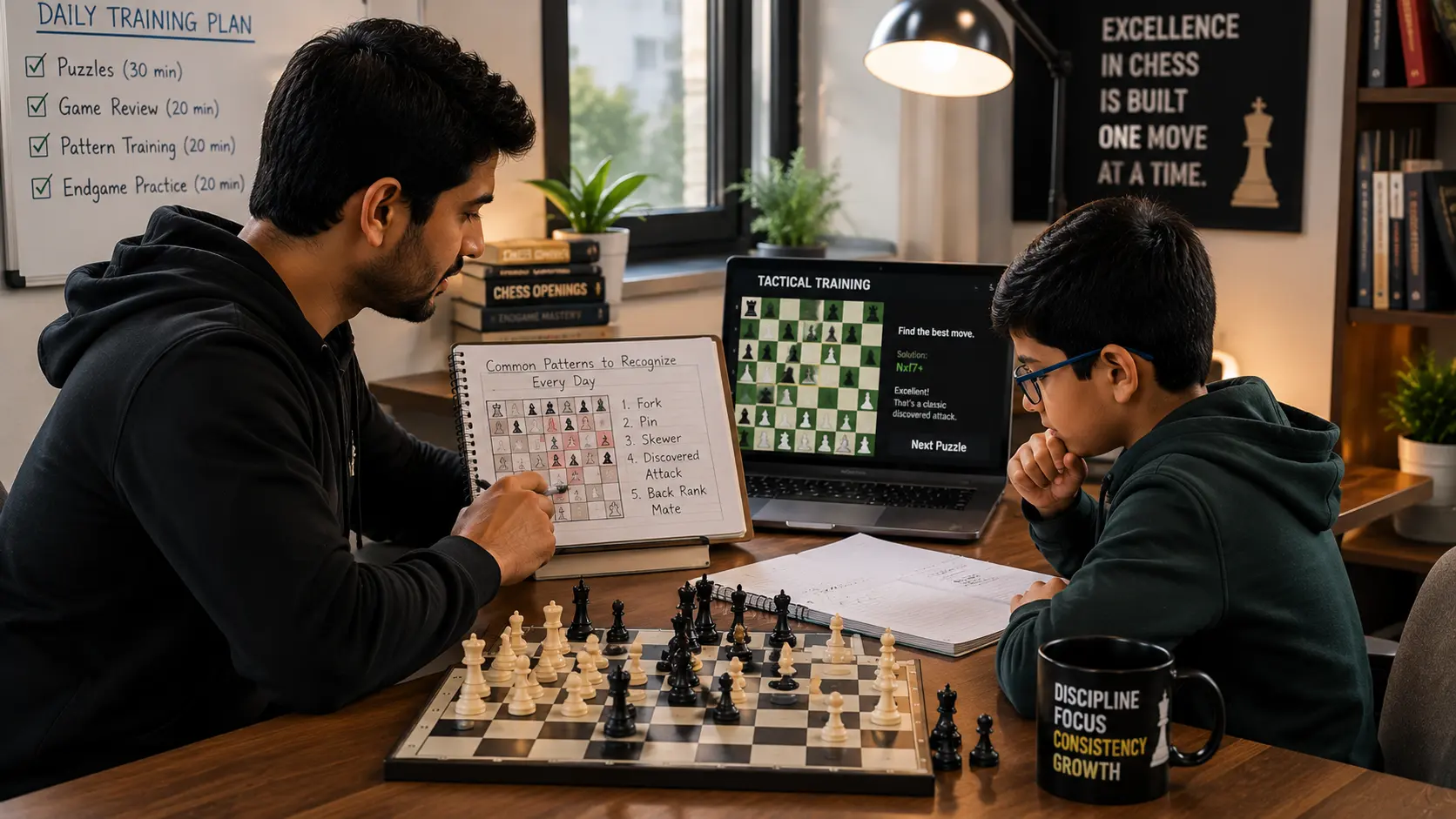
What should a standard training day look like? The ideal Chess Practice Routine balances active learning (like solving puzzles) with practical application (playing games). Below is an optimal 2-hour Daily Chess Training schedule. If you only have one hour, simply cut the times in half.
| Activity | Time | Why It Matters in Your Routine |
|---|---|---|
| Tactical Puzzles | 20 mins | Builds pattern recognition and prevents you from blundering pieces. Tactics decide 99% of beginner games. |
| Opening Study | 15 mins | Ensures you reach the middlegame with a safe king and active pieces. Focus on ideas, not memorization. |
| Middlegame Concepts | 20 mins | Teaches you how to formulate a plan when there are no immediate tactics available. |
| Endgame Practice | 15 mins | Gives you the confidence to trade pieces, knowing you can win the resulting simplified position. |
| Practice Game | 30 mins | Apply what you've learned. (Must be a slow game, e.g., 15 minutes per side minimum). |
| Game Analysis | 20 mins | Reviewing your mistakes is the most crucial part of any Chess Practice Routine. Find out *why* you lost. |
Step-by-Step Chess Improvement Plan
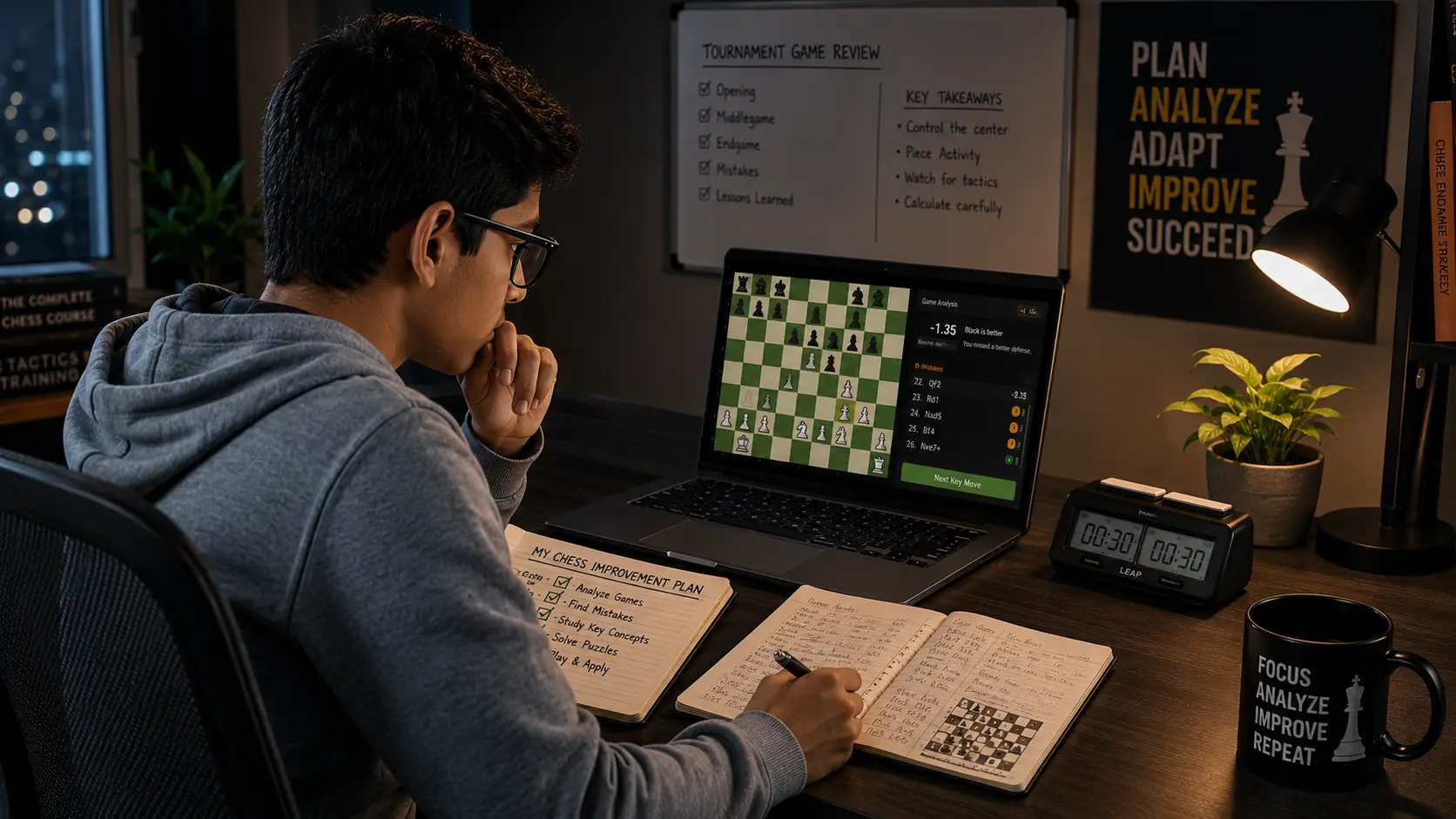
Now that you know the timeline, let's break down exactly how to execute each phase of your Chess Practice Routine effectively.
Step 1: Solve Tactical Puzzles
Why it matters: Chess is largely a game of visual patterns. Forks, pins, skewers, and discovered attacks happen in almost every game. The core of your Chess Practice Routine must be solving puzzles to train your brain to spot these patterns instantly.
Common mistakes: Guessing the first move that looks good. If you get a puzzle wrong, don't just click to the next one. Figure out why your move failed.
Coach's Tip
Always calculate the entire line in your head *before* making the first move on the digital board. This simulates real tournament conditions where you cannot take moves back.
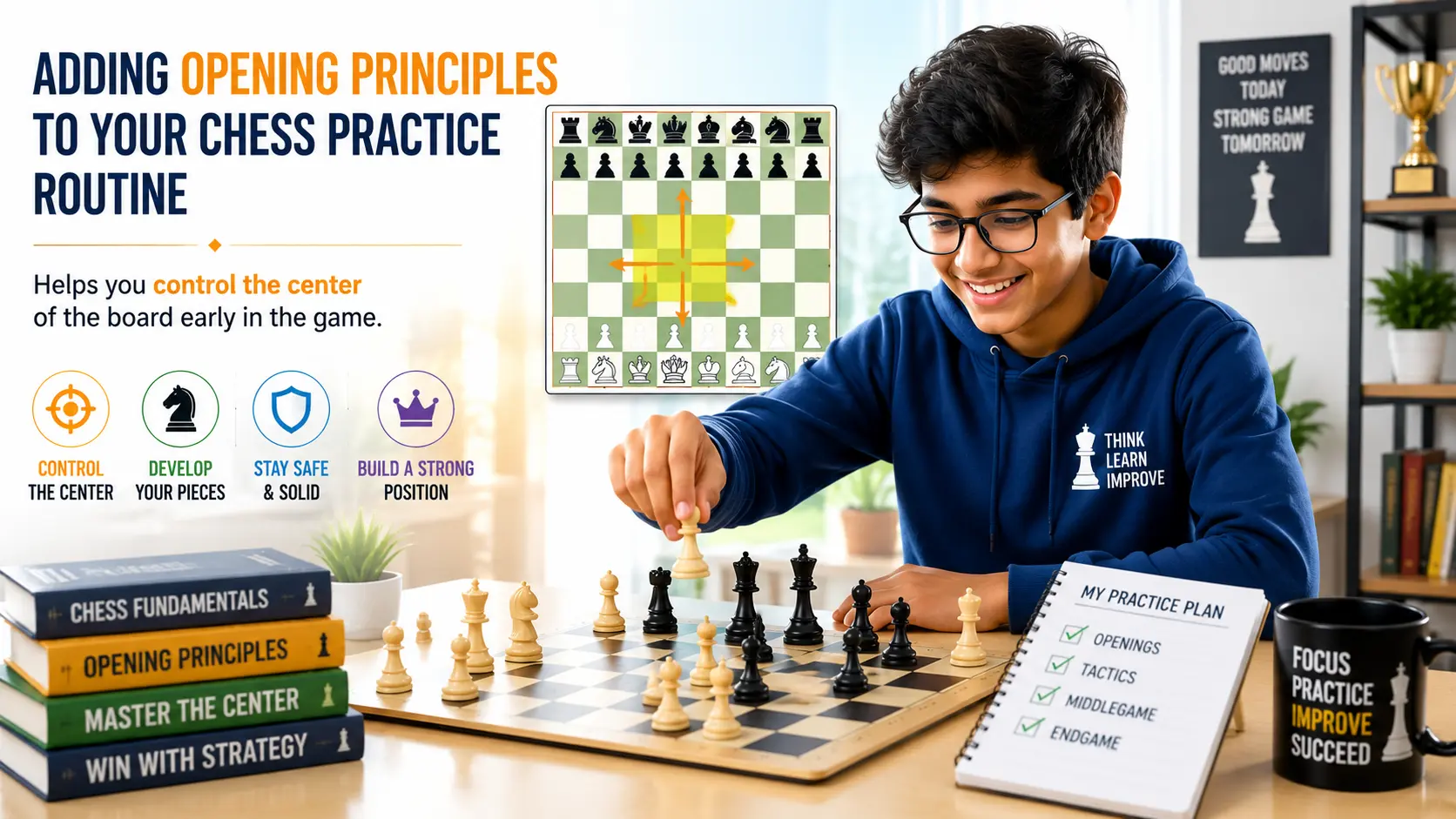
Step 2: Study Opening Principles
Why it matters: A good Chess Practice Routine doesn't involve memorizing 20 moves of Sicilian Dragon theory. It involves understanding *why* pieces go to certain squares. You need a reliable repertoire to survive the first 10 moves comfortably.
Common mistakes: Trying to learn too many openings at once. Stick to one opening for White and two for Black (one against e4, one against d4).
Example: Spend your 15 minutes reviewing your primary opening, such as the Italian Game, focusing on how you intend to control the center and where your Knights should optimally land.
Step 3: Practice Middlegame Planning
Why it matters: Once the opening is over, you need a plan. Middlegame study involves understanding pawn structures, weak squares, and piece activity.
Common mistakes: Aimlessly moving pieces without a coordinated goal. Your Chess Improvement Plan must teach you how to evaluate a position logically.
Step 4: Learn Basic Endgames
Why it matters: If you are up a pawn but don't know the "Rule of the Square" or how to take "Opposition," you will draw a winning game. Endgame study is the secret weapon of a powerful Chess Practice Routine.
Common mistakes: Ignoring endgames completely because they look "boring."
Coach's Tip
Start by mastering basic checkmates (Queen vs. King, Rook vs. King) before moving on to King and Pawn endings.
Step 5: Play Longer Time-Control Games
Why it matters: You cannot Improve Chess Skills if you only play 3-minute blitz. You need time to calculate, formulate plans, and apply the concepts you just studied.
Common mistakes: Playing "hope chess"—making a move quickly and hoping the opponent doesn't see your threat. Your Chess Practice Routine should include games of at least 15+10 time control.
Step 6: Analyze Every Game
Why it matters: This is the absolute most important step in your Daily Chess Training. Analyzing your games reveals your personal weaknesses so you can adjust your training accordingly.
Common mistakes: Looking only at the engine's evaluation bar. You must ask yourself *why* you made a blunder. Was it a time-pressure mistake? A missed tactic? A strategic misunderstanding?
How Beginners Can Improve Chess Skills Faster
If you are relatively new to the game, jumping into a rigorous Chess Practice Routine can feel overwhelming. To Improve Chess Skills quickly, beginners should avoid getting bogged down in grandmaster-level theory.
Do not memorize endless opening lines. Focus intensely on opening principles: control the center, develop your minor pieces, and castle your King to safety. If you do these three things, you will survive the opening.
Furthermore, to Improve Chess Skills, you must build good habits. Sit on your hands before you move. Ask yourself: "What is my opponent's threat? Are there any unprotected pieces?" By answering these questions on every single turn, your Daily Chess Training will translate directly into fewer blunders and higher ratings.
Check out our guide on Beginner Chess Lessons: Learn Chess the Right Way from the Start for foundational concepts.
Weekly Chess Improvement Plan
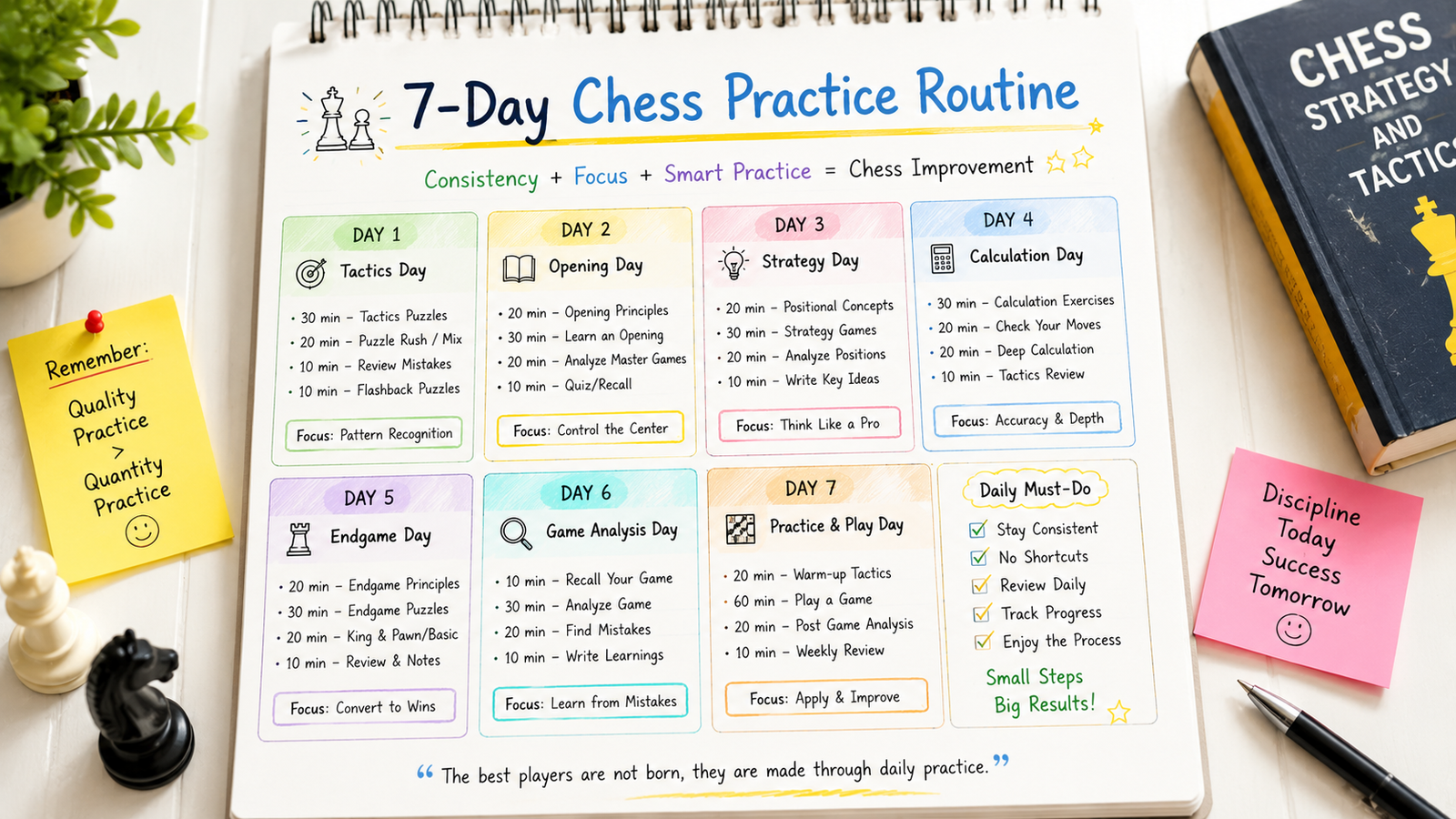
To keep your Chess Practice Routine fresh and engaging, you shouldn't study everything every single day. Here is a highly effective 7-day Chess Improvement Plan that balances all phases of the game.
| Day | Primary Focus | Specific Activities |
|---|---|---|
| Monday | Tactics & Calculation | 30 mins of puzzles, 1 Rapid Game, Game Analysis. |
| Tuesday | Opening Repertoire | Review your White opening, study master games in that opening, 1 Rapid Game. |
| Wednesday | Endgame Mastery | Practice King and Pawn endings against a computer, 1 Rapid Game. |
| Thursday | Tactics & Calculation | Puzzle Rush (for speed recognition), 1 Rapid Game, Game Analysis. |
| Friday | Opening Repertoire | Review your Black openings, update your repertoire file, 1 Rapid Game. |
| Saturday | Tournament Play | Play a longer tournament (e.g., 30-minute games) on Chess.com or locally. |
| Sunday | Deep Review & Rest | Analyze all games from Saturday. Rest and reset for the new week. |
Common Mistakes Players Make During Practice
Even with a Chess Practice Routine, players often sabotage their own progress. Here are the most common pitfalls to avoid during your Daily Chess Training:
- Playing too many blitz games: Fast chess ruins deep calculation. It reinforces bad habits and impulsive decision-making. (Read more in our article: 10 Common Chess Mistakes Beginners Should Avoid).
- Never reviewing losses: It hurts the ego to look at a game you lost, but your losses contain the exact lessons you need to improve.
- Ignoring endgames: Players lose countless half-points because they don't know how to convert a slight advantage in the endgame.
- Learning too many openings: A beginner switching from the Caro-Kann to the Sicilian to the French Defense every week will never learn the resulting middlegame plans for any of them. (See: 7 Best Chess Openings Every Beginner Should Learn).
- Practicing inconsistently: Cramming 5 hours on the weekend is inferior to 45 minutes of a daily Chess Practice Routine.
How Professional Chess Coaching Accelerates Improvement
While self-study is commendable, nothing accelerates a Chess Improvement Plan quite like a professional coach. Trying to fix your own flaws is difficult because you often don't know what you don't know.
A professional coach provides personalized guidance, tailoring a Chess Practice Routine exactly to your strengths and weaknesses. Instead of guessing which endgame to study, your coach provides a structured curriculum. They offer weekly feedback, highlighting the strategic blind spots you missed during your own game analysis.
Furthermore, a coach provides accountability. When you know you have a session coming up, you are much more likely to stick to your Daily Chess Training schedule. For serious players, tournament preparation with a FIDE-rated expert is absolutely invaluable.
Learn more about how formal training works in our guide: Chess Coaching: Learn, Improve, and Master the Game with Expert Guidance.
Why Choose Brainiac Chess Academy?
If you are ready to stop guessing and start following a proven Chess Practice Routine, Brainiac Chess Academy is your ideal partner in chess mastery.
We pride ourselves on our team of Experienced Coaches who specialize in creating a Personalized Chess Improvement Plan for every single student. Whether you are looking for convenient Online Coaching or immersive Offline Coaching, our Beginner-Friendly Curriculum ensures you learn the right concepts at the right time.
We maintain strictly Small Batch Sizes so that every student receives individual attention. From mastering the basics to intense Tournament Preparation, we offer a Flexible Learning Schedule designed to fit into your busy life while ensuring you consistently Improve Chess Skills.
(Still deciding on the format? Check out Online vs Offline Chess Classes: Which Is Better).
Book Your Free Demo Class
Want a structured Chess Practice Routine designed by experienced coaches?
Brainiac Chess Academy offers online and offline coaching with personalized training plans, regular game analysis, and tournament preparation.
📞 Call / WhatsApp: +91 9324829329
👉 Book Your Free Demo Right Now
Frequently Asked Questions
What is the best Chess Practice Routine?
How many hours should I practice chess daily?
Can beginners follow this routine?
Should I study openings every day?
How important are tactics?
Is online coaching effective?
How long before I see improvement?
Do I need a chess coach?

Conclusion
Improving at chess is not a mystery reserved for geniuses; it is the natural byproduct of discipline and structure. By transitioning from random, hope-based play to a highly deliberate Chess Practice Routine, you are taking control of your chess journey. Remember that progress isn't always a straight line upward. There will be plateaus and tough tournament days, but if you stick to your daily schedule, solve your puzzles, and ruthlessly analyze your mistakes, your rating will inevitably climb.
Trust the process, be patient with yourself, and commit to the training. If you are ready to take your game to the next level and want expert guidance to streamline your learning, the team at Brainiac Chess Academy is here to help you succeed on every square of the board.