How Chess Helps Improve Mathematical Thinking
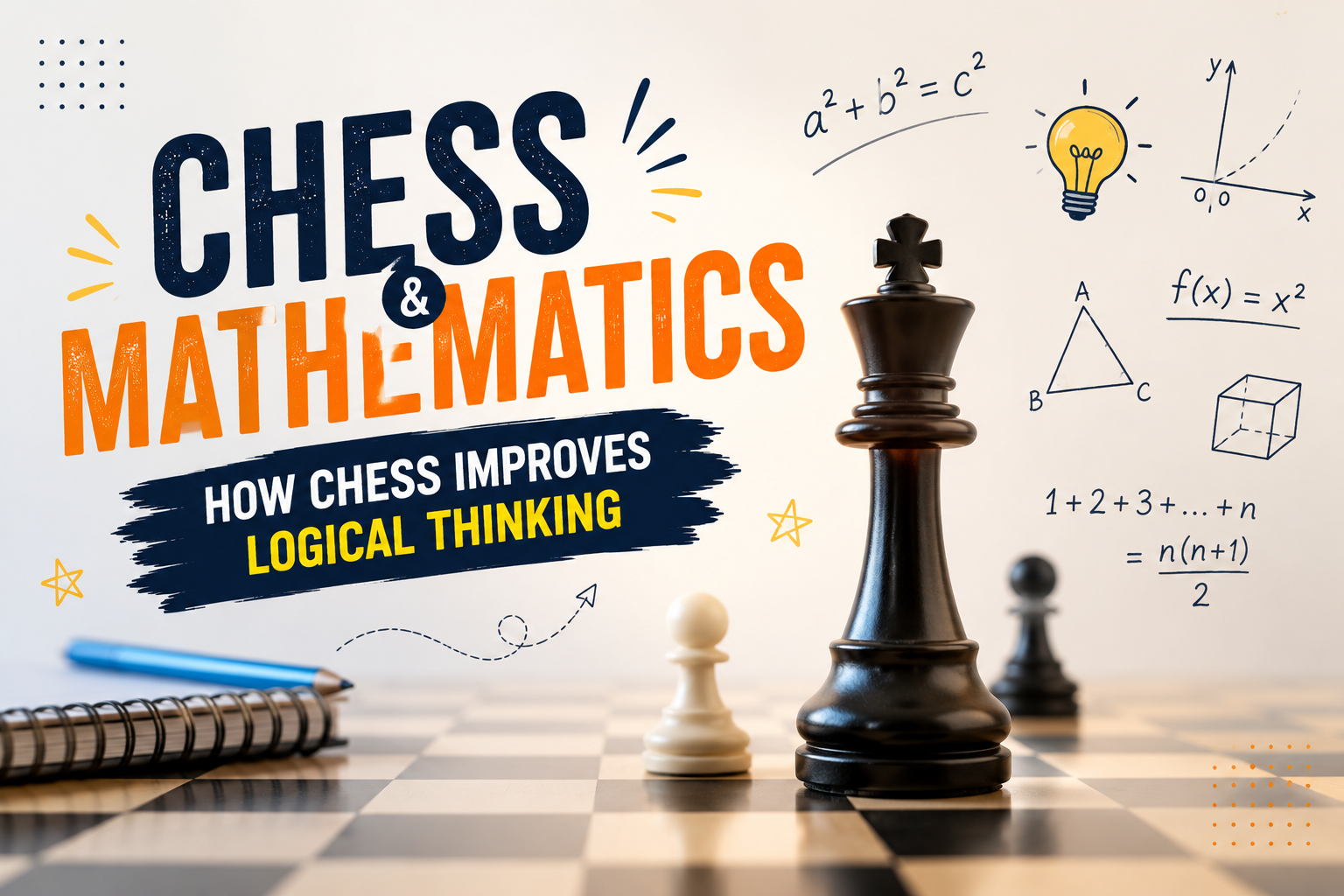
Have you ever wondered why so many prominent mathematicians, engineers, and scientists are also avid chess players? The profound relationship between Chess and Mathematics is not a coincidence. As a mathematics educator and FIDE-rated chess coach, I observe the overlap between these two disciplines every single day in the classroom and at the chessboard.
Both subjects demand a high level of logical reasoning, strict pattern recognition, and long-term strategic thinking. Whether a student is trying to solve a complex algebraic equation or calculating a forced checkmate in three moves, the brain is engaging in the exact same cognitive processes. This shared mental architecture is why we emphasize using Chess for Logical Thinking as a foundational tool for young minds.
In this comprehensive guide, we will explore the deep-rooted connection between Chess and Mathematics. You will learn how the game naturally strengthens a child's mathematical thinking, aids in Brain Development, and equips students with the analytical skills they need to excel in academics. Let us dive into the 64 squares of logic.
What Is the Relationship Between Chess and Mathematics?
To understand the bond between Chess and Mathematics, we must look beyond numbers and wooden pieces. At its core, mathematics is not just about memorizing multiplication tables; it is the study of logic, structures, spaces, and change. Chess mirrors this perfectly.
When studying the synergy of Chess and Mathematics, educators focus on several shared pillars:
- Logic over Memorization: Just as you cannot memorize every math problem, you cannot memorize every chess game. You must apply fundamental rules (axioms) to navigate unknown positions.
- Sequential Thinking: In math, solving an equation requires executing operations in a specific order (BODMAS). In chess, executing a combination in the wrong move order results in a lost game.
- Decision-Making under Constraints: Math problems have rules and boundaries. Chess gives you constraints like time controls and piece movement limits, forcing the brain to optimize solutions efficiently.
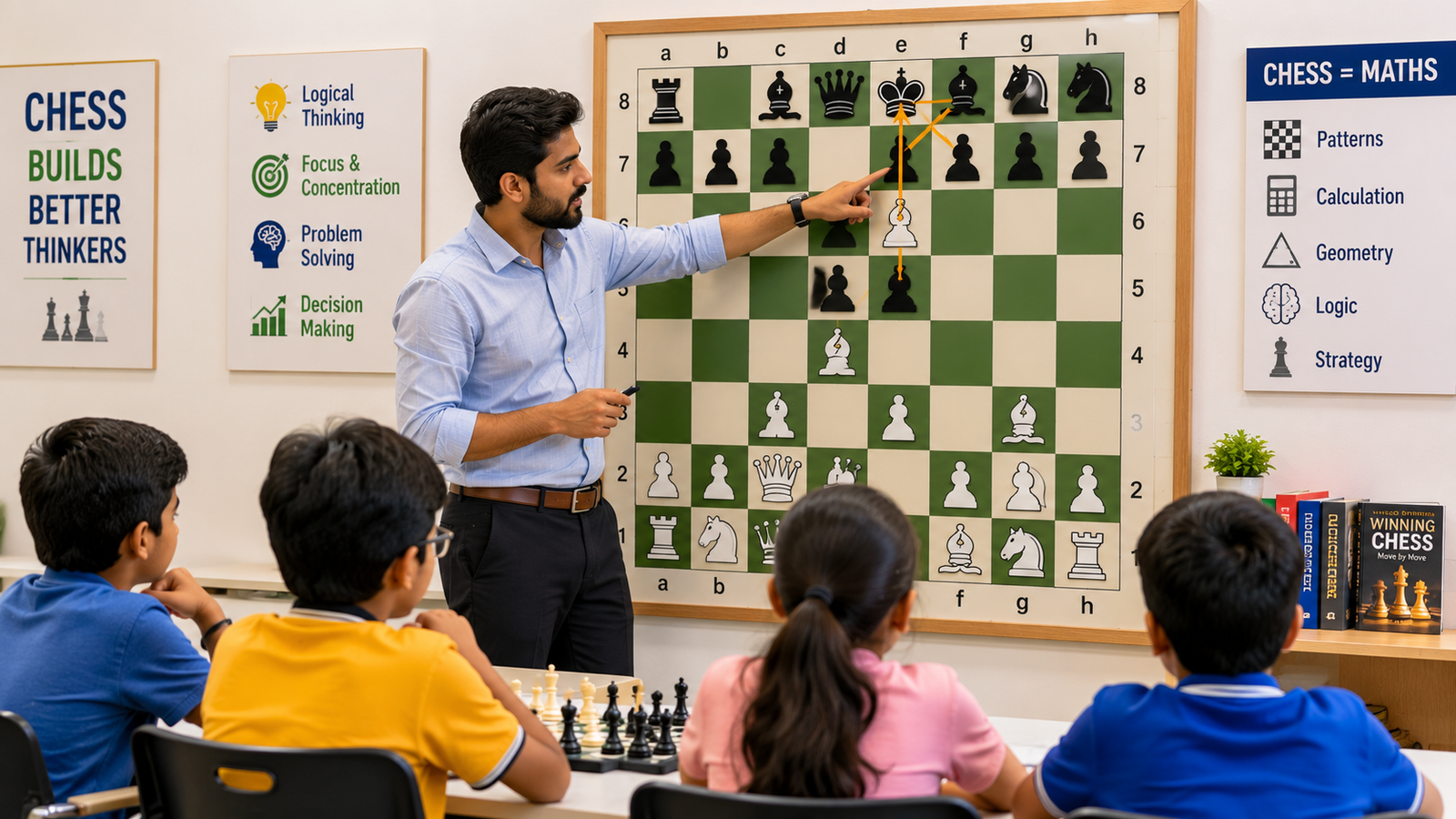
10 Ways Chess Improves Mathematical Thinking
The practical application of Chess and Mathematics is vast. Here are ten distinct cognitive skills that bridge the gap between the chessboard and the math exam, enhancing overall Brain Development.
1. Pattern Recognition
The Skill: The ability to identify repeating sequences and structures.
How Chess Develops It: A master chess player does not look at 32 independent pieces; they look at structural patterns (like a fianchettoed bishop or a smothered mate). This trains the brain to rapidly identify patterns, which is the exact skill needed to factor algebraic expressions.
Coach's Insight
In my classes, students who excel at spotting chess tactics like 'pins' and 'forks' almost always grasp mathematical sequences (like Fibonacci or arithmetic progressions) much faster.
2. Logical Reasoning
The Skill: Using a rational, systematic series of steps to arrive at a conclusion.
How Chess Develops It: Chess operates on an "If-Then" logic loop. "If I move my knight here, then my opponent will attack my queen, then I will counter-attack." This is the foundation of geometric proofs and boolean algebra.
3. Problem-Solving Skills
The Skill: Finding solutions to difficult or complex issues.
How Chess Develops It: Every single chess move poses a new problem to solve. Building Math Skills Through Chess happens naturally because a child learns not to panic when faced with a difficult board state, translating to resilience when facing a tough math word problem.
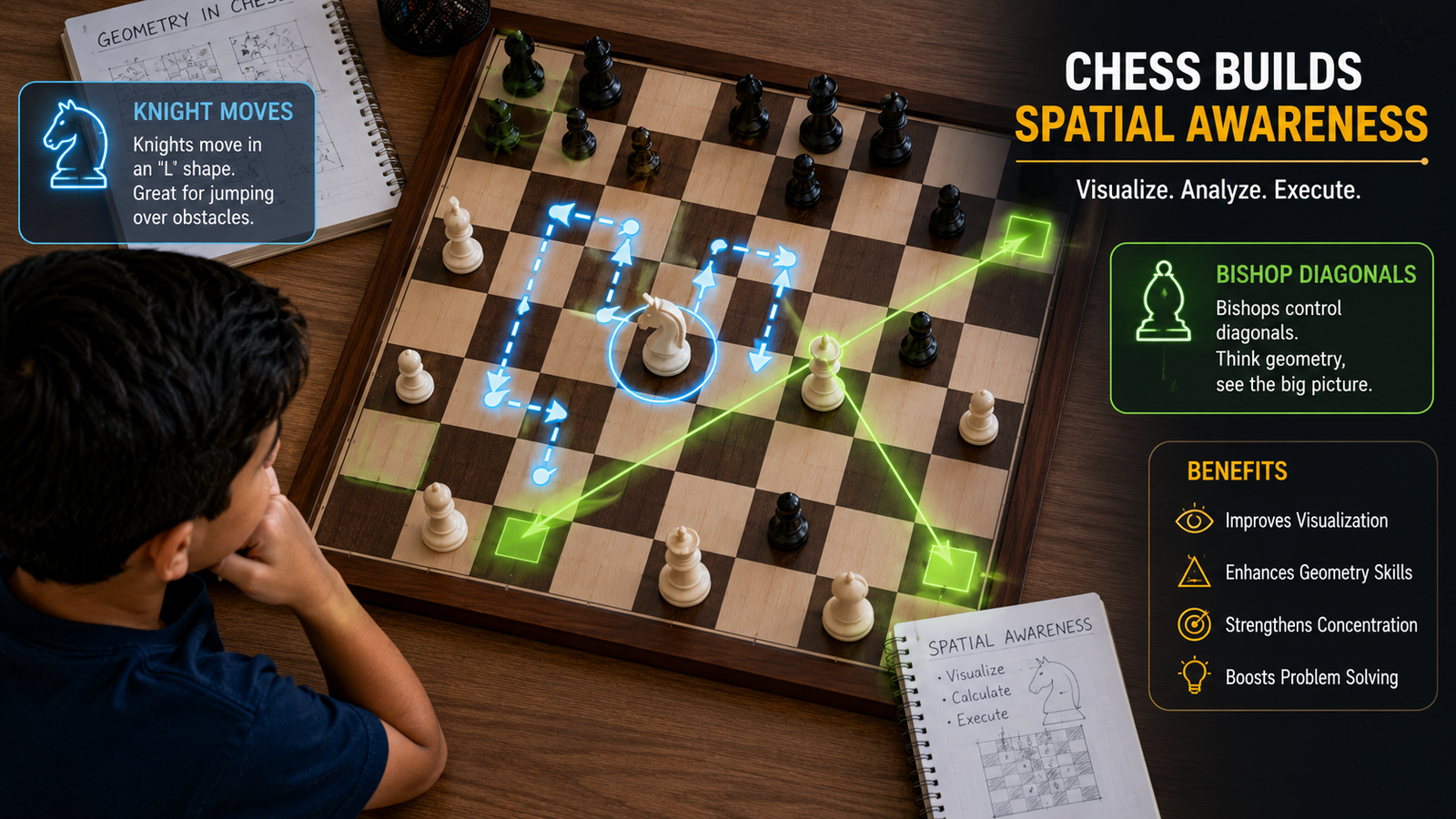
4. Spatial Awareness
The Skill: Understanding how objects relate to one another in a given space.
How Chess Develops It: Players must visualize how a knight (moving in an L-shape) or a bishop (moving diagonally) controls unseen squares. This spatial visualization directly boosts performance in geometry and trigonometry.
5. Mental Calculation
The Skill: Processing mathematical operations in the head without paper.
How Chess Develops It: When calculating a series of trades (captures) on a single square, a player is essentially doing mental arithmetic: "I have 3 attackers, he has 2 defenders; therefore, I win material." This rapid calculation is the bedrock of Chess and Mathematics.
6. Decision Making
The Skill: Selecting the best possible option from multiple alternatives.
How Chess Develops It: In a math test, a student must decide which formula to apply. In chess, a player evaluates candidate moves and commits to the optimal one, fostering decisive, confident thinking.
7. Critical Thinking
The Skill: Objective analysis and evaluation of an issue to form a judgment.
How Chess Develops It: Chess forces you to evaluate your opponent's threats objectively. You cannot indulge in wishful thinking. You learn to question your own assumptions—a vital skill for advanced mathematics and scientific inquiry.
8. Concentration
The Skill: Directing all mental effort toward a single task.
How Chess Develops It: A single lapse in concentration during a chess game leads to a blunder. Playing chess naturally stretches a child's attention span, which translates directly to sitting through a long, complex mathematics exam without losing focus.
9. Strategic Planning
The Skill: Setting long-term goals and determining the steps to achieve them.
How Chess Develops It: You do not win a chess game by accident. You must formulate a plan (e.g., "I will attack the queenside"). This mirrors the multi-step planning required for calculus or solving simultaneous equations.
10. Analytical Thinking
The Skill: Breaking down complex information into smaller, manageable parts.
How Chess Develops It: Analyzing a chaotic middlegame requires breaking the position into manageable chunks (king safety, pawn structure, piece activity). This is exactly how we teach students to break down complex algebraic word problems.
Chess and Mathematics: Similar Skills Compared
To further illustrate the bond between Chess and Mathematics, let us compare how specific chess concepts align with standard academic mathematical skills.
| Chess Skill | Mathematical Skill | Real-Life Benefit |
|---|---|---|
| Planning an Attack | Algebraic Thinking | Better, more structured problem-solving. |
| Board Visualization | Geometry & Coordinates | Faster spatial visualization and mapping. |
| Piece Counting / Trades | Arithmetic & Probability | Improved numerical accuracy under pressure. |
| If-Then Move Calculation | Proofs & Logical Reasoning | Better, more rational decision-making. |
| Positional Strategy | Multi-step Math Problems | Enhanced long-term planning and patience. |
How Chess Helps Students Perform Better in Mathematics
As an educator, I am often asked by parents if enrolling their child in chess classes will automatically increase their school grades. While I am careful to clarify that chess is not a magic wand, the cognitive carryover—especially regarding Chess and Mathematics—is undeniable.
First, chess drastically improves concentration. A student who can sit still and focus on a chessboard for an hour can easily focus on a 45-minute math assignment. Second, chess teaches structured, step-by-step thinking, which significantly reduces the careless mistakes students often make in arithmetic.
Most importantly, utilizing Chess Classes for Kids Worldwide builds immense confidence. When a child realizes they can navigate the immense complexity of a chessboard, a standard middle-school math test suddenly feels much less intimidating.
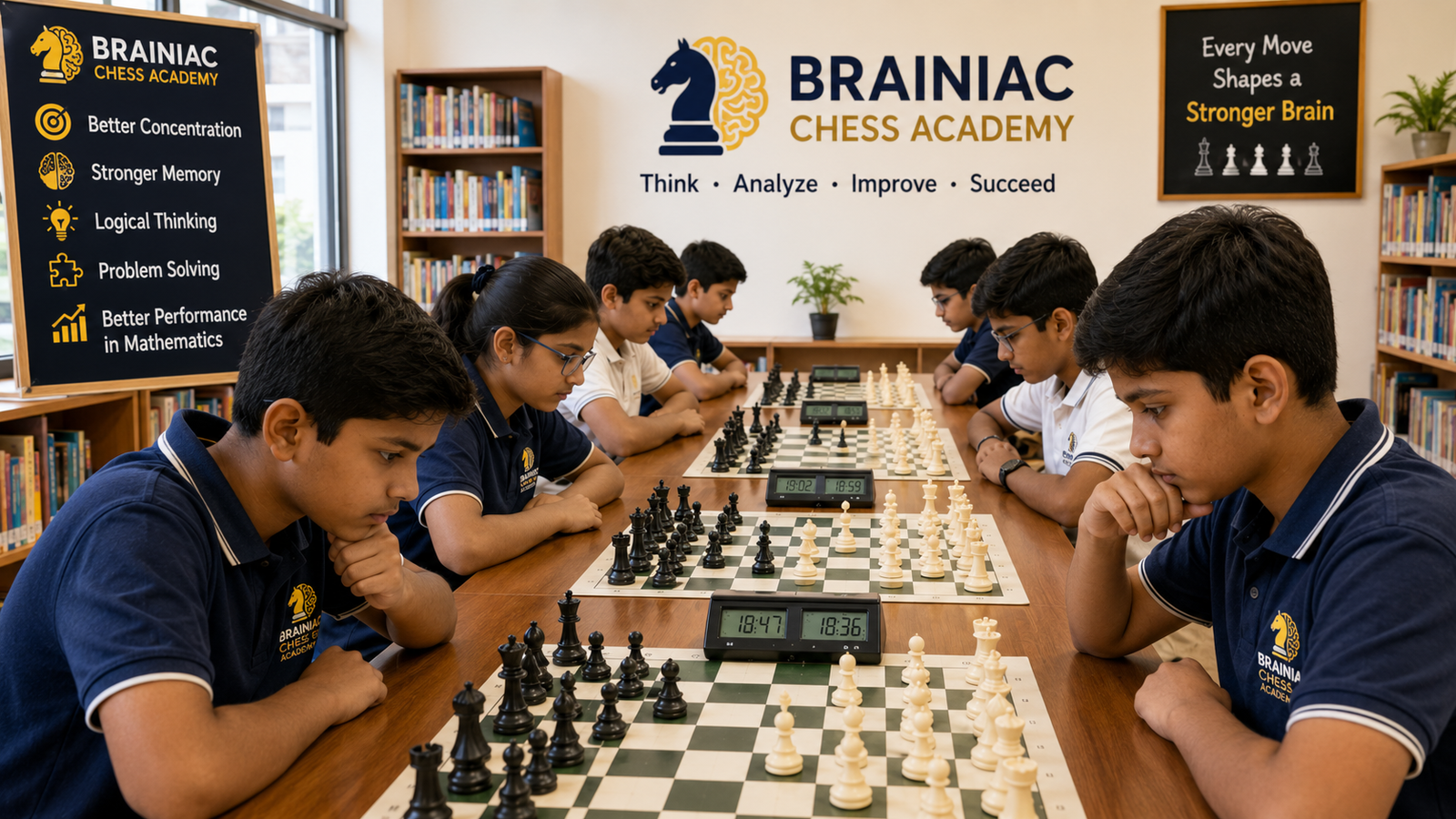
Chess for Logical Thinking: Practical Activities for Students
If you want to actively bridge Chess and Mathematics, playing full games is not the only way. At Brainiac Chess Academy, we use specific exercises to target Brain Development.
- Solve Tactical Puzzles: Treating chess puzzles like math equations. "Find the mate in 2" forces strict calculation.
- Visualization Exercises: Have the student look at a board, close their eyes, and verbally explain where the pieces are. This builds incredible spatial memory.
- Endgame Calculation Drills: Pawn endgames are pure mathematics. Calculating whether a king can catch a pawn before it promotes requires counting squares and understanding geometry (The Rule of the Square).
- Predict the Opponent's Move: This fosters empathy and perspective-taking, crucial elements of advanced logic.
How Parents Can Use Chess to Support Learning at Home
Parents play a crucial role in cultivating Math Skills Through Chess. You do not need to be a Grandmaster to help your child reap the cognitive benefits.
Start by organizing weekly family chess sessions. Make it a fun, low-pressure environment. Before your child starts their math homework, have them solve two or three chess puzzles to "warm up" their brain.
Encourage them to think aloud while playing. Ask them, "Why did you make that move?" Forcing them to verbalize their logic strengthens their reasoning skills. Celebrate their progress in calculation, not just whether they win or lose.
Coach's Insight
Never let chess feel like a chore. The magic of Chess and Mathematics lies in the fact that chess is inherently a game. Learning happens naturally when a child is having fun.
Common Myths About Chess and Mathematics
Despite the strong link between Chess and Mathematics, several myths persist that deter parents and students.
Myth 1: Only math geniuses can play chess.
Reality: This is completely backward. You do not need to be a math genius to play chess; playing chess helps you *become* better at math. Chess is for everyone.
Myth 2: Chess is too difficult for young children.
Reality: Children as young as four can learn piece movements. Their brains are sponges for pattern recognition, making early childhood the perfect time for Brain Development through chess.
Myth 3: Chess replaces traditional math education.
Reality: Chess is a supplementary tool, not a replacement. It builds the *framework* for logical thinking, making it easier for school teachers to input mathematical concepts.
Myth 4: Playing chess guarantees straight A's in math.
Reality: While the correlation in Chess and Mathematics is strong, academic success also requires dedicated studying, good teaching, and attending school classes. Chess provides the cognitive boost, but the student must still do the academic work.
Why Choose Brainiac Chess Academy?
Understanding the link between Chess and Mathematics is the first step; finding the right environment to nurture those skills is the next. At Brainiac Chess Academy, we specialize in translating board skills into real-world cognitive growth.
Our Expert Coaches are trained not just to teach chess openings, but to foster deep analytical thinking. We offer Personalized Learning plans through both Online Coaching and in-person sessions. Our Beginner-Friendly Curriculum is designed to remove the intimidation factor, ensuring that every student feels confident.
Whether you are looking for foundational logic training for a primary schooler or rigorous tournament preparation for a teenager, our academy in Navi Mumbai is equipped to elevate your child's thinking. We even offer Chess Classes for Adults, because cognitive development never stops.
Book Your Free Demo Class
Help your child build stronger logical thinking, better concentration, and structured problem-solving skills through expert chess coaching. Brainiac Chess Academy offers engaging online and offline chess classes for children, students, and adults.
📞 Call / WhatsApp: +91 9324829329
👉 Book Your Free Demo Right Now
Frequently Asked Questions
Does chess improve mathematical thinking?
What is the connection between Chess and Mathematics?
Can chess help children with math?
Does chess improve logical reasoning?
At what age should children start chess?
Is chess useful for school students?
Does chess improve concentration?
Can adults also benefit from chess?
Conclusion
The intricate dance between Chess and Mathematics is one of the most beautiful educational synergies that exists. By teaching a child to navigate the 64 squares, we are not just teaching them how to capture a king; we are teaching them how to organize their thoughts, approach complex problems systematically, and trust their own logical reasoning.
Chess is a powerful, lifelong tool for academic and personal growth. It transforms abstract mathematical concepts—like geometry, calculation, and probability—into a tangible, exciting game. We encourage parents and educators to look beyond the competitive aspect of the sport and utilize it as a fundamental pillar for Brain Development.
If you are ready to give your child the cognitive advantage they deserve, we are here to help. Join the Brainiac family today and watch their analytical skills soar both on the board and in the classroom!