Chess vs Coding: Which Builds Better Problem-Solving Skills?
Last month, a mother of an eight-year-old boy sat in my office in Sector 7, Vashi, looking slightly overwhelmed. "I have a limited budget and limited time," she explained. "Half the parents at school are enrolling their kids in programming boot camps, and the other half are hiring chess tutors. I need to know the truth about Chess vs Coding—which one will actually help my son develop better Problem Solving Skills for the future?"
If you are a parent navigating the modern landscape of child education, this scenario likely sounds incredibly familiar. The debate of Chess vs Coding is one of the most common discussions among parents today who want to give their children an intellectual edge. The truth is, it should not be viewed as a winner-takes-all battle. Both activities are phenomenal tools for cognitive development, but they train the brain in vastly different ways.
In this comprehensive, research-backed guide, we will explore the nuances of Chess vs Coding. As educational consultants and experienced FIDE-rated coaches, we will break down how each activity shapes logical reasoning, creativity, and STEM Learning, helping you make the most informed decision for your child's unique developmental stage.
Both activities build excellent Problem Solving Skills, but in different ways. Chess develops forward-thinking, strategic adaptability, and risk assessment under pressure. Coding teaches algorithmic thinking, logic, and automation. For foundational cognitive development, experts often recommend starting with chess to build the focus needed for advanced coding.
Why Parents Compare Chess and Coding Today
Before diving into the specifics of Chess vs Coding, it is vital to understand why these two activities are constantly pitted against each other. Over the last decade, the educational landscape has shifted dramatically. Rote memorization is out; dynamic critical thinking is in.
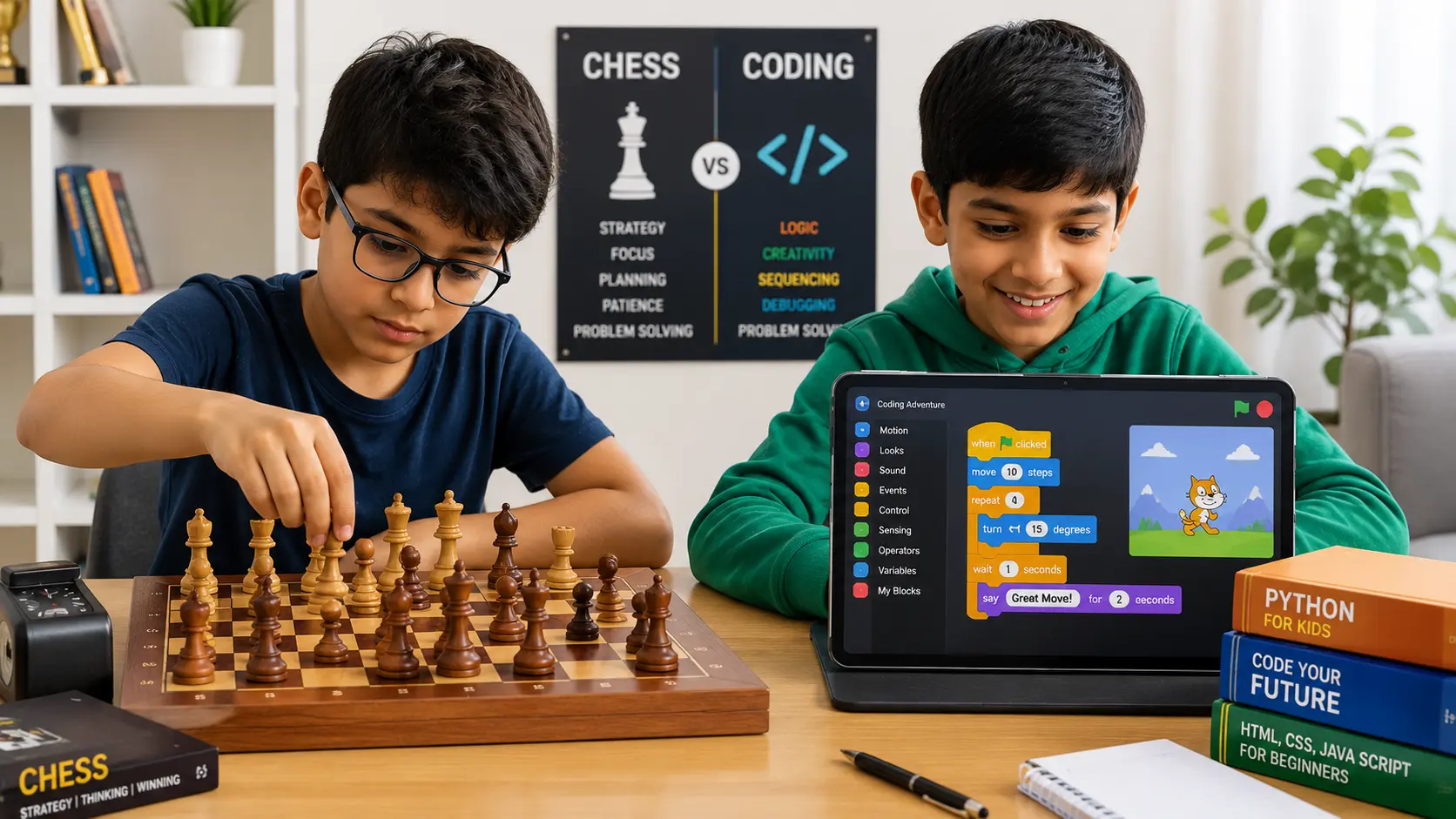
Parents are actively seeking extracurricular activities that offer more than just entertainment. They want activities that provide "future-ready skills." Here is why Chess vs Coding dominates the conversation:
- The Rise of STEM Education: Both fields are heavily linked to STEM Learning (Science, Technology, Engineering, and Mathematics). They require children to analyze data, spot patterns, and execute logical sequences.
- Screen-Time Concerns: Many parents are acutely aware of digital fatigue. While coding is inherently tied to screens, chess offers a tactile, offline alternative that still builds immense mental agility. Exploring Benefits of Chess for Kids often highlights this offline advantage.
- Demand for Logical Thinking: Whether a child is debugging a python script or calculating a middle-game combination, both activities demand rigorous logical deduction.
- Academic Competition: Parents want activities that naturally translate to better academic performance, specifically in mathematics and reading comprehension.
What Skills Does Chess Develop?
Chess has been played for over a thousand years, making it one of the oldest and most proven tools for mental conditioning. Let’s break down the specific cognitive abilities it sharpens.
Strategic Thinking and Long-Term Planning
In chess, you cannot simply react; you must proactively plan. A player must formulate a strategy that spans the entire game, adapting when the opponent interferes. This teaches children that immediate gratification (capturing a single pawn) is often less valuable than long-term positioning (controlling the center of the board).
♟️ Coach's Insight
When teaching at Online Chess Classes – Brainiac Academy, I always tell my students: "A bad plan is better than no plan at all." Chess forces children to visualize a goal and execute it step-by-step.
Pattern Recognition
A chessboard holds a finite number of squares but near-infinite possibilities. Over time, a child’s brain begins to recognize tactical patterns—pins, forks, and skewers. This pattern recognition is the exact same neurological process used in advanced mathematics.
Patience and Emotional Control
Losing a chess game is entirely the player's responsibility; there is no luck involved. Learning to manage the frustration of a blunder and sit quietly for an hour requires immense discipline. Parents can read more about How Chess Builds Discipline and Patience in Children to understand this profound transformation.
♟️ Coach's Insight
A child who can sit silently and calculate for 45 minutes during a game will have zero trouble maintaining focus during a standard school exam.
What Skills Does Coding Develop?
On the other side of the Chess vs Coding spectrum lies programming. Coding is the language of the modern world, and introducing it to children opens up a universe of digital creativity.
Computational Thinking and Logic
Coding teaches children how to take a massive, overwhelming problem and break it down into small, manageable sequences (algorithms). If a character in a game needs to jump, the child must logically write the exact sequence of commands to make that happen.
Digital Creativity and Automation
Unlike chess, which operates within strict, unchanging rules, coding allows children to create their own rules. They can build an app, animate a story, or design a website from absolute scratch. It transforms them from passive consumers of technology into active creators.
Resilience Through "Debugging"
In programming, things rarely work on the first try. Children learn that failure (a bug) is not the end; it is simply a puzzle that needs fixing. They must go back through their logic line by line to find the error, which builds tremendous perseverance.
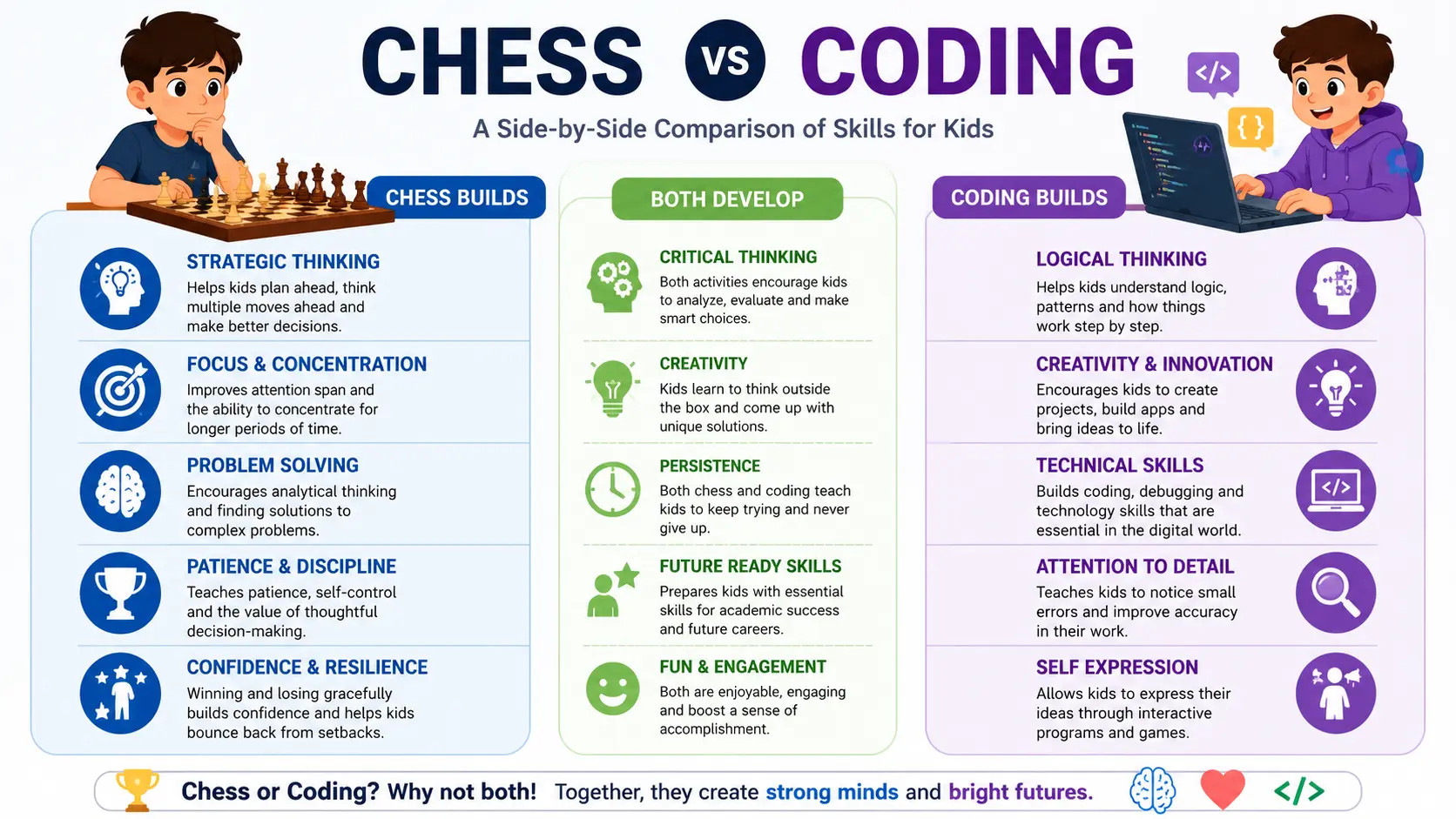
Chess vs Coding: A Side-by-Side Comparison
When analyzing Chess vs Coding, it helps to look at the data objectively. Here is how both activities stack up across essential developmental areas.
| Skill | Chess | Coding |
|---|---|---|
| Logical Thinking | ⭐⭐⭐⭐⭐ | ⭐⭐⭐⭐⭐ |
| Strategic Planning | ⭐⭐⭐⭐⭐ | ⭐⭐⭐⭐ |
| Creativity | ⭐⭐⭐ | ⭐⭐⭐⭐⭐ |
| Decision Making | ⭐⭐⭐⭐⭐ | ⭐⭐⭐ |
| Focus & Attention | ⭐⭐⭐⭐⭐ | ⭐⭐⭐⭐ |
| Patience & Resilience | ⭐⭐⭐⭐⭐ | ⭐⭐⭐⭐ |
| STEM Readiness | ⭐⭐⭐⭐ | ⭐⭐⭐⭐⭐ |
| Problem Solving Skills | ⭐⭐⭐⭐⭐ | ⭐⭐⭐⭐⭐ |
As the table demonstrates, assessing Chess vs Coding reveals that both are extraordinary for building Problem Solving Skills, but they excel in slightly different zones. Chess is the ultimate master of pure decision-making and focus, while coding takes the lead in digital creativity and direct tech-application.
How Chess Strengthens Problem Solving Skills
In the context of Chess vs Coding, many parents ask exactly *how* chess builds such robust Problem Solving Skills. Let's look at the anatomy of a chess move.
Before a child touches a piece, their brain goes through a rapid cycle of critical thinking:
- Threat Assessment: "What is my opponent trying to do to me?"
- Evaluating Options: "I have three different moves. Which one is best?"
- Predicting Outcomes (Calculation): "If I move here, they move there, then I move there..."
- Execution and Adaptability: Committing to the move and adapting if the opponent plays something unexpected.
This cycle trains the brain in dynamic risk assessment. Unlike coding, where you can safely "test" your code and undo a mistake without consequence, chess forces children to live with their decisions. This high-stakes environment significantly accelerates the maturation of executive functions in the brain.
How Chess Supports STEM Learning
It is a common misconception that only technology-based activities support STEM Learning. The World Chess Federation (FIDE) has long documented the profound impact of chess on mathematical proficiency.
Chess operates on geometric and algebraic principles. The board is an X-Y axis grid. Pieces hold numerical values (Queen = 9, Rook = 5, Knight = 3). Children naturally perform complex calculations of material value exchanges without even realizing they are doing math.
Furthermore, chess builds **Algorithmic Thinking**. A chess opening is essentially a well-documented algorithm: "If white plays e4, and black plays e5, then the most logical response is Nf3." By learning to memorize, understand, and deviate from these sequences, children lay a massive, sturdy foundation for future STEM Learning subjects.
Should Children Learn Chess Before Coding?
When weighing Chess vs Coding, sequence matters. Can a child learn both? Absolutely. But *should* they learn one before the other?
As child development specialists, we frequently recommend that **chess should precede coding**. Here is the educational logic behind this recommendation:
To be successful in coding, a child must possess the ability to sit still, focus intensely on a screen, and push through the frustration of bugs. If a young child lacks this foundational patience, a coding interface can quickly become overwhelming.
Chess, played on a physical board, acts as the mental gym that builds this very focus. Teaching a 5-to-7-year-old chess develops their attention span and impulse control in a screen-free environment. Once they have developed the discipline required to analyze a chessboard for 30 minutes, they are incredibly well-prepared to tackle the logical complexities of programming languages a few years later. Establishing a solid Chess Practice Routine early on makes the transition to complex STEM tasks seamless.
Common Misconceptions About Chess and Coding
The Chess vs Coding conversation is unfortunately filled with myths that confuse parents. Let’s debunk the most common ones:
- Myth: Chess is only for naturally "gifted" children.
Reality: Chess is a learned skill, not an innate talent. It *creates* sharper minds; it does not just cater to them. Structured coaching can turn any child into a strategic thinker. - Myth: Coding replaces the need for strategic games.
Reality: Coding teaches syntax and digital logic; chess teaches human psychology, adaptability under pressure, and spatial reasoning. They complement each other perfectly. - Myth: Children must choose only one activity.
Reality: Many top-tier students balance both. They might study chess on weekends to refine their Problem Solving Skills and take coding classes during the week for digital literacy.
Which Is Better for Different Age Groups?
To simplify the Chess vs Coding decision, we have created a developmental roadmap based on cognitive readiness. This helps parents align their investments with their child's natural growth phases.
| Age Group | Recommended Focus | Why This Works Best |
|---|---|---|
| 5–7 Years | Chess Foundation | Builds essential focus, spatial awareness, and patience entirely offline. |
| 8–10 Years | Chess + Basic Coding | Chess provides tactical depth, while block-based coding introduces digital logic. |
| 11–14 Years | Chess + Programming | Advanced chess calculation pairs beautifully with text-based programming (Python). |
| 15+ Years | Advanced Chess + Coding Projects | Students use both to build elite resumes, excel in math, and prepare for careers. |
Parents interested in beginning this journey the right way should read What Parents Should Know Before Enrolling Their Child in Chess to understand what a quality curriculum looks like.
Why Choose Brainiac Chess Academy?
While the Chess vs Coding debate highlights the importance of cognitive development, *how* your child learns is just as important as *what* they learn. At Brainiac Chess Academy, we don't just teach kids how to move pieces; we teach them how to think.
Whether you choose our physical center in Sector 7, Janata Market, Vashi, Navi Mumbai, Maharashtra, or opt for our premium digital platform, your child receives world-class instruction. Here is why parents trust us to build their child's Problem Solving Skills:
- Expert Coaches: Our FIDE-rated mentors understand child psychology and tailor lessons to individual learning speeds.
- Beginner to Advanced Curriculum: A structured path from absolute beginner to master-level play via our Online Chess Academy for Beginners to Masters.
- Tournament Preparation: We organize regular Chess Tournaments Online to help children test their resilience in competitive but safe environments.
- Small Batch Sizes: Ensuring personalized attention so no child gets left behind in complex tactical discussions.
We are deeply committed to preparing your child for advanced STEM Learning by laying an unshakeable foundation of critical thinking through the royal game.
Book Your Free Demo Class
Whether your child dreams of becoming a chess champion, a software engineer, or simply a confident problem solver, developing strong thinking skills early creates lifelong advantages.
Brainiac Chess Academy provides structured coaching that builds discipline, strategy, and analytical thinking through engaging chess lessons.
📞 Contact Us: +91 9324829329
👉 Book Your Free Demo Right Now
Frequently Asked Questions
Chess vs Coding: Which is better?
Can chess improve coding skills?
Should children learn both?
Does chess improve mathematics?
Is coding enough for problem solving?
At what age should children start chess?
Does chess help in STEM Learning?
Is online chess coaching effective?
Conclusion
When it comes to the ongoing debate of Chess vs Coding, the most important takeaway for parents is that both are phenomenal investments in your child's future. Coding will give your child the tools to build the digital world, but chess will give them the mental fortitude, patience, and strategic foresight to navigate it successfully.
By encouraging activities that build strong Problem Solving Skills and foster STEM Learning, you are ensuring your child is prepared for whatever academic or career challenges lie ahead. If you want to lay the most robust cognitive foundation possible, starting with the deep, engaging strategy of chess is a proven path to success.
At Brainiac Chess Academy, we are dedicated to transforming young minds into confident, strategic thinkers. Encourage curiosity, build resilience, and start their journey today.