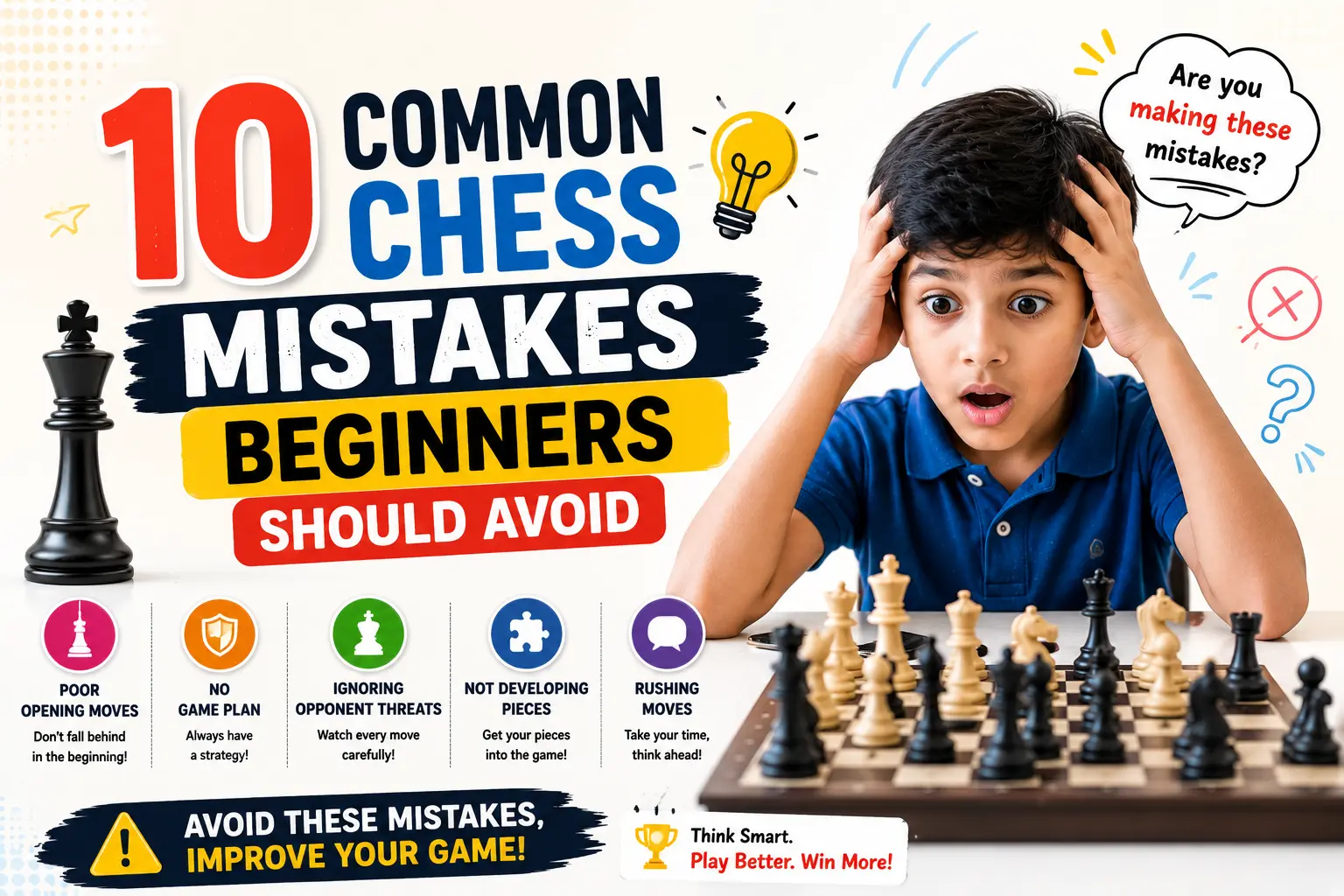
10 Common Chess Mistakes Beginners Should Avoid
Every grandmaster was once a beginner who blundered their queen on move six. If you have recently started your journey across the 64 squares, you have likely experienced the frustration of building a seemingly perfect position, only to lose it all to a hidden tactic. This is entirely normal. In fact, making errors is an essential part of the learning process. The secret to rapid improvement isn't achieving perfection immediately—it is identifying and fixing the common chess mistakes that are holding you back.
As experienced coaches, we watch hundreds of amateur games every week. Fascinatingly, novices across the world tend to fall into the exact same traps. When you understand these common chess mistakes, you can stop relying on luck and start playing with deliberate strategy. Every blunder is just a lesson in disguise.
In this comprehensive guide, we will break down the absolute most common chess mistakes beginners make. More importantly, we will explain exactly why they happen from a psychological standpoint, how you can fix them, and what practical habits will help you transform from a struggling novice into a confident club player. Let's dive in and start fixing your game!
Why Beginners Keep Making the Same Chess Mistakes
Before we look at the specific blunders on the board, we need to understand the root cause of these beginner chess mistakes. Why do intelligent people repeatedly make the same errors game after game?
- Lack of Pattern Recognition: Chess relies heavily on recognizing visual patterns (like forks and pins). Beginners simply haven't seen enough games yet to possess this mental library.
- Playing Too Quickly: Often referred to as "hope chess," beginners tend to make a move hoping their opponent won't see the threat, without taking the time to calculate their opponent's best reply.
- No Structured Training Plan: Playing thousands of rapid games online without reviewing them reinforces bad habits. You need a method to your madness.
- Poor Understanding of Fundamentals: Many players jump straight into complex opening theory before they understand basic principles like piece activity and king safety.
- Learning Without Guidance: Self-teaching is great, but without an experienced coach to point out recurring flaws, you might spend months repeating the same common chess mistakes.
If any of these sound familiar, don't worry. Acknowledging them is how you learn chess faster.
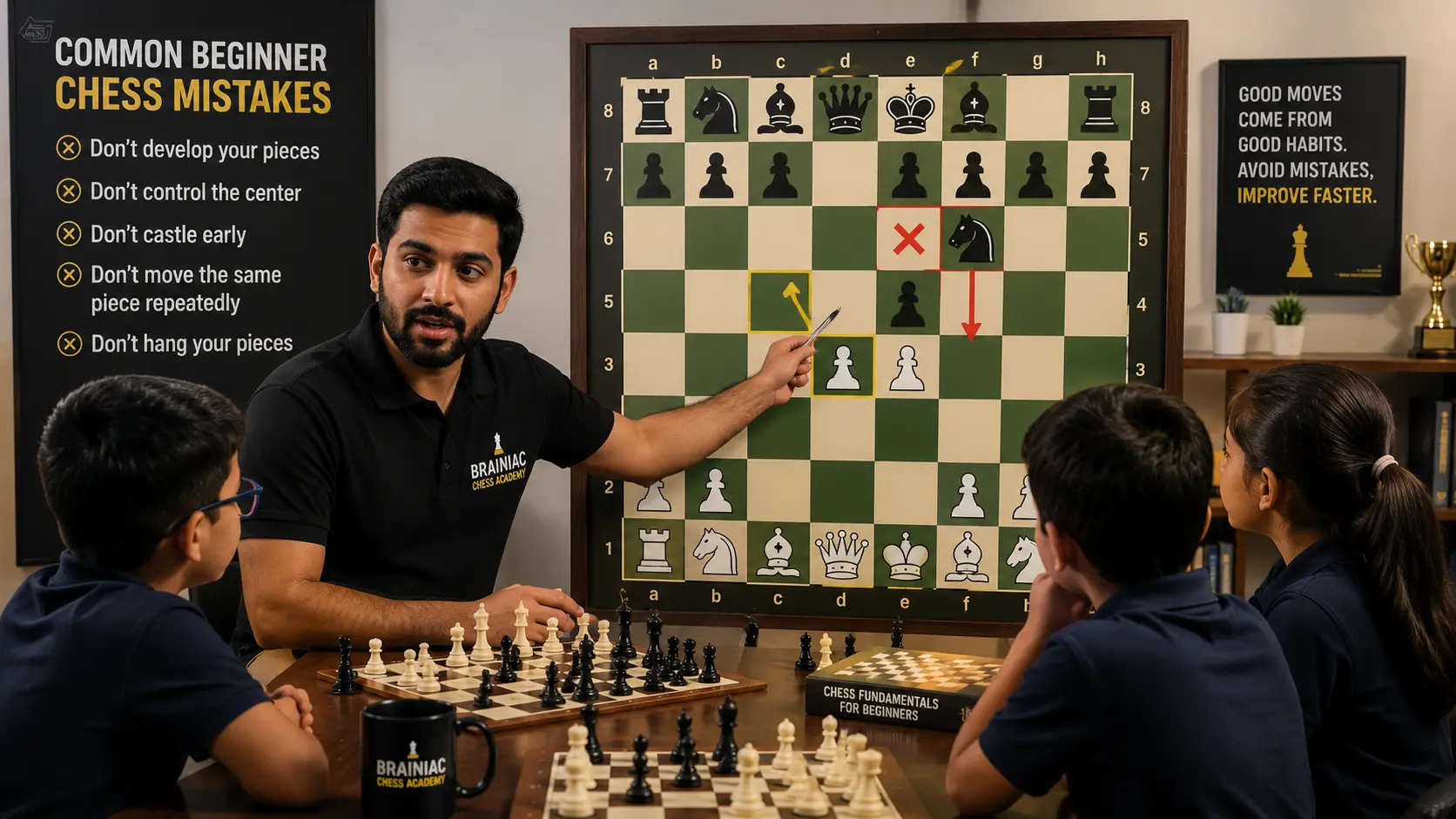
10 Common Chess Mistakes Beginners Should Avoid
Let’s examine the tactical and strategic errors that cost beginners the most games. If you can eradicate these ten common chess mistakes from your play, your rating will skyrocket.
1. Moving the Queen Too Early
Why beginners make it: The Queen is the most powerful piece on the board. Beginners naturally want to unleash her immediately to attack the opponent and deliver a quick "Scholar's Mate."
Why it is dangerous: When you bring your Queen out on move two or three, your opponent can develop their minor pieces (Knights and Bishops) while attacking your Queen at the same time. You are forced to waste valuable time retreating, giving your opponent a massive lead in development.
Example: Playing 1. e4 e5 2. Qh5. If black defends correctly with Nc6 and g6, the white Queen will be chased around the board.
How to avoid it: Leave your Queen at home during the opening. Develop your Knights and Bishops first.
Coach's Tip
Think of your Queen as the commander of an army. The commander doesn't charge into battle alone; she waits for the foot soldiers and cavalry to prepare the battlefield first.
2. Ignoring King Safety
Why beginners make it: Novices are often so focused on attacking their opponent's pieces that they completely forget to protect their own most vital asset—the King.
Why it is dangerous: Leaving your King in the center of the board while the center pawns are traded off invites devastating attacks. Most quick checkmates happen because a King was left stranded on its starting square.
How to avoid it: Castle early! Castling tucks your King away in a safe corner behind a wall of pawns and brings your Rook into the game simultaneously. It is one of the easiest ways to fix beginner chess mistakes.
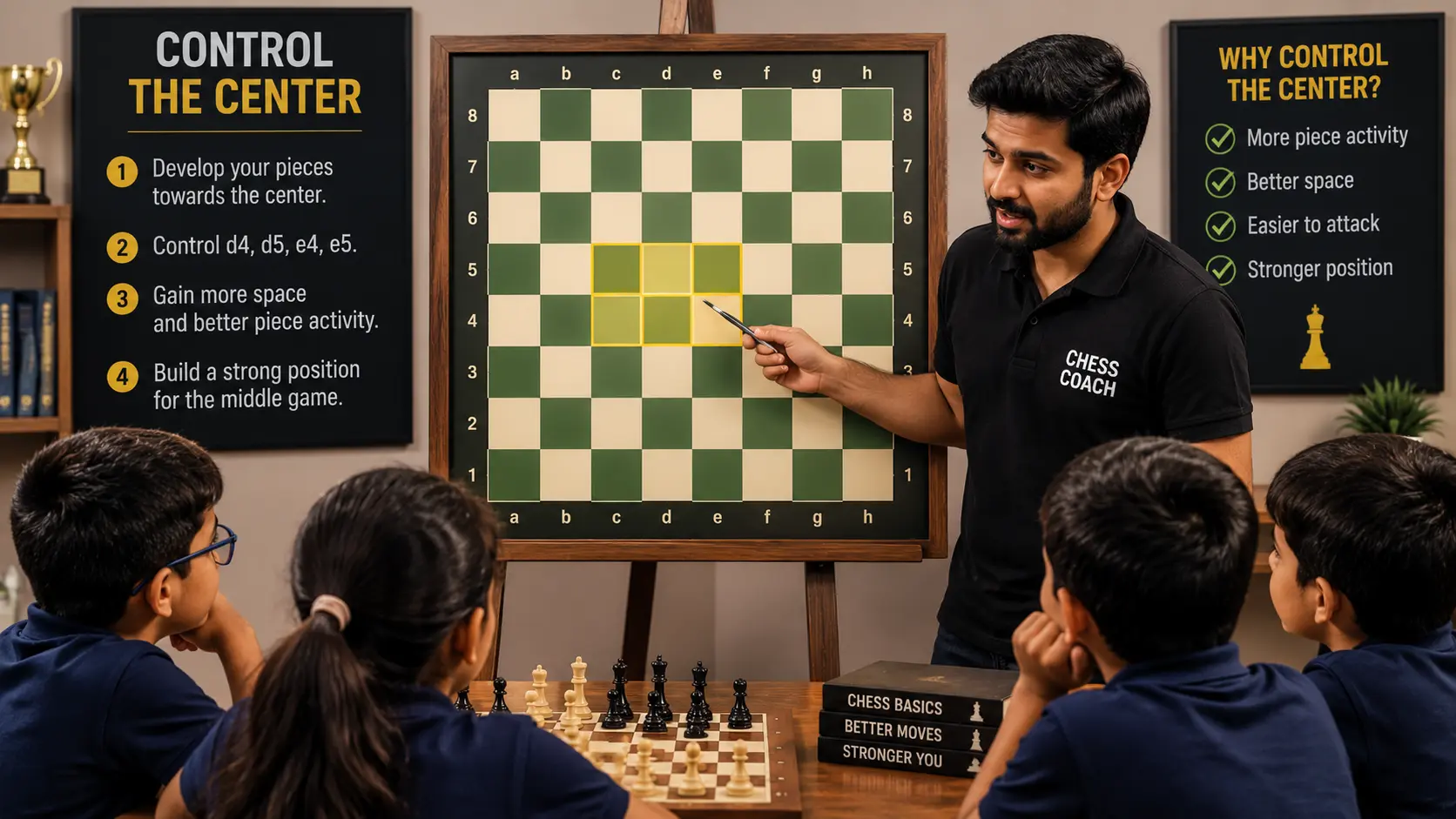
3. Not Controlling the Center
Why beginners make it: A beginner might push the edge pawns (a-pawn or h-pawn) because it feels safe, or they want to activate their Rooks quickly.
Why it is dangerous: The center of the board (squares e4, d4, e5, and d5) acts like the high ground in a battle. Whoever controls the center dictates the flow of the game. Pieces placed in the center attack more squares and can shift from defense to offense quickly.
How to avoid it: Start your games by placing pawns in the middle of the board and developing your Knights toward the center.
4. Developing Pieces Too Slowly
Why beginners make it: They spend the opening pushing too many pawns instead of bringing out their actual fighting pieces.
Why it is dangerous: In the opening phase, time (called "tempo") is everything. If you make 6 pawn moves while your opponent develops 3 Knights and Bishops, they will overwhelm you with piece activity.
How to avoid it: Follow the golden rule: Do not move a piece twice in the opening unless it is absolutely necessary or under attack.
5. Playing Too Fast
Why beginners make it: Adrenaline! It is exciting to blitz out moves, especially when playing online.
Why it is dangerous: Chess requires calculation. If you move instantly, you are relying on impulse rather than logic. This is the primary reason beginners leave pieces completely undefended (also known as "hanging a piece").
How to avoid it: Before every move, sit on your hands. Ask yourself: "What did my opponent's last move do? Is there a threat?" Taking just five extra seconds per move will prevent half of your common chess mistakes.
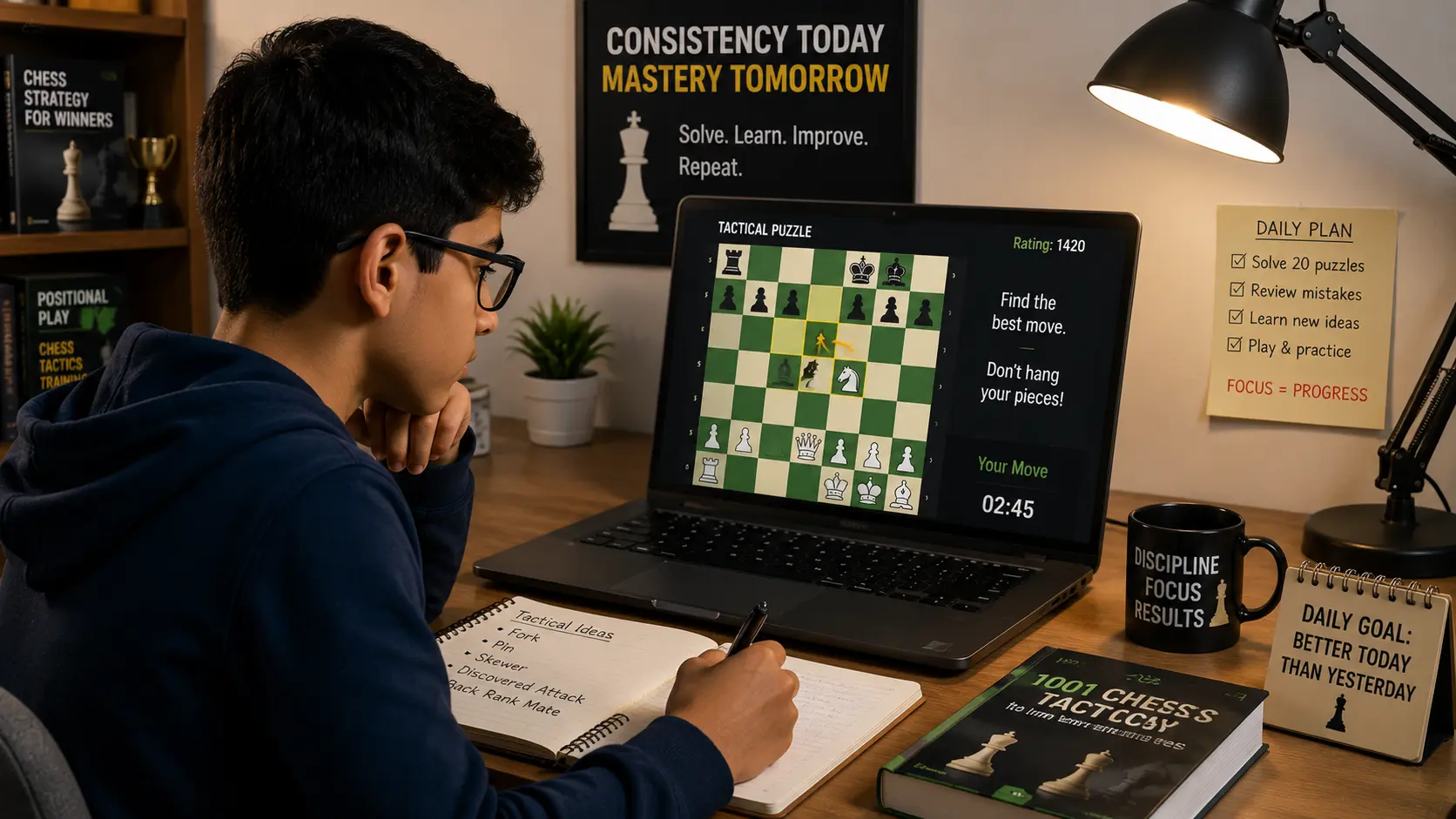
6. Missing Tactical Opportunities
Why beginners make it: They lack the pattern recognition to see forks, pins, and skewers. They focus only on their own plans and ignore the weaknesses in their opponent's position.
Why it is dangerous: You will miss out on free pieces or forced checkmates, allowing your opponent back into the game.
How to avoid it: Always look for checks, captures, and threats (CCT) on every single turn. This mental checklist is one of the best chess tips for beginners.
Coach's Tip
Look for "loose" pieces. A loose piece is any piece on the board that is not protected by another piece. Loose pieces are magnets for tactical combinations!
7. Ignoring Endgames
Why beginners make it: Endgames look boring because there are fewer pieces on the board. Beginners prefer studying flashy openings.
Why it is dangerous: You can play a brilliant opening and middle game, be up a full piece, and still draw or lose because you do not know how to checkmate with a King and Rook against a lone King.
How to avoid it: Learn the basic checkmating patterns first. If you know how to win a won game, you will confidently transition into the endgame.
8. Memorizing Openings Without Understanding
Why beginners make it: They watch a YouTube video about a "secret trap" and try to memorize 15 moves deep without understanding the logic behind the moves.
Why it is dangerous: The moment the opponent plays a move outside of your memorized sequence, you will be completely lost.
How to avoid it: Do not memorize lines; learn the *ideas* behind the opening. If you understand why a piece belongs on a certain square, you can find the right move even if you forget the theory.
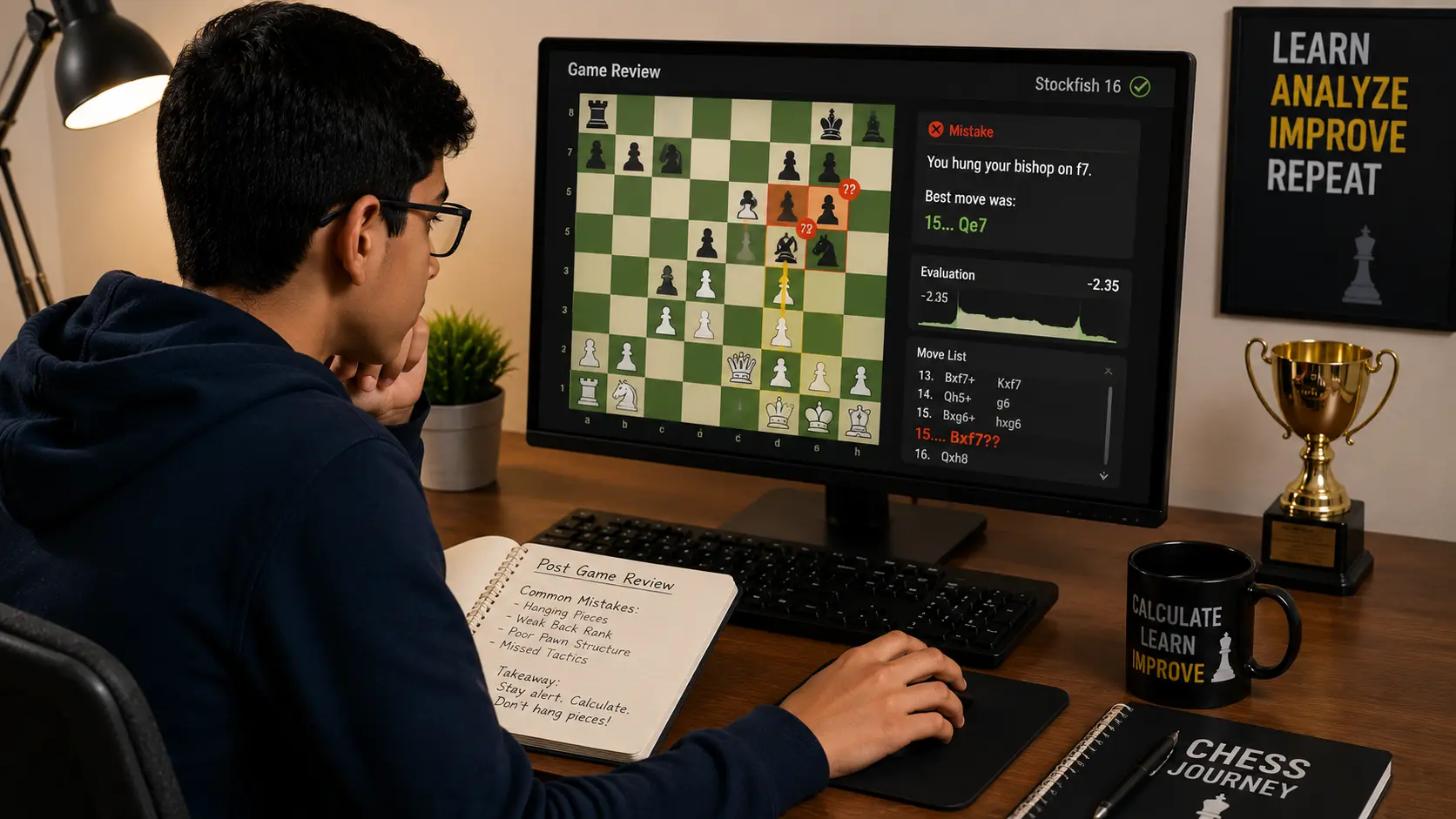
9. Not Analyzing Your Games
Why beginners make it: After a tough loss, the easiest thing to do is hit "New Game" and try to forget the pain of defeat.
Why it is dangerous: If you do not review your games, you will never know *why* you lost, guaranteeing you will repeat the exact same common chess mistakes tomorrow.
How to avoid it: Spend at least 5 minutes after every game reviewing your critical mistakes. Use a computer engine to see where you blundered.
10. Giving Up Too Early
Why beginners make it: They lose a Knight early on and resign immediately, feeling embarrassed or defeated.
Why it is dangerous: You strip yourself of the opportunity to practice defensive resilience. At the beginner level, blunders happen constantly on both sides.
How to avoid it: Fight on! Even if you are losing, look for ways to complicate the position. Make it as difficult as possible for your opponent to win. You will be surprised how often they blunder back.
Chess Tips for Beginners to Improve Faster
Now that we have diagnosed the problems, how do we fix them? If you want to learn chess faster, passive reading isn't enough. You need to apply active training methods. Here are foundational chess tips for beginners to implement today:
- Solve puzzles daily: Tactics are the vocabulary of chess. Doing 15 minutes of puzzles every day builds crucial pattern recognition.
- Analyze games: Reviewing your own mistakes is the single fastest way to improve.
- Learn opening principles: Focus on controlling the center, developing minor pieces, and castling, rather than memorizing exact variations.
- Study basic endgames: Mastering King and Pawn endgames will give you immense confidence in simplifying winning positions.
- Play longer games: Stop playing 3-minute blitz. Play 15-minute or 30-minute games where you actually have time to think and avoid impulsive common chess mistakes.
- Learn from stronger players: Watching grandmaster games or joining an academy exposes you to high-level strategic concepts.
If you are looking for a complete guide on how to structure your learning, we highly recommend reading our guide on Chess Classes for Beginners: A Complete Guide to Learn Chess from Scratch.
Daily Habits That Help You Learn Chess Faster
Consistency is key. You do not need to study for 5 hours a day to see results. A structured, focused 1-hour routine is much more effective than sporadic cramming. Here is a sample daily training schedule to help you eliminate common chess mistakes:
| Chess Activity | Time Allocation | Primary Goal |
|---|---|---|
| Tactical Puzzles | 20 mins | Stop hanging pieces and spot basic forks/pins. |
| Practice Game (Rapid) | 25 mins | Apply concepts in a real, slow-paced game. |
| Game Analysis | 10 mins | Review the game you just played to find the critical blunder. |
| Endgame / Opening Study | 5 mins | Learn one new checkmate pattern or opening principle. |
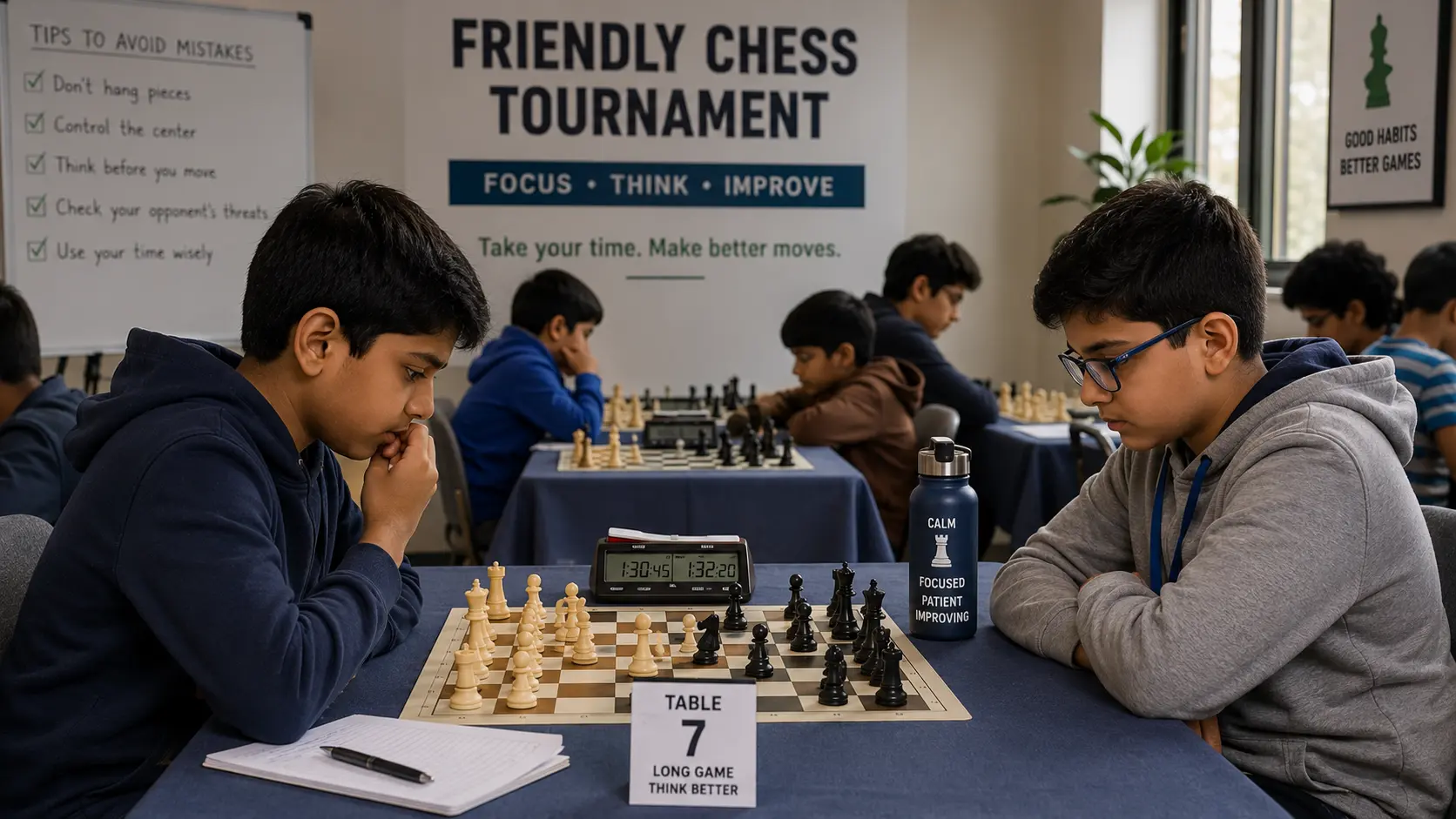
How Professional Coaching Helps Beginners Avoid Mistakes
While self-study is great, nothing accelerates your progress like professional coaching. Trying to figure out common chess mistakes on your own is like trying to fix a car engine without a manual.
An experienced coach provides a structured curriculum tailored to your exact weaknesses. Instead of wondering what you should study today, your coach tells you exactly what to focus on. They offer personalized feedback on your games, pointing out the subtle strategic errors that a computer engine cannot explain in plain English.
Furthermore, regular coaching builds discipline. Knowing you have a session coming up encourages you to finish your homework and practice consistently. If you are serious about improving, check out Why Chess Classes Are a Must for Every Learner (Especially Kids & Beginners) to see how formal education bridges the gap between amateur and expert.
Why Choose Brainiac Chess Academy?
At Brainiac Chess Academy, our mission is to make learning chess accessible, structured, and incredibly fun. We specialize in taking absolute beginners and transforming them into confident, strategic thinkers.
Our programs feature Experienced Coaches who possess a deep understanding of how novices learn. We maintain Small Batch Sizes to ensure every single student receives the Personalized Coaching they deserve. We don't just teach moves; we teach the logic behind the game.
Whether you are looking for interactive Online Chess Classes from the comfort of your home or engaging Offline Chess Coaching at our center, we have a Beginner Friendly Curriculum designed for your success. We also provide Tournament Preparation for those ready to take their skills to the competitive arena.
Book Your Free Demo Class
Ready to avoid common chess mistakes and improve faster?
Brainiac Chess Academy offers structured online and offline coaching designed for beginners, helping students build strong fundamentals through expert guidance and personalized feedback.
📞 Call / WhatsApp: +91 9324829329
👉 Book Your Free Demo Right Now
Frequently Asked Questions
What are the most common chess mistakes?
Why do beginners lose so often?
How can I stop blundering?
Should beginners memorize openings?
How can I improve chess quickly?
Is online coaching effective?
How often should beginners practice?
Do chess coaches help improve faster?
Conclusion
Chess is a journey of continuous learning. Recognizing that you are making these common chess mistakes is not a sign of failure; it is the very first step toward mastery. By focusing on king safety, controlling the center, taking your time, and reviewing your games, you will stop handing free victories to your opponents. Remember, the goal isn't to play a perfect game tomorrow—it is to make one less blunder today.
Focus on steady improvement, cultivate good training habits, and do not be afraid to seek professional guidance. At Brainiac Chess Academy, we are dedicated to helping you unlock your full potential on the board. The international chess community is vast and rewarding, and your first brilliant victory is just around the corner.