How to Stay Motivated While Learning Chess

I remember sitting with a student who was on the verge of tears. He had just lost his fifth rapid game in a row online. "I'm never going to get better," he said, pushing his chair back. "I keep making the same blunders. I think I should just quit." If you have ever felt this way, you are not alone. Figuring out how to Stay Motivated in Chess is arguably the hardest skill to master, even more challenging than memorizing complex opening theory or calculating deep endgames.
As a FIDE-rated chess coach and sports psychologist, I have guided hundreds of students through this exact emotional slump. The truth is, every single grandmaster in the world has experienced painful losing streaks, shattered confidence, and agonizing rating drops. It is an unavoidable part of the game.
If you are struggling to Stay Motivated in Chess, this guide is for you. In this comprehensive article, we will break down why players lose their drive, how to set achievable Chess Goals, and provide practical, daily strategies to help you navigate your Chess Improvement Journey without burning out.
Why Many Chess Players Lose Motivation
Before we can fix a lack of motivation, we have to understand where it comes from. Learning chess is intellectually demanding, and the feedback loop can be brutally honest. Here are the most common reasons players hit a mental wall:
- Losing Streaks: Chess is a zero-sum game. When you lose, there is no one to blame but yourself. A streak of 5 or 10 losses can make you feel entirely incompetent.
- Rating Drops: Watching your hard-earned ELO rating plummet in a single afternoon triggers anxiety and a fear of playing again.
- Unrealistic Expectations: Expecting to become a master in six months is a recipe for disappointment. Slow improvement is normal.
- Comparing Yourself With Stronger Players: Looking at prodigies on Chess.com and wondering why you aren't progressing as fast as they are.
To Stay Motivated in Chess, you must first accept that these challenges are entirely normal. Plateaus are not a sign that you have stopped learning; they are a sign that your brain is consolidating new information.
10 Practical Ways to Stay Motivated in Chess
Motivation is not a magical feeling that you wake up with; it is a habit you cultivate. Here are ten actionable strategies you can use today to Stay Motivated in Chess.
1. Set Small Weekly Goals
Why it works: Focusing purely on your rating is dangerous because you cannot always control the outcome of a game. Setting process-oriented Chess Goals keeps you in control of your success.
Practical example: Instead of saying "I will reach 1200 rating this week," say "I will solve 15 puzzles every day this week."
Common mistake to avoid: Setting arbitrary rating targets that induce anxiety.
Coach's Tip
Success in chess is about controlling the controllables. You control your effort, not your opponent's brilliance.
2. Celebrate Small Wins
Why it works: To Stay Motivated in Chess, your brain needs dopamine hits from positive reinforcement, not just from checkmates.
Practical example: Pat yourself on the back for spotting a hidden tactic, even if you eventually lost the game in the endgame.
Common mistake to avoid: Only celebrating when you win a tournament or gain 50 rating points.
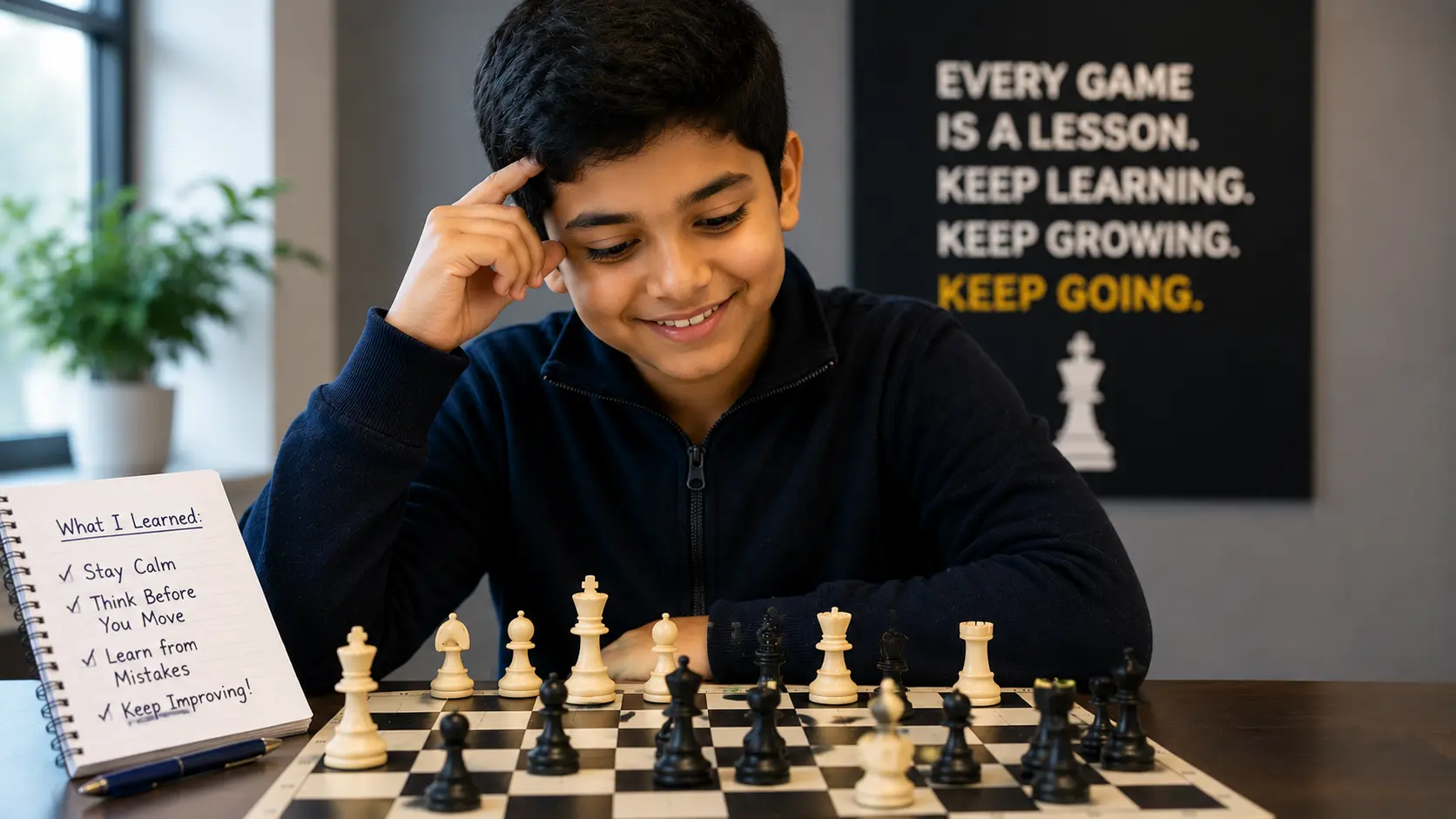
3. Focus on Learning, Not Rating
Why it works: Rating is a byproduct of skill. If you chase skill, the rating will naturally follow. This mindset shift is essential for a healthy Chess Improvement Journey.
Practical example: After a loss, focus entirely on the one opening mistake you made, completely ignoring the -8 rating points on the screen.
Common mistake to avoid: Playing "just one more game" to win back lost rating points (tilt playing).
4. Analyze Every Game
Why it works: Ignorance breeds frustration. If you don't know why you lost, you will feel helpless. Analysis gives you actionable data.
Practical example: Use an engine to identify your first major blunder in a game, and write down the reason you made it.
Common mistake to avoid: Only analyzing games you lost, or relying entirely on the computer without using your own brain first.
5. Practice Tactical Puzzles
Why it works: Solving puzzles provides immediate, low-stress satisfaction. It is a fantastic way to Stay Motivated in Chess when you don't have the mental energy for a full game.
Practical example: Dedicate 20 minutes a day to a puzzle rush or targeted tactical themes (like pins and skewers).
Common mistake to avoid: Guessing puzzle moves quickly rather than calculating until the end.
6. Play Different Time Controls
Why it works: Burnout often comes from monotony. Mixing up your play style keeps the game fresh and exciting.
Practical example: If you are exhausted from intense 30-minute classical games, switch to learning Rapid Chess vs Classical Chess for a week to lighten the mood.
Common mistake to avoid: Playing too much 1-minute bullet chess, which ruins your deep calculation skills.
7. Join Friendly Tournaments
Why it works: Chess can be lonely. Engaging with a community reminds you that it is, at its core, a social game meant to be enjoyed.
Practical example: Participate in unrated club tournaments where the focus is on fun and post-game discussions.
Common mistake to avoid: Treating every casual club game like it is the World Championship final.
8. Learn From Strong Players
Why it works: Inspiration is contagious. Watching grandmasters play or receiving Chess Coaching shows you the beautiful possibilities of the game.
Practical example: Watch YouTube analysis of famous historical games, like Kasparov's immortal game, to reignite your passion.
Common mistake to avoid: Trying to blindly copy a grandmaster's complex opening without understanding the basic principles behind it.
9. Maintain a Training Routine
Why it works: Motivation is fickle, but discipline is reliable. When you don't feel like playing, a routine carries you forward, helping you Learning Chess Faster.
Practical example: Follow a strict Chess Practice Routine at the same time every day, treating it like going to the gym.
Common mistake to avoid: Cramming 5 hours of study into Sunday and doing nothing the rest of the week.
10. Enjoy the Journey
Why it works: If you only care about the destination (becoming a master), the decades of work it takes to get there will be miserable. You must learn to love the process to truly Stay Motivated in Chess.
Practical example: Smile when your opponent plays a brilliant tactic against you. Appreciate the beauty of the geometry.
Common mistake to avoid: Tying your self-worth and happiness to your chess results.
Coach's Insight
A true Chess Improvement Journey is non-linear. You will have weeks where you feel like a genius, and weeks where you feel like you've forgotten how the knight moves. Embrace both phases.
How to Set Realistic Chess Goals
Setting the right targets is the foundation of mental resilience. If your goals are impossible, you will constantly feel like a failure. Here is how to reframe your Chess Goals for a healthier mindset.
| Unrealistic Goal (Avoid) ❌ | Better Goal (Focus On) ✅ | Why It's Better |
|---|---|---|
| Gain 300 rating in one month | Improve tactical accuracy by 10% | You control your puzzle practice, but you can't guarantee your opponents will make mistakes. |
| Win every game this weekend | Learn one new lesson from every game | Removes the anxiety of losing and frames every game as a win-win educational experience. |
| Memorize 20 moves of theory | Understand the core opening principles | Memorization fades under pressure; understanding survives. It aids in Learning Chess Faster. |
| Never lose to a lower-rated player | Reduce one-move blunders | Everyone blunders occasionally. Focusing on reducing them is achievable and measurable. |
Building a Successful Chess Improvement Journey
To Stay Motivated in Chess over the course of years, you need to view your progress as a marathon, not a sprint. A successful Chess Improvement Journey requires immense consistency and a long-term mindset.
Keep a physical journal to track your progress. Write down the dates you learned a new opening, the day you finally understood opposition in pawn endgames, and the days you overcame a tough losing streak. Reviewing these past struggles and realizing how far you have come is incredibly empowering.
Remember that learning from mistakes is the only vehicle for progress. If you are afraid to lose, you are afraid to learn. Embrace the discipline chess builds, and trust the process.
Learning Chess Faster Without Feeling Overwhelmed
Many beginners think Learning Chess Faster means studying 12 hours a day. In reality, that just leads to severe burnout and a total loss of motivation. Efficiency beats volume every time.
Create a balanced daily study routine. Dedicate 30% of your time to puzzles, 50% to playing and analyzing slow games, and 20% to studying endgames and opening principles. Ignore hyper-specific grandmaster opening lines; they are irrelevant for beginners.
To ensure you Stay Motivated in Chess, schedule a mandatory "Weekly Review" every Sunday. Look over your best game and your worst game of the week, write down three key takeaways, and then step away from the board.
Common Motivation Mistakes Players Make
Even with the best intentions, players often sabotage their own drive. If you are struggling to Stay Motivated in Chess, ensure you are not falling into these traps:
- Playing only blitz: Fast time controls are fun but terrible for deep learning, leading to plateau-induced frustration.
- Obsessing over ratings: Checking your live ELO after every single move is a recipe for a panic attack.
- Skipping game analysis: Moving to the next game immediately after a loss guarantees you will repeat the same mistake.
- Studying too much theory: Reading books on the Sicilian Najdorf when you are a beginner will overwhelm you and kill your joy for the game. Start with Beginner Chess Lessons first.
Coach's Weekly Motivation Plan
Structure is the antidote to a lack of motivation. Use this balanced 7-day plan to ensure your Chess Improvement Journey remains engaging and stress-free.
| Day | Activity | Focus Area |
|---|---|---|
| Monday | Tactical Puzzles (20 mins) | Pattern recognition and calculation without the stress of a clock. |
| Tuesday | 1 Rapid Game + Deep Analysis | Applying mistake-avoidance in a real-game scenario. |
| Wednesday | Opening Study (15 mins) | Reviewing the first 5 moves of your favorite white opening. |
| Thursday | Endgame Practice | Mastering basic checkmates (King + Rook vs King). |
| Friday | Watch a Master Game | Inspiration and understanding grandmaster strategic plans. |
| Saturday | Tournament Practice | Playing a slightly longer game to build mental endurance. |
| Sunday | Weekly Review & Goal Setting | Reflecting on mistakes and setting fresh Chess Goals for next week. |
Why Choose Brainiac Chess Academy?
Trying to navigate your Chess Improvement Journey entirely alone can be daunting. At Brainiac Chess Academy, we specialize in helping students overcome plateaus, rebuild their confidence, and genuinely enjoy the learning process.
Our Expert Coaches provide Personalized Feedback that software engines simply cannot offer. We identify your psychological weaknesses and tactical blind spots, creating a Goal-Oriented Learning path specifically for you.
We are proud to offer comprehensive Offline Coaching in Navi Mumbai, alongside top-tier online programs like our Chess Classes Online Delhi and Online Chess Academy Hyderabad. As part of a Chess Academy Worldwide network, we maintain Small Batch Sizes to ensure every student from absolute beginner to advanced tournament player gets the attention they deserve.
Book Your Free Demo Class
Whether you're a beginner struggling with blunders or an advanced player preparing for tournaments, staying motivated becomes significantly easier with expert guidance and structured learning.
Brainiac Chess Academy helps students stay consistent, track progress, and fall in love with the game through personalized coaching.
📞 Contact Us: +91 9324829329
👉 Book Your Free Demo Right Now
Frequently Asked Questions
How do I stay motivated in chess?
Why do I lose motivation after losing games?
How long does it take to improve?
Should I play every day?
What are realistic chess goals?
How can I improve faster?
Is online coaching effective?
Can adults improve at chess?
Conclusion
Chess is a beautiful, complex, and sometimes frustrating game. If you can learn to manage the psychological highs and lows, the resilience you build on the board will positively impact every other area of your life. To truly Stay Motivated in Chess, you have to let go of perfectionism. Forgive yourself for blundering a queen, learn the lesson hidden in the mistake, and set up the board again tomorrow.
Your Chess Improvement Journey is uniquely yours. Embrace the slow climb, celebrate your growing understanding, and lean on the support of a good community and dedicated coaches when you hit a wall.
If you are ready to reignite your passion for the game and start learning with structure and purpose, Brainiac Chess Academy is here to support you. Let's make your chess journey incredible, together.