










Can Kids Learn Chess Online from a Coach in Another Country?
An honest, educational breakdown for parents evaluating international online chess coaching—covering time zones, communication, digital tools, and trust.
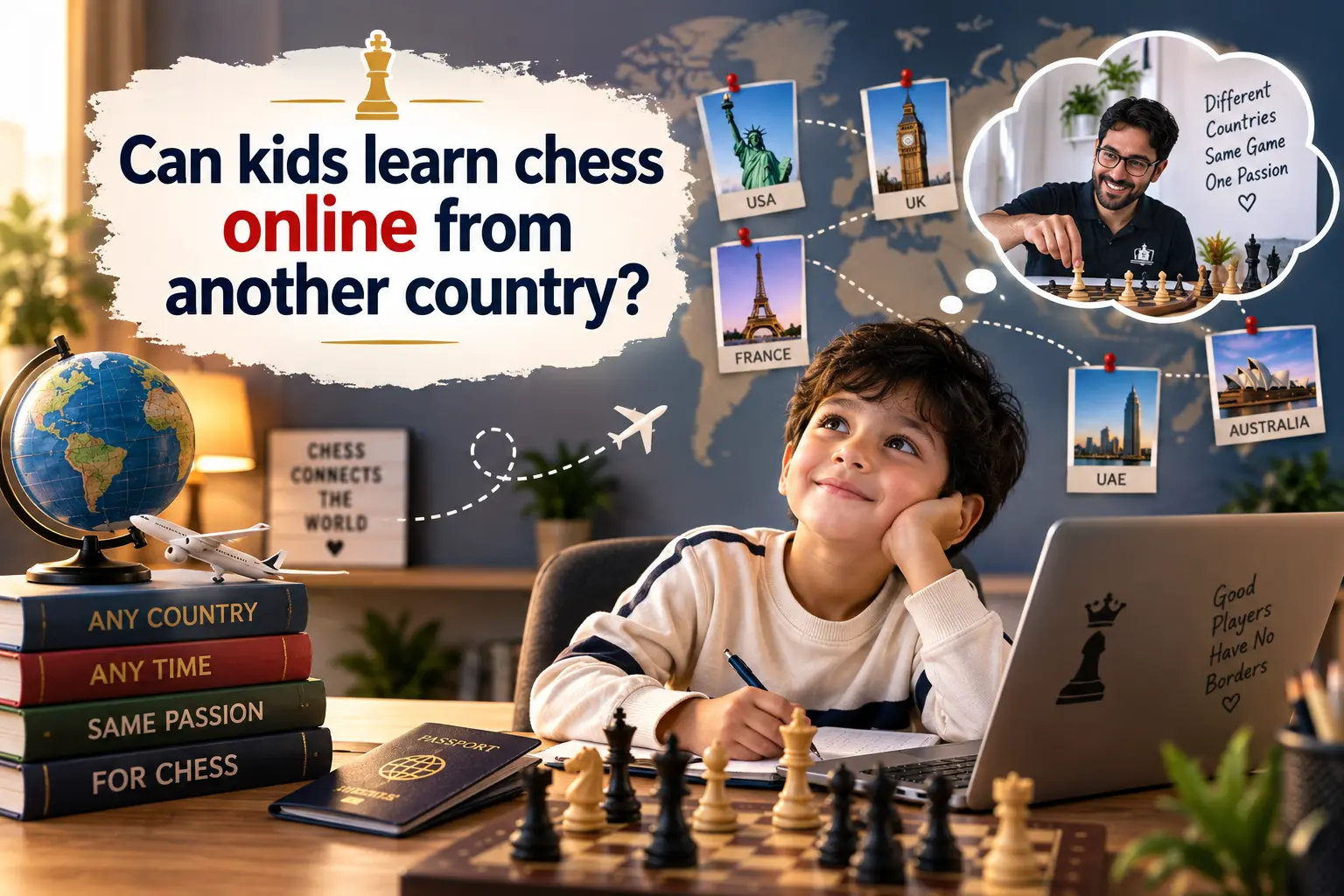
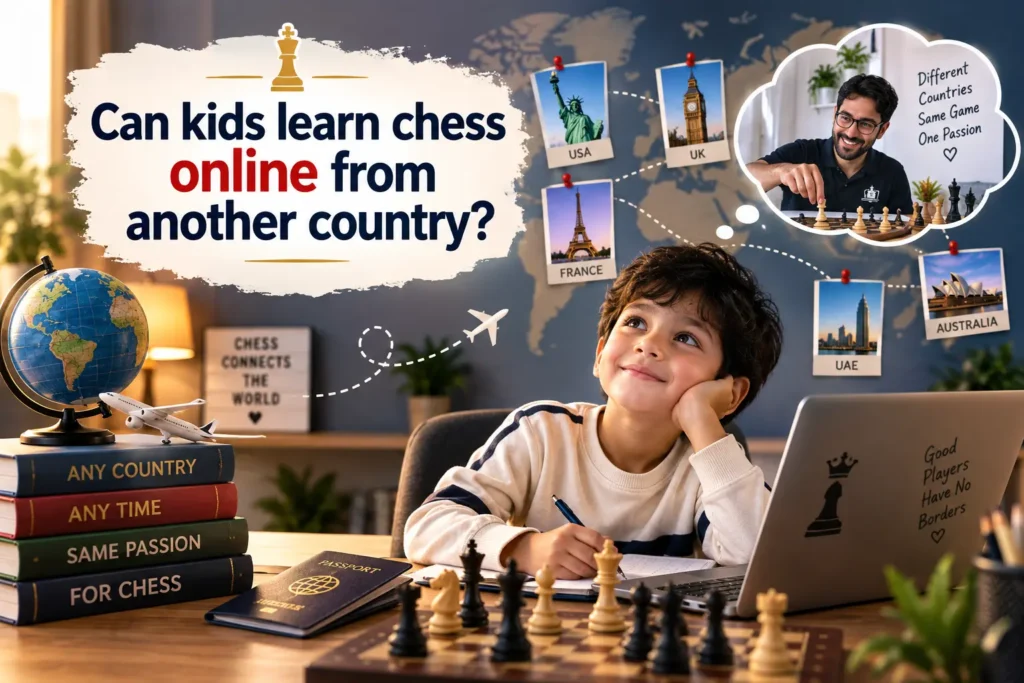
When parents consider enrolling their child in structured chess training, they often face a common practical barrier: local coaching options may be limited, inconveniently located, or mismatched with the family's schedule. Naturally, this leads to a fundamental question: Can my child really learn chess online from a coach who lives in another country?
It is completely normal to feel hesitant. Parents naturally wonder whether a remote instructor across the globe can keep a child engaged, explain complex tactical ideas clearly, or adjust to local time differences. The short answer is yes—when supported by interactive digital tools, a structured curriculum, and clear communication, children can comfortably learn chess online from another country without sacrificing instructional quality.
Modern virtual learning platforms allow students and coaches to connect seamlessly through real-time video feeds, shared digital chessboards, interactive exercises, and structured assignment tracking. However, success depends heavily on how the coaching program is designed. In this guide, we break down how cross-border chess coaching operates, what technology makes it work, how time zones are managed, and how you can evaluate whether this learning model is right for your child.
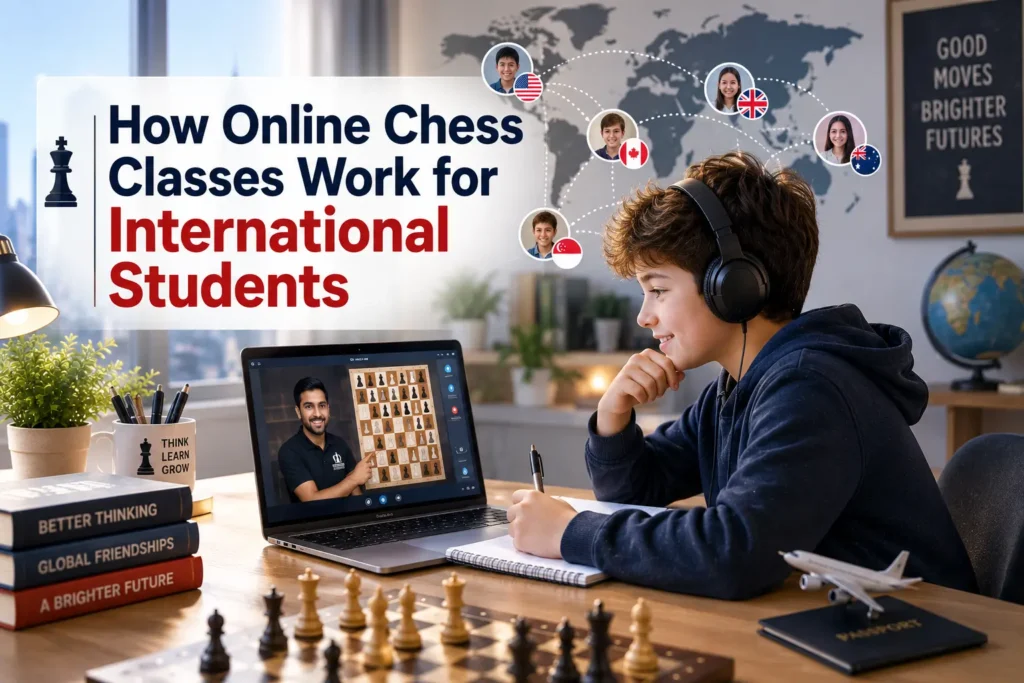
Yes, children can effectively learn chess online from a coach in another country. International online chess coaching succeeds when coaches utilize live video, interactive digital chessboards, structured progress tracking, and flexible scheduling that respects your local time zone. Success relies on clear communication, engaging lessons, and consistent home practice rather than physical proximity.
Can Kids Really Learn Chess Online from a Coach in Another Country?
Physical distance does not dictate the quality of chess instruction. Unlike sports that require physical presence on a field, chess is fundamentally an intellectual and visual game. Every element of traditional over-the-board training—demonstrating piece maneuvers, analyzing past games, solving tactical puzzles, and playing practice matches—translates smoothly into digital environments.
For children, effective learning depends primarily on active engagement rather than sitting in the same room as an instructor. When an international chess coach uses shared boards where pieces move in real time, children do not merely watch a lesson; they actively participate by moving pieces, testing variations, and receiving immediate feedback.
Furthermore, remote learning removes geographic limitations. Parents are no longer restricted to local instructors who may lack experience in youth coaching. Instead, families can connect with structured academies that offer dedicated curriculums designed specifically for young learners, regardless of where the coach is located.
How Does International Online Chess Coaching Work?
Understanding the operational flow helps parents know what to expect. Professional international online chess coaching follows a systematic process designed to make learning structured, transparent, and manageable for families across different countries.
Enquiry & Skill Evaluation
The journey begins with an initial evaluation where a coach assesses the student's current understanding, tactical familiarity, and concentration level.
Level & Batch Placement
Students are placed into appropriate learning tracks—such as Absolute Beginner, Elementary, Intermediate, or Advanced—to ensure learning stays well-paced.
Time-Zone Alignment
Class schedules are coordinated to match local after-school hours or weekend mornings in the family's home country.
Live Interactive Training
Students log into virtual classrooms featuring shared interactive chessboards, live video, and real-time exercise solving.
Following live sessions, coaches assign targeted weekly homework, evaluate practice games played on safe online platforms, and share progress updates with parents. Families living in North America, for instance, frequently explore online chess classes in Canada to see how remote coaching aligns with local academic calendars.
Does the Coach Need to Be in the Same Country as the Child?
A coach's physical location is far less important than their teaching ability, patience, and curriculum structure. While local coaches offer in-person presence, they may not always possess specialized experience in youth pedagogy or structured opening and endgame curriculums.
When evaluating chess training options, parents should distinguish between location and instruction quality. Key factors to evaluate include:
- Youth Coaching Experience: Has the coach successfully taught children of similar age and skill levels?
- Communication Clarity: Does the coach explain strategic ideas using simple, encouraging language?
- Structured Curriculum: Is there a clear syllabus moving from fundamental piece values up to complex positional planning?
- Class Interaction: Are sessions interactive, or does the coach spend most of the time lecturing?
- Systematic Feedback: Does the coach review student games played outside of class hours?
An experienced remote chess coaching setup often offers greater structure than informal local clubs, ensuring your child makes steady, measurable progress regardless of international borders.
For younger children, the quality of communication matters just as much as chess expertise. A great coach knows how to translate abstract concepts—like pawn structure or piece activity—into simple stories and visual metaphors that keep young minds focused.
How Do Different Time Zones Work?
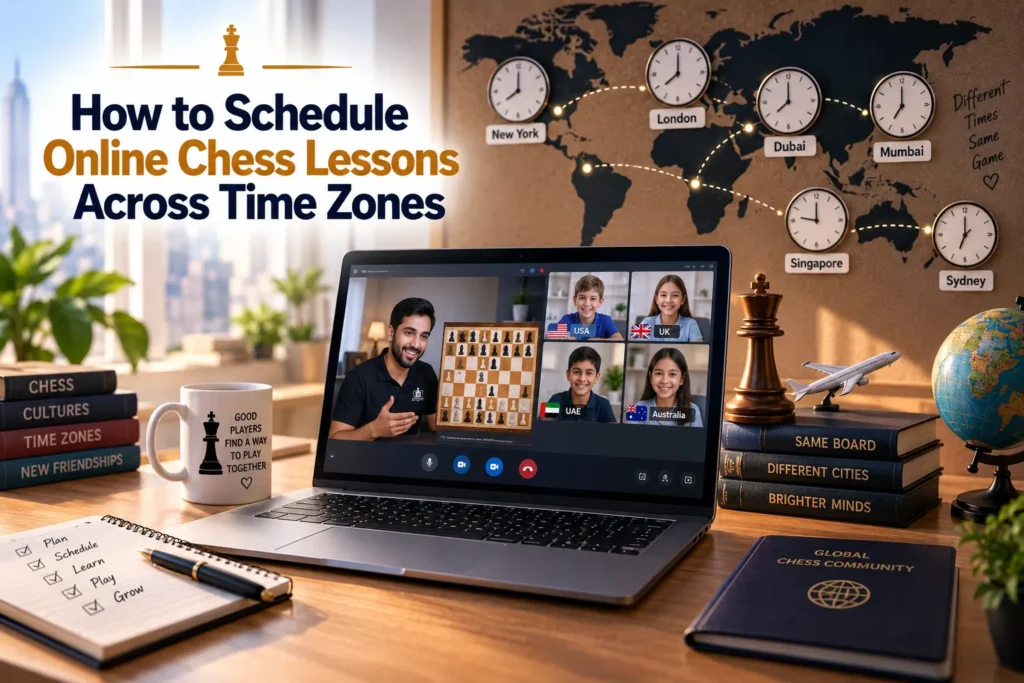
Time-zone coordination is often the primary operational concern for parents considering global chess classes. Because a coach in Asia, Europe, or South America operates on a different clock than a student in North America or Australia, scheduling requires clear organization.
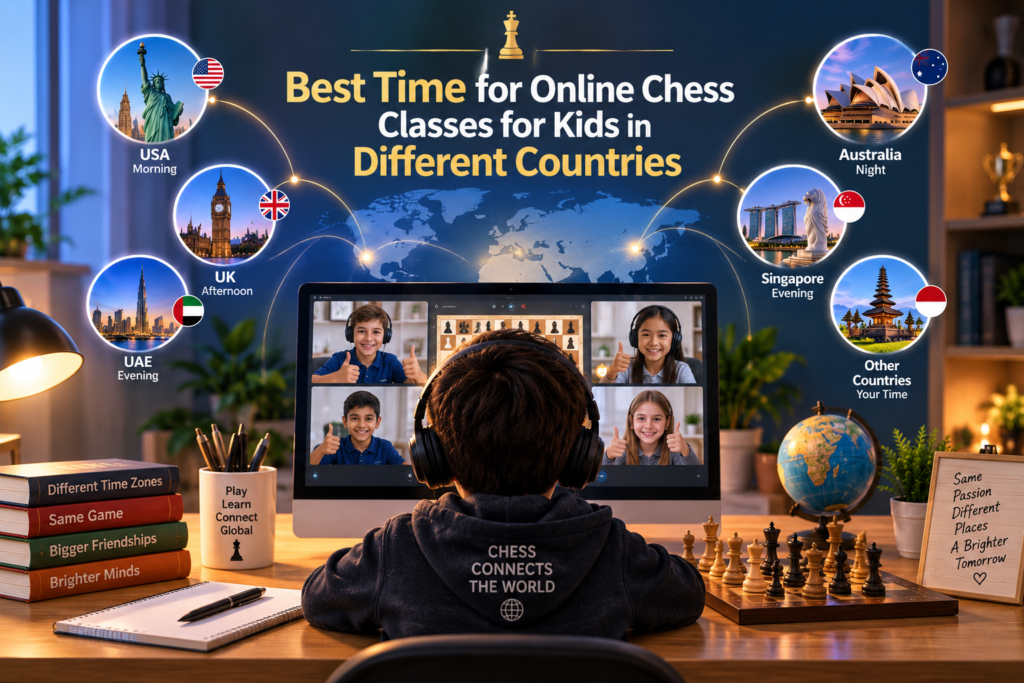
Professional international academies handle time zones by managing dedicated morning, evening, and weekend batch schedules tailored specifically to major global regions:
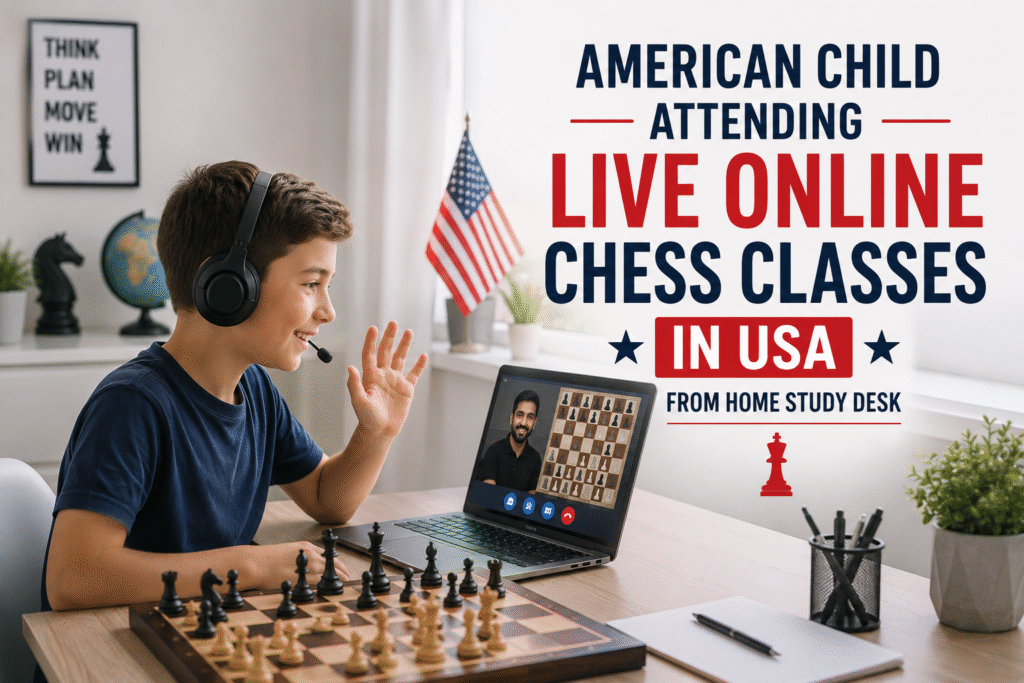
- United States & Canada (EST, CST, PST): Classes are commonly scheduled for late afternoons after school or on weekend mornings. Families can check options for online chess classes in the USA to see how batch timings match local routines.
- United Kingdom & Europe (GMT/BST, CET): Sessions typically run in the mid-afternoon or early evening. Parents exploring online chess classes in the UK can choose slots that do not conflict with secondary school schedules.
- Middle East & Gulf Region (GST): Evening batches fit comfortably after school hours.
- Australia & New Zealand (AEST/AWST): Weekend morning sessions or early evening slots provide convenient access. Our guide on online chess classes in Australia details how flexible scheduling supports Australian students.
Brainiac Chess Academy is physically located in Navi Mumbai, Maharashtra, India, and delivers live online coaching to international students around the world. By operating batches across multiple time zones, academies ensure children attend classes when they are fresh and alert, rather than late at night.
How Do Kids Communicate With an International Chess Coach?
Effective communication is the foundation of remote learning. Modern video conferencing software combined with interactive chessboard web applications allows seamless interaction between coach and student.
During a typical online lesson, communication happens through multiple integrated channels:
- Audio & Video Streams: High-definition video allows the coach and student to see facial expressions, maintaining an encouraging personal connection.
- Shared Interactive Boards: Both student and coach can drag pieces across the board. The coach can highlight key squares or draw tactical arrows to explain ideas visually.
- Real-Time Problem Solving: The coach sets up a puzzle position, and the student solves it live while explaining their reasoning aloud.
- Direct In-Class Chat: Useful for sharing game links, notation notes, or specific tactical puzzles during class.
For students in fast-paced educational environments, programs such as online chess classes in Singapore demonstrate how interactive digital communication maintains high engagement levels among young learners.
What Does a Child Need to Learn Chess Online?
Setting up a home learning environment for online chess requires minimal specialized hardware. Most families already own the necessary equipment.
Computer or Tablet
A desktop computer or laptop with a mouse is ideal for easy board navigation. Tablets are also suitable for younger children.
Stable Internet Connection
A standard broadband connection ensures smooth video streaming and lag-free piece movements on digital boards.
Webcam & Microphone
Built-in or external cameras and microphones allow two-way communication and active participation during lessons.
Quiet Learning Space
A distraction-free desk environment helps children maintain focus during tactical calculations and analysis.
While lessons take place digitally, having a physical chessboard at home is beneficial. Setting up training positions on a real board between classes helps solidify spatial awareness for future over-the-board play.
Can Beginners Take Online Chess Lessons From an International Coach?
Yes, absolute beginners adapt to virtual coaching very quickly. In fact, digital chessboards often make learning the basic rules easier because computer software prevents illegal piece moves automatically, giving young children instant visual reinforcement.
A structured curriculum for online chess lessons for kids who are complete beginners typically covers:
- Board Setup & Square Coordinates: Learning ranks, files, and board orientation.
- Piece Movements & Values: Understanding how each piece captures and its relative point value.
- Fundamental Rules: Mastering check, checkmate, stalemate, castling, and en passant.
- Basic Tactical Patterns: Identifying single-move forks, pins, and skewers.
- Opening Principles: Controlling the center, developing pieces quickly, and keeping the king safe.
By starting with simple visual exercises, a skilled international chess coach helps young beginners build confidence before introducing deeper strategic concepts.
When a child is learning chess remotely, consistency beats lesson length every time. Two 45-minute structured sessions per week combined with 10 minutes of daily puzzle solving yield far better long-term retention than a single long weekend lecture.
How Is a Child's Progress Tracked Online?
Evaluating progress in chess involves much more than watching a rating number fluctuate on a website. Rating points vary across platforms and are not always an accurate reflector of a child's growing strategic understanding.
Responsible remote academies track measurable skill indicators, including:
- Tactical Accuracy: The percentage of thematic puzzles solved correctly during timed practice drills.
- Calculation Quality: The ability to analyze two or three moves ahead accurately before choosing a line.
- Blunder Frequency: A steady decrease in accidental piece giveaways during weekly games.
- Endgame Execution: Confidence in converting winning material advantages into checkmate using structured techniques.
- Game Analysis Reflection: The student's ability to explain why a past move was weak during post-game review sessions.
Regular feedback reports sent to parents ensure families stay informed about strengths, areas for improvement, and upcoming learning goals.
Can Online Chess Training Work Without a Parent Sitting Beside the Child?
Parental involvement naturally shifts based on a child's age, attention span, and technical independence. Chess training online is designed to foster independent thinking, but initial guidance can be helpful.
For children aged 5 to 7, having a parent nearby during the first few sessions helps with logging into the platform, ensuring the microphone is working, and keeping the child focused. Once routine is established, young learners usually manage the technology independently.
For children aged 8 and older, most students participate in live classes and complete homework independently. The coach maintains engagement by asking direct questions, calling on students to solve board positions, and keeping class sizes small.
What Are the Benefits of Learning Chess From a Coach in Another Country?
Enrolling in an international chess program offers several practical advantages for modern families seeking high-quality extracurricular activities from home.
- Access to Experienced Youth Coaches: Connect with dedicated academies that specialize in teaching children, regardless of local coaching availability.
- Elimination of Commute Time: Save hours spent driving to local clubs after school or during busy weekends.
- Flexible Class Schedules: Choose from multiple batch slots that align smoothly with your family's daily routine.
- Digital Game Recording & Analysis: Every practice game played online is saved automatically, allowing coaches to analyze exact move histories with the student.
- International Learning Environment: Students interact and play practice matches with peers from around the world, broadening their global perspective.
Local Chess Coaching vs. International Online Coaching
To help parents make an informed choice, the table below compares traditional local coaching with learning from an international online instructor:
| Factor | Local In-Person Coaching | International Online Coach |
|---|---|---|
| Location & Travel | Requires commuting to local center | 100% home-based learning |
| Coach Selection | Limited to local geographic area | Access to experienced global coaches |
| Scheduling Flexibility | Fixed center hours and weekend slots | Multiple batch slots matching local time zones |
| Teaching Tools | Physical boards and demonstration boards | Interactive digital boards, arrows & instant resets |
| Game Analysis | Relies on handwritten notation or memory | Instant access to exact digital PGN game logs |
| Peer Exposure | Local neighborhood or club students | International peers from diverse countries |
What Challenges Should Parents Consider?
While international online chess coaching offers great convenience, it is important to maintain realistic expectations. Parents should consider potential challenges before enrolling:
Pros of International Coaching
- Access to structured, age-appropriate curriculums
- Zero travel stress or commuting time
- Comfortable, safe learning environment at home
- Automated digital game tracking and puzzle tools
Practical Considerations
- Requires consistent broadband internet connection
- Adds 1–2 hours of focused screen time per week
- Younger children may need technical help initially
- Requires self-discipline for homework practice
How Can Parents Choose the Right International Chess Academy?
Selecting the right academy ensures your child receives high-quality instruction suited to their developmental stage. Use this checklist when evaluating international options:
- ✓ Verified Coaching Experience: Ensure coaches have proven experience teaching children, not just adult players.
- ✓ Structured Curriculum: Confirm the academy follows a step-by-step syllabus with clear milestones for each level.
- ✓ Small Batch Sizes: Group classes should remain small to guarantee individual attention and board time for every child.
- ✓ Interactive Demo Class: Request a live trial session to evaluate how the coach interacts with your child before committing.
- ✓ Transparent Time-Zone Scheduling: Verify that batch times comfortably match your local morning or afternoon routine.
- ✓ Parent Communication: Look for academies that provide regular updates on your child's progress and practice performance.
For a complete step-by-step evaluation framework, read our detailed parent guide on how to choose an online chess academy for your child.
Frequently Asked Questions
Can kids learn chess online from a coach in another country?
Yes, kids can successfully learn chess online from an international coach. Shared digital chessboards, real-time video calls, structured curriculums, and regular practice games make cross-border learning effective and engaging.
Is international online chess coaching suitable for young children?
Online coaching works well for young children when lessons are interactive, visually engaging, and kept to appropriate lengths. Coaches use stories, arrows, and fun exercises to maintain focus.
How are time-zone differences handled?
Academies manage flexible batch slots spanning morning, afternoon, and weekend hours to ensure international students can attend live classes without disrupting their regular sleep or school schedules.
What equipment does my child need for online chess classes?
A desktop computer, laptop, or tablet with a stable internet connection, webcam, microphone, and a mouse is all that is required to participate in live virtual sessions.
Can beginners learn chess online internationally?
Absolute beginners start with fundamental board coordinates, piece movements, rules, checkmate patterns, and basic opening principles guided step-by-step by an experienced instructor.
How does an online chess coach give feedback?
Coaches review digital game files (PGNs), highlight recurring mistakes during live analysis sessions, provide real-time corrections during class exercises, and share regular progress notes with parents.
Can online chess coaching help with tournament preparation?
Yes. International online coaching includes opening repertoire building, tactical drill training, clock management strategies, and post-tournament game reviews for competitive players.
How should parents choose an international chess academy?
Parents should evaluate coach qualifications, age-appropriate curriculum structure, class sizes, time-zone availability, parent communication policies, and book a live trial session before enrolling.