











How Online Chess Classes Work for International Students
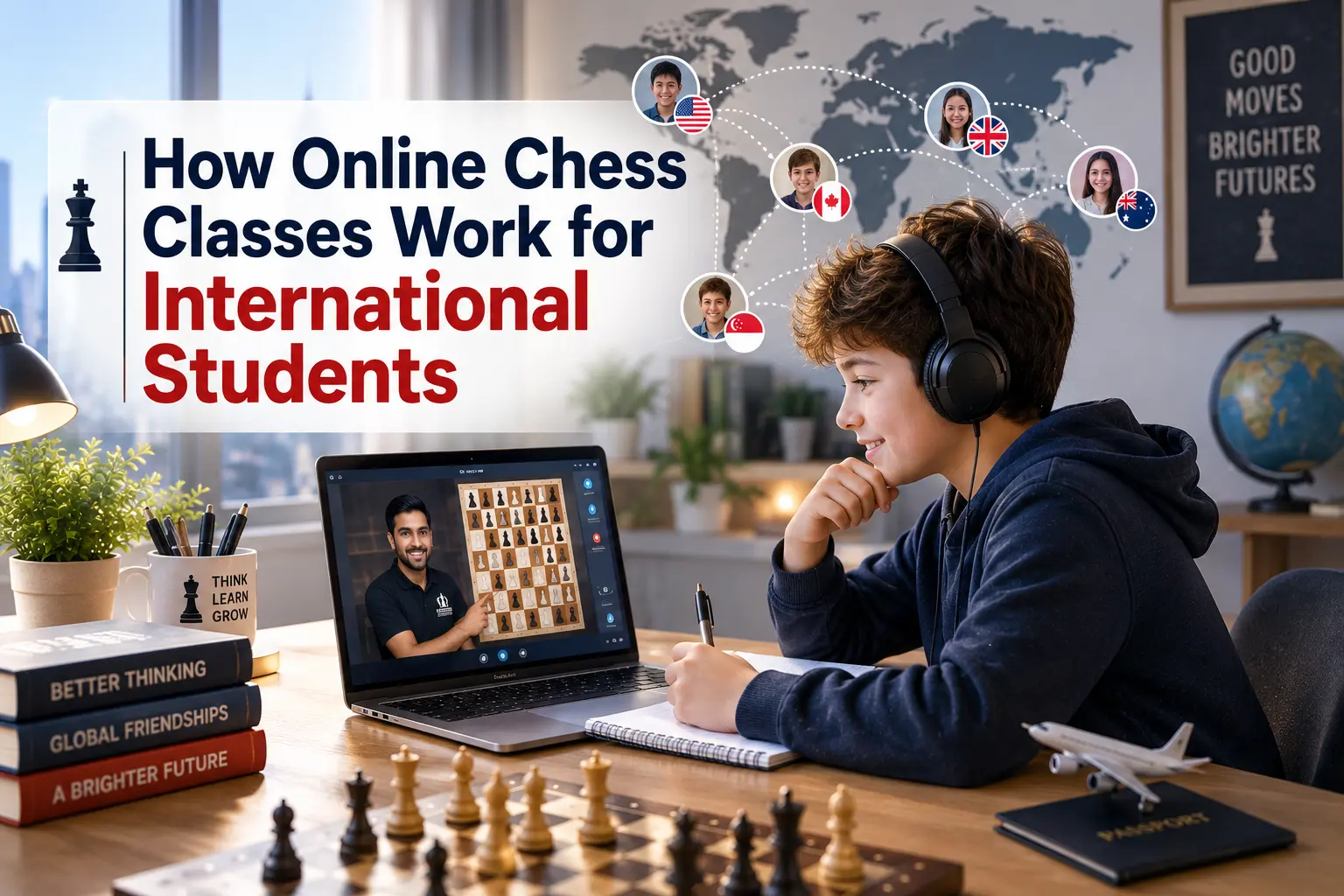
Finding the right chess coaching can be surprisingly difficult when a child lives outside the country where the academy is based. Parents often want to know how live lessons work, how coaches teach on a digital board, whether time zones will be a problem, and how progress is actually measured. This guide explains what families should expect from Online Chess Classes for International Students.
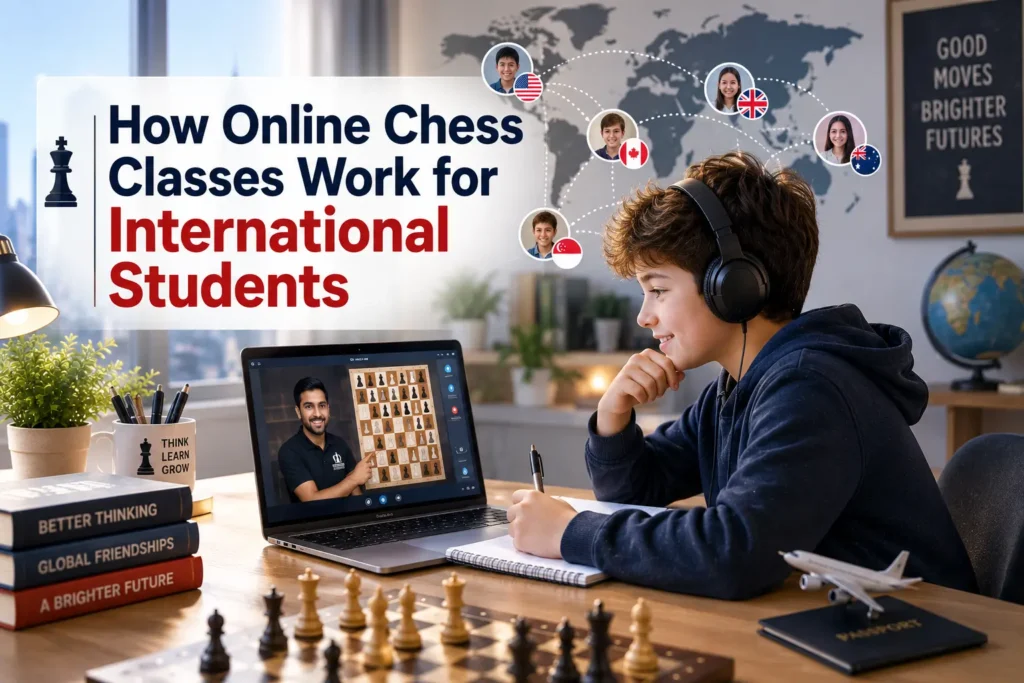
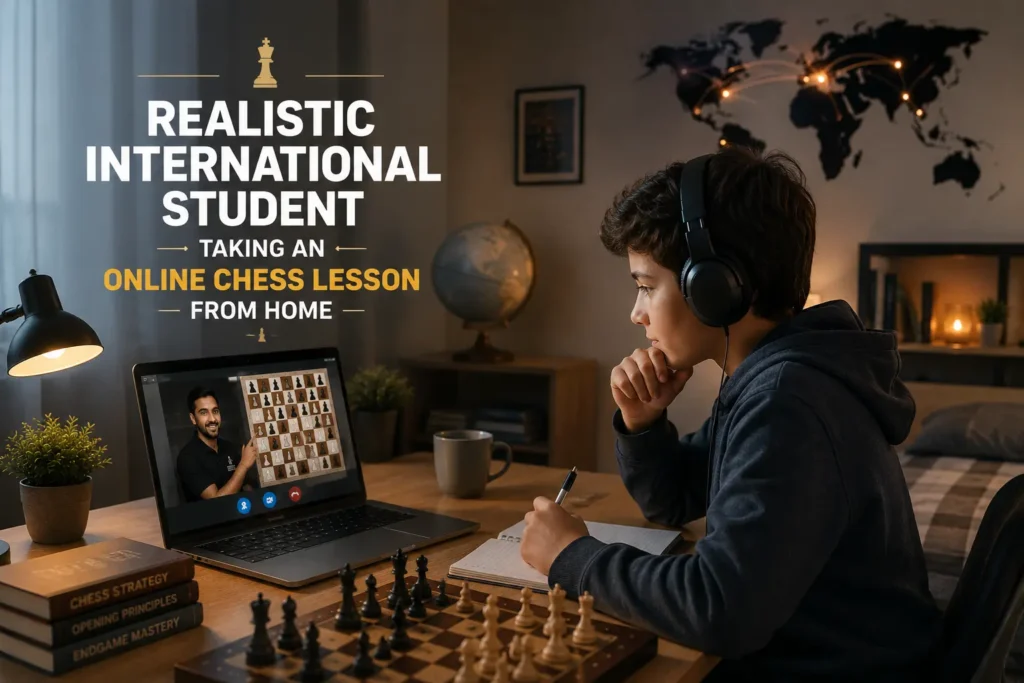
Online chess classes for international students usually combine live video instruction, an interactive digital chessboard, guided practice, homework, game analysis, and regular feedback. Students attend scheduled sessions from home while the coach demonstrates positions, observes their decisions, corrects mistakes, and adjusts future lessons according to their level and progress.
A child does not need to live near a chess academy to receive structured chess coaching. With the right online setup, a student in another country can learn directly with a coach, solve positions on a digital board, play practice games, receive feedback, and continue training without travelling to a physical classroom.
The important question, however, is not simply whether chess can be taught online. It can. The more useful question is how the learning process is organised and whether the academy has a system that keeps the student engaged and progressing.
This matters particularly for parents searching for international chess classes. A good online programme should feel like an actual lesson rather than a child watching someone play chess on a screen.
How Do Online Chess Classes Work for International Students?
The process is usually straightforward, but the quality of the experience depends on how well each stage is handled. A typical student journey looks something like this:
- Registration or enquiry: The parent or student contacts the academy and shares basic information such as age, previous chess experience, location, and learning goals.
- Assessment or demo: The coach may use a trial lesson, conversation, or practical chess exercises to understand the student's current ability.
- Level identification: Instead of placing every child into the same course, the academy should determine what the student already understands and what needs attention.
- Class scheduling: A suitable recurring time is selected while considering the student's local time zone and existing school or extracurricular commitments.
- Live lesson: The student joins the online class and works directly with the coach using video, audio, and an interactive chessboard.
- Practice: The student solves positions, plays training games, answers questions, or applies the concept introduced during the lesson.
- Feedback: The coach reviews the student's decisions and explains mistakes rather than simply providing the correct move.
- Progress tracking: Future lessons can be adjusted according to recurring mistakes, strengths, tactical understanding, game performance, and learning pace.
This structure is one reason remote chess coaching can work well for students abroad. The physical classroom is replaced by a digital learning environment, while the core coaching relationship remains between the student and coach.
Brainiac Chess Academy, based in Sector 7, Janata Market, Vashi, Navi Mumbai, Maharashtra, India, offers online chess coaching to students internationally. Families interested in coaching options for Canadian students can also explore our guide to online chess classes in Canada.
What Happens During a Typical Online Chess Class?
There is no single format that every academy must follow, and a good lesson should change according to the student's level and current needs. However, an effective Live Online Chess Coaching session often contains several familiar stages.
01. Warm-Up & Review
The coach may revisit a position, concept, or homework exercise from the previous lesson. This helps identify what the student remembers and where additional explanation is needed.
02. New Concept
The coach introduces a new idea, such as a tactical pattern, opening principle, calculation method, or endgame concept.
03. Digital Demonstration
The concept is demonstrated on an interactive chessboard. Instead of only listening, the student can see how the position changes move by move.
04. Guided Practice
The student is given positions or decisions to solve. The coach can ask questions and observe the thought process before giving assistance.
05. Tactical Exercises
Short calculation or tactical positions can reinforce the lesson and help the student recognise the idea independently.
06. Questions & Homework
The student can clarify doubts before receiving a practical task for continued learning between sessions.
The goal is not to fill every minute with explanation. Chess is a decision-making skill, so students need opportunities to think, make choices, explain their ideas, and sometimes get things wrong.
How Do Students Learn Chess on a Digital Chessboard?
For families new to virtual chess classes, the digital board can initially seem unfamiliar. In practice, it is one of the most useful parts of online chess coaching.
The coach can set up a specific position and demonstrate a move. The student can then move pieces, try a different continuation, solve a tactical problem, or play a training position with the coach.
For example, imagine a beginner is learning why moving the same piece repeatedly in the opening can waste time. Instead of explaining the principle only with words, the coach can create an opening position, ask the student to choose a move, and then compare different choices directly on the board.
More advanced students can use the same environment for calculation exercises, opening preparation, endgame positions, and analysis of their own games.
The strongest online lessons are interactive. A student should regularly be asked to predict, calculate, explain, and make decisions rather than simply watch the coach move pieces.
Can Beginners Join Online Chess Classes?
Yes. Online chess lessons can be suitable for children who are completely new to the game, provided the teaching approach matches their age and starting level.
A beginner may start with very basic concepts:
- How the chessboard is arranged
- How each piece moves
- Capturing pieces
- Check and checkmate
- Basic opening principles
- Simple tactical ideas
- Basic endgame positions
- How to think before making a move
The important point is that age alone should not determine the teaching level. Two children of the same age can have completely different chess experience. One may have played casually for years, while another may be touching a chessboard for the first time.
A sensible assessment helps the coach begin at the appropriate point instead of making the student repeat concepts they already understand or introducing material that is too difficult.
How Do Online Chess Coaches Track Student Progress?
Chess progress should not be judged only by a rating or by whether a student wins a particular game. A young player can be improving significantly even while their results remain inconsistent.
Coaches can look at several practical indicators:
Tactical Understanding
Can the student recognise common tactical patterns and identify threats?
Calculation
Can the student calculate variations before moving a piece?
Opening Understanding
Does the student understand opening principles rather than memorising moves blindly?
Endgame Skills
Can the student handle basic winning and drawing positions?
Decision-Making
Does the student consider checks, captures, threats, and the opponent's ideas?
Consistency
Are the same mistakes happening repeatedly, or is the student beginning to correct them?
Game analysis is especially valuable because it connects classroom learning with actual decisions made during a game. Over time, this gives the coach a clearer picture of what should be taught next.
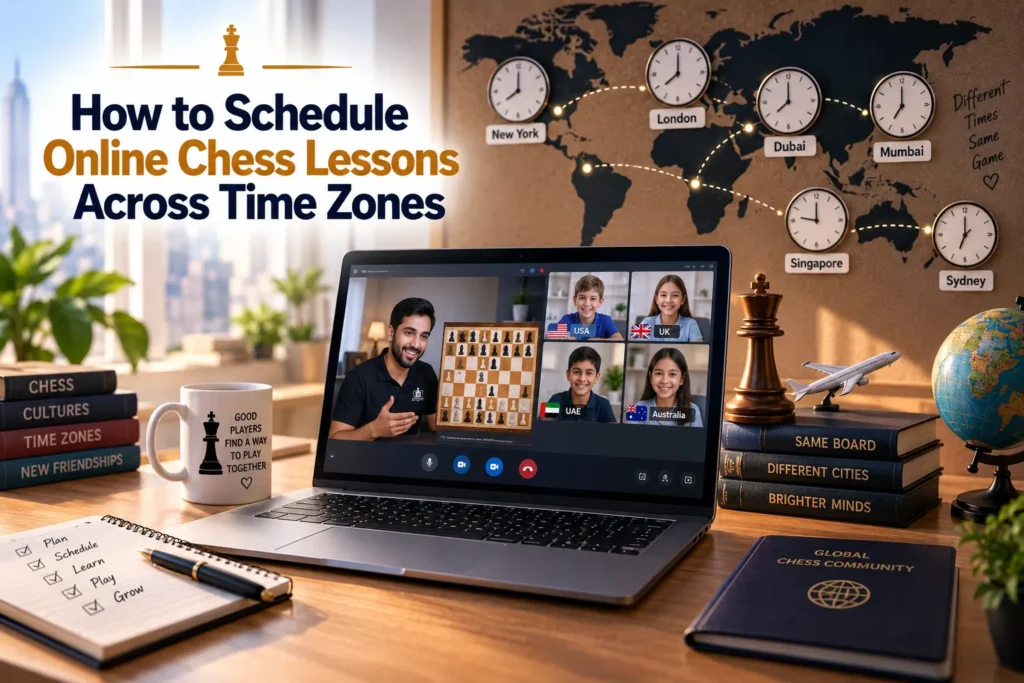
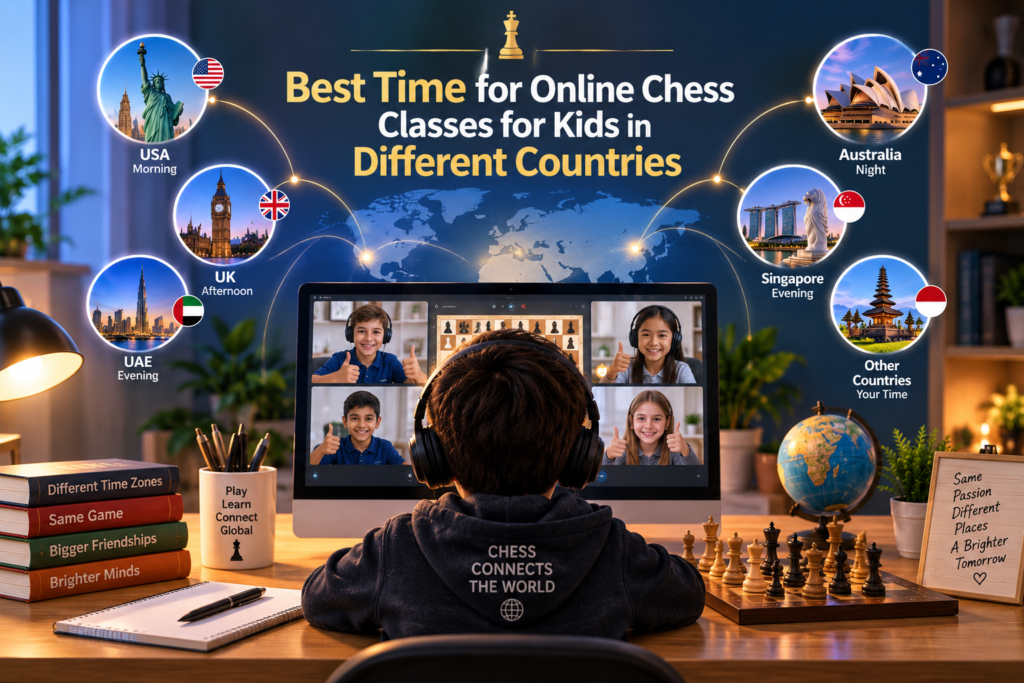
How Do Online Chess Classes Handle Different Time Zones?
Time zones are one of the first practical questions international parents should ask. A class that works perfectly for a student in India may not be convenient for a child finishing school in the United States or Australia.
Good scheduling begins by converting the academy's available times into the student's local time. Families should also consider school hours, homework, sports, sleep routines, and other commitments before choosing a recurring class.
Families exploring coaching options for children in the United States can also read our guide to online chess classes in the USA.
Students in the UK can explore online chess classes in the UK when considering how live coaching can fit around school and local schedules.
Families comparing options for Australian students can also explore online chess classes in Australia.
What Kind of Practice Do International Students Do Between Classes?
A live lesson introduces ideas, but improvement also depends on what happens between classes. Online Chess Training becomes much more useful when students have a manageable practice routine instead of being given a large amount of unstructured work.
Depending on the student's level, practice may include:
- Tactical puzzles: Short positions that develop pattern recognition and calculation.
- Practice games: Games where the student focuses on applying a particular lesson.
- Lesson review: Replaying important positions from the previous class.
- Opening principles: Understanding development, king safety, centre control, and piece coordination.
- Endgame exercises: Repeating important technical positions until the ideas become familiar.
- Game analysis: Looking back at personal games and identifying moments where a better decision was possible.
The amount of practice should be realistic for the child's age and schedule. A short, focused routine that the student follows consistently can be more useful than a long list of tasks that quickly becomes overwhelming.
How Does Feedback Work in Online Chess Coaching?
Feedback is one of the biggest differences between structured coaching and simply playing chess online.
If a student loses a queen, for example, telling them “you should have moved the queen” does not teach much. A useful coach looks at the decision behind the mistake.
The discussion might involve four questions:
- What did you think would happen after this move?
- What did your opponent threaten?
- What other candidate moves were available?
- What can you look for next time before making a similar decision?
This type of feedback turns a single mistake into a reusable learning point. The objective is not to eliminate every mistake immediately. It is to help the student recognise patterns and gradually make better decisions independently.
Good chess coaching should not simply tell a student the correct move. It should help them understand why the move works.
Can International Students Prepare for Chess Tournaments Online?
Yes. Online coaching can support several parts of tournament preparation, although the amount and type of preparation should depend on the student's experience and the event they are preparing for.
Tactical Preparation
Practise tactical patterns that can help a player recognise opportunities and threats during tournament games.
Opening Preparation
Review suitable opening ideas and understand the plans behind the positions rather than relying only on memorisation.
Game Analysis
Analyse previous games to identify recurring decision-making problems.
Time Management
Practise making decisions without spending excessive time on positions that do not require deep calculation.
Practice Games
Use realistic training games to apply concepts under time and decision pressure.
Tournament Routine
Discuss preparation, concentration, reviewing games, and maintaining a consistent approach between rounds.
Online coaching cannot guarantee a particular tournament result. What it can provide is structured preparation and an opportunity to work on specific weaknesses before an event.
Online Chess Classes vs Learning Chess Completely on Your Own
Self-learning can certainly be valuable. Books, videos, puzzles, and online games give students access to an enormous amount of chess material. The main limitation is that independent learners may not always know what they should study next or why they are making the same mistakes repeatedly.
| Learning Area | Structured Online Coaching | Completely Self-Led Learning |
|---|---|---|
| Structured curriculum | Lessons can be organised around the student's level and goals. | Student decides what to study and when. |
| Coach feedback | Direct feedback can explain the reasoning behind mistakes. | Feedback usually comes from self-analysis or automated tools. |
| Accountability | Regular sessions create a learning routine. | Depends entirely on the student's consistency. |
| Personal guidance | Exercises can be adjusted according to individual needs. | Content may not match the student's exact weaknesses. |
| Practice | Coach can recommend targeted practice. | Student chooses their own games and exercises. |
| Mistake analysis | Coach can identify recurring patterns and explain them. | Student needs to recognise the pattern independently. |
| Progress tracking | Progress can be reviewed across lessons and games. | Student generally monitors progress themselves. |
| Flexibility | Scheduling can be arranged around availability. | Maximum flexibility, but no fixed learning structure. |
These approaches do not have to be mutually exclusive. Many students benefit from combining coaching with independent puzzles, games, reading, and practice.
What Should Parents Look for in International Chess Classes?
Choosing an online academy deserves the same care as choosing an in-person coach. The fact that classes happen through a laptop does not make the teaching quality less important.
Before enrolling, parents can use this checklist:
- Experienced coaches: Look for coaches who can explain chess clearly to children at the appropriate level.
- Structured curriculum: Lessons should have a logical progression rather than being a collection of unrelated topics.
- Correct student level: The academy should assess the child's current ability instead of assuming every beginner or intermediate student needs the same material.
- Interactive classes: Students should have opportunities to answer questions, solve positions, move pieces, and make decisions.
- Feedback system: Ask how the academy identifies and communicates mistakes.
- Flexible scheduling: International families should be able to find a practical time in their local time zone.
- Trial or demo option: A trial can help parents evaluate teaching style, communication, and student comfort.
- Parent communication: Parents should know enough about what their child is learning and where additional practice may be useful.
- Progress tracking: There should be some method for reviewing development over time.
- Tournament preparation: If competitive chess is the goal, ask whether tournament-specific training can be included.
Parents comparing coaching providers may also find our detailed guide on how to choose an online chess academy for your child useful.
Why Live Online Chess Coaching Can Be Useful for Students Abroad
The biggest practical advantage of live online coaching is continuity. A student does not have to stop learning chess simply because there is no suitable academy nearby.
Families can attend lessons from home, avoid commuting, and build chess practice around school and other activities. This can be particularly useful for families who move between countries or travel regularly.
Students living in the UAE, for example, can explore information about online chess classes in the UAE while considering how remote coaching fits into their routine.
Similarly, families in Singapore looking for structured online learning can explore online chess classes in Singapore.
For international students, the value is not simply convenience. A well-organised programme can provide a consistent learning relationship even when the student's location, school schedule, or daily routine changes.
Pros and Cons of Online Chess Classes for International Students
Pros
- Convenient learning from home
- Flexible scheduling across countries
- No commuting to a physical academy
- Access to structured coaching
- Regular personalised feedback
- Easy continuity during travel or relocation
Cons
- Requires a stable internet connection
- Younger children may need parental support
- Screen-based learning may not suit every child
- Students still need independent practice
- Technical problems can occasionally interrupt lessons
- Some students may prefer a physical classroom environment
The right choice depends on the child. Online learning works particularly well when the student is comfortable using digital tools, can participate actively during lessons, and has a practical environment for focused learning.
People Also Ask About Online Chess Coaching
Ready to Start Learning Chess Online?
If you are looking for structured online chess coaching for a child living in India or abroad, you can explore Brainiac Chess Academy's online learning options and see whether the teaching approach is a good fit. A free demo can help you understand how the classes work before making a decision.
Book Your Free Demo Right NowFrequently Asked Questions
1. How do online chess classes work for international students?
Students join live online lessons from home using video, audio, and an interactive digital chessboard. The coach teaches concepts, demonstrates positions, asks the student to solve problems, reviews games, gives feedback, and assigns suitable practice between sessions.
2. Can my child learn chess online from another country?
Yes. A child can receive live chess coaching from an academy based in another country as long as the online platform, lesson schedule, communication, and teaching approach are suitable for the family.
3. Are online chess classes suitable for beginners?
Yes. Beginners can start with board orientation, piece movement, captures, check, checkmate, basic tactics, opening principles, and simple endgames. The key is placing the child at an appropriate learning level.
4. How are different time zones handled in online chess coaching?
International students should select class times based on their local time rather than the academy's location alone. Parents should confirm available schedules and consider school, homework, sleep, and extracurricular commitments.
5. Do students need a physical chess board?
Not necessarily. Most online lessons can be conducted using an interactive digital chessboard. A physical board can still be useful for independent practice, but it is not always required for the live class.
6. Can online chess coaching help with tournament preparation?
Yes. Coaches can work on tactical exercises, opening preparation, game analysis, time management, practice games, and tournament routines. Preparation should be tailored to the player's level and the specific event.
7. How often should a child attend online chess classes?
There is no single ideal frequency for every child. It depends on age, current level, goals, available practice time, and whether the student is learning casually or preparing for competitive chess.
8. How should parents choose an online chess academy?
Parents should evaluate coaching experience, curriculum structure, student interaction, level assessment, feedback, scheduling flexibility, progress tracking, communication, and whether a trial or demo is available before enrolling.
Conclusion: What Makes Online Chess Classes Work?
The technology behind an online chess lesson is only one part of the experience. What matters most is how the technology is used to create meaningful interaction between the student and coach.
Effective Online Chess Classes for International Students should give children opportunities to think, solve positions, ask questions, analyse mistakes, practise between lessons, and receive feedback that matches their individual level.
For parents, the best starting point is to look beyond the convenience of online learning and examine the actual teaching process. Ask how students are assessed, how lessons are structured, how progress is monitored, how feedback is provided, and whether the schedule works in your local time zone.
When those elements are handled thoughtfully, chess coaching from home can become a practical and consistent way for students abroad to learn, practise, and prepare for their next stage of chess development.